

Writing how-to content that earns backlinks requires solving real issues with clear, actionable, and well-researched guides.
These posts attract 55% more views than other blog formats and can generate 90,000 shares on average.
To make your content stand out, focus on:
- Choosing the right topics: Analyze competitors, target evergreen ideas, and utilize audience feedback.
- Structuring effectively: Use clear headlines, step-by-step formatting, and back up claims with data and examples.
- Adding visuals: Include infographics, videos, or interactive tools to enhance engagement and linkability.
- Promoting strategically: Target resource pages, use outreach tools, and repurpose content into different formats.
The key is to combine detailed, easy-to-follow instructions with unique elements like original data or custom visuals. Promote your content through outreach and link-building strategies to maximize its impact and backlinks.
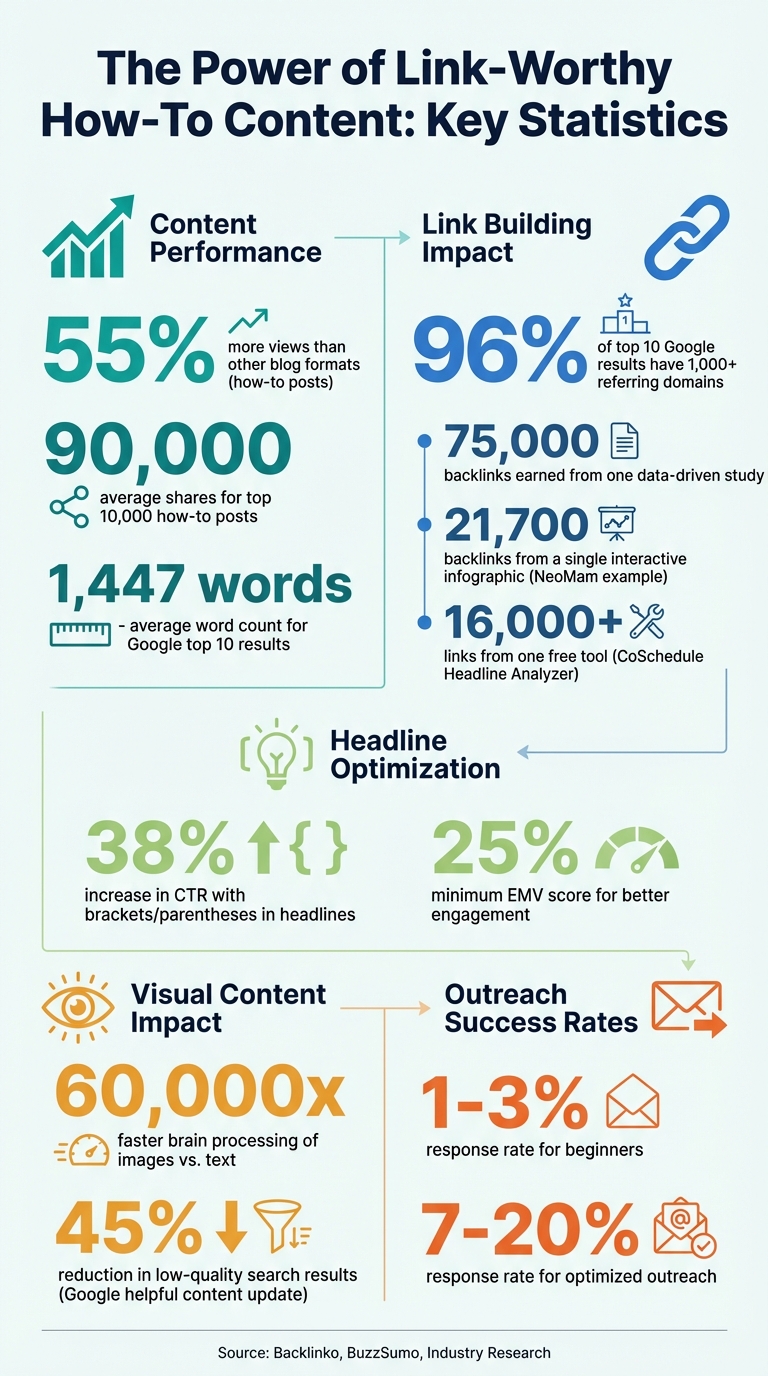
How-To Content Performance Statistics and Link Building Success Metrics
How to Create Link-Worthy Content | SEO Tips That Work
Finding High-Impact Topics for Your How-To Content
Choosing the right topic is the cornerstone of creating how-to guides that not only educate but also attract quality backlinks.
The key to writing a guide that stands out lies in selecting topics that solve actual problems and bring something fresh to the subject. Start by looking at what’s already working in your niche, then identify areas where you can add a unique twist.
Dive into competitor content, evaluate long-term potential, and listen to audience feedback to zero in on topics with the most impact.
Analyze Competitors’ Top-Performing Content
One good way to uncover winning topics is by studying your competitors’ top-performing content. Moz Link Explorer can help you identify their “Top Pages.”
Filter results by “Status Code: 200-OK” to see which guides have earned the most backlinks. Look for keyword gaps, these are search terms your competitors rank for, but you don’t. These gaps highlight proven topics with existing demand.
Once you’ve found popular guides, think about how you can improve them. Add exclusive data, create custom infographics, or provide more detailed instructions.
For instance, in 2018, Brian Dean and the Backlinko team conducted a study on voice search. Instead of a typical list post, they produced a data-backed post that earned over 1,500 backlinks from bloggers and journalists looking for reliable insights.
Another tip: Use Google’s “People Also Ask” feature to find related questions that competitors might have missed. Expanding on these questions can help you address overlooked user needs and create a roadmap for your content.
Focus on Evergreen and Niche-Specific Topics
While competitor analysis reveals what’s trending now, evergreen topics holds long-term value. They stay relevant over time, making them great for sustained backlink growth. Before taking on a topic, use Google Trends to check its long-term appeal.
Look for topics with steady or upward-trending search volume.
Take Brian Dean’s 2018 example of validating the keyword “SEO Audit” with Google Trends. He developed a comprehensive evergreen SEO audit guide, which, through regular updates, has consistently ranked in Google’s top five for over eight years.
Choose topics that allow you to showcase your expertise. Cover the subject in-depth, including related subtopics, to establish authority.
“If you want an article about how to unclog a toilet, don’t hire a freelance writer. Hire a plumber.” – Brian Dean, Founder, Backlinko
Make sure your topic aligns with your business goals.
Content that doesn’t connect to your objectives can dilute your efforts. Focus on keywords with high search volume and reasonable competition.
Long-tail keywords, for instance, generate 1.76 times more clicks than shorter ones.
Use Audience Feedback and Trends
Your audience often holds the key to the topics they want most.
Platforms like Reddit and Quora are goldmines for spotting recurring questions in your niche. These often reveal content gaps where users are still searching for answers.
Google Search Console is another valuable tool.
Look for queries that get impressions but few clicks; these may signal emerging topics that haven’t been fully addressed yet.
You can also use the Keyword Magic Tool to filter for “Questions” and sort by “Easy” Keyword Difficulty (KD%) to uncover quick-win opportunities.
Finally, review your existing content using Google Analytics. Identify pages with high engagement and repeat visitor rates, then replicate those topics to keep your audience coming back and to attract more backlinks.
Structuring Your How-To Content for Better Linkability
Once you’ve identified compelling topics, the next step is organizing your guide effectively. The way you structure your content makes all the difference; it influences how readers engage with it and how likely other creators are to link back to it.
A well-organized guide simplifies complex ideas, builds trust through reliable evidence, and gives others a reason to cite your work.
The key to writing a guide that earns backlinks lies in 3 main elements: clear headlines, logical formatting, and solid data. These elements set the stage for content that doesn’t just inform but also attracts quality links.
Write Clear and Engaging Headlines
Headlines are your first chance to grab attention.
To make them work, place your primary keyword near the beginning to appeal to both readers and search engines.
Proven headline formats, like Keyword-Colon (e.g., “Local Keyword Research: 4 Easy Steps”) or List/Number styles (e.g., “5 Powerful Local SEO Tools”), set clear expectations for the audience.
Adding elements like brackets or parentheses can enhance click-through rates by up to 38%, for example, tags like “[2024 Update]” or “[Case Study]” signal fresh, credible content.
Take Backlinko’s “19 NEW SEO Techniques [2024 Update]” as an example. This approach generated 5,500 backlinks from over 1,100 domains in 2024. Headlines that evoke curiosity, urgency, or emotion tend to perform better. An Emotional Marketing Value (EMV) score of at least 25% can significantly increase engagement and shares.
When writing headlines, think about how you want others to reference your content. For instance, Backlinko’s “Google Ranking Factors” study focused its headline on original research, making it easy for journalists to cite.
That single post earned over 75,000 backlinks from sites quoting its data. You can also create a branded concept to make your strategy stand out.
Brian Dean’s “Content Upgrade” idea, for example, earned over 2,100 backlinks from 780 domains because it was both unique and easy for others to reference.
Use Step-by-Step Formatting
Breaking down information into manageable steps transforms overwhelming topics into approachable guides. “How-to” posts, on average, receive 55% more views than other blog formats, and the top 10,000 how-to posts generate over 90,000 shares each.
This format improves not only readability but also the perceived authority of your content, making it more linkable.
Use H2 and H3 subheaders to divide your guide into scannable sections. This allows readers to quickly find the steps they need.
For each major step, include visuals like screenshots, photos, or videos to make the instructions clearer and provide assets that others can link to.
A great example is Laura Roeder’s guide, “How to Improve Your Facebook News Feed Visibility”, which used numbered steps and annotated images.
This approach resulted in over 9,000 shares.
“The best ‘how to’ posts are educational.” – Steve Rayson, Director, BuzzSumo
Don’t just explain the steps; also provide the reasoning behind them.
This not only enhances your credibility but also aligns with Google’s E-E-A-T (Experience, Expertise, Authoritativeness, and Trustworthiness) guidelines.
Add Data and Examples
Strong headlines and a clear structure are important, but backing up your claims with data is what makes your guide stand out.
Including original research or case studies differentiates your content from generic advice. Content creators often search for reliable statistics and data to support their arguments, making well-researched guides a magnet for backlinks.
“Writers, journalists, and contributors for different leading sites are always on the lookout for reliable scientific evidence, studies, and data to back their arguments and boost their credibility.” – Davor Bomeštar, CEO, Fortis Agency
If you’re publishing original data, write your headline and opening sentence in a way that makes it easy for reporters to quote.
Visual representations like charts, tables, or infographics also increase the likelihood of being shared and linked. If original data isn’t an option, citing established sources like .gov sites, universities, or industry leaders can still build credibility.
Case studies are also extremely effective. They provide concrete proof of your claims and resonate with other content creators. For example, Backlinko’s “41 Best SEO Tools (Free & Paid)” didn’t just list tools; it tested each one and highlighted specific features.
This approach attracted over 6,000 monthly visitors. Even controversial findings can drive links. TravelMath’s study showing that five-star hotels were often dirtier than lower-rated options earned backlinks from high-authority news and travel sites because it challenged conventional wisdom with verifiable evidence.
“When sharing personal experiences, focus on specific outcomes and measurable results. Google’s E-E-A-T guidelines value demonstrable expertise.” – Brian Dean, Founder, Backlinko
sbb-itb-566d57e
Adding Visuals and Assets to Your Content
Even the most well-organized guide becomes more engaging when paired with custom visuals. Research shows that the human brain processes images 60,000 times faster than text. This makes visuals a powerful tool for simplifying complex ideas and making data easier to grasp. Adding these visual elements aligns naturally with earlier tips on creating clear, step-by-step content.
The trick is to use original visual assets instead of relying on generic stock images. Custom graphics, infographics, and interactive tools not only enhance your content but also position your brand as a credible source.
These assets give other publishers something valuable to embed on their sites, often with a backlink to you as the original creator.
Create Infographics and Custom Visuals
Infographics are widely recognized as one of the best ways to attract links. A great example comes from NeoMam, which created an interactive infographic in 2013 called “13 reasons your brain craves infographics.”
This single piece earned 21,700 backlinks from 1,300 referring domains. The success stemmed from more than just the data; it was the visual appeal and shareability that made it a hit.
Breaking infographics into smaller, shareable components works even better. Instead of creating one long image, design modular visuals that can be shared individually on platforms like social media or embedded in niche blog posts.
This approach, often called “Infographics 2.0”, makes your content more flexible and increases the likelihood that other publishers will find content that suits their needs.
“The future of the infographic is not bigger, it’s smarter. It’s a responsive, atomized system of visual truths that can be shared, embedded, and remixed across the web.” – Webbb.ai Analysis
Take it a step further by including an embed code with your infographics. Make sure the code contains a hard-coded backlink to your site.
Focus on visuals that explain unique concepts or strategies. For example, Brian Dean’s “On-Page SEO” infographic broke down a complex topic into an easy-to-understand format.
It generated 19,271 social media shares and 825 comments, while significantly improving the page’s link profile.
Embed Explainer Videos or Interactive Tools
Custom visuals are helpful, but adding videos or interactive tools enhances the impact of your content. Videos and tools not only make concepts easier to understand but also increase engagement.
For instance, PMT, a music retailer, created a video tutorial on how to sound like Ed Sheeran using specific gear. This video earned 25 backlinks from 19 domains and racked up over 152,000 YouTube views, driving traffic back to their store.
Interactive tools are equally effective because they solve actual problems. Take CoSchedule‘s Headline Analyzer as an example; it has attracted over 16,000 links from more than 3,600 referring domains by offering immediate, practical value.
“If you can solve a user problem with a free tool, you can give your users what they want while also racking up backlinks in the process.” – Backlinko
To succeed with tools, focus on addressing specific challenges in your niche. Oracle nailed this with their Oracle Cloud Stacker, an interactive game that simplified cloud infrastructure concepts. It turned a dry topic into something engaging and shareable.
When promoting your tools, identify websites or blogs discussing problems your tool solves. For example, if you’ve built a calculator for complex formulas, reach out to bloggers who explain those formulas and suggest linking to your tool as a shortcut for their readers.
Offer Downloadable Resources
Downloadable assets like templates, checklists, and worksheets are another way to enhance your content while driving backlinks. These resources provide immediate value to readers and are highly linkable because other content creators often search for ready-made tools to share with their audiences.
By providing tools that simplify tasks or save time, you create something others want to reference. For example, a well-designed checklist for a multi-step process can become a go-to resource that bloggers link to in their own guides.
Make these resources easy to access, but consider requiring an email opt-in to grow your contact list. This way, you’re offering value to readers while also capturing leads.
Host the resources on dedicated landing pages with clear descriptions and preview images. This not only gives publishers a specific URL to link to but also helps search engines recognize the value of your asset.
When promoting your resources, focus on “helpful links” or resource hub pages in your niche. These curators are always on the lookout for useful tools to share with their audiences.
Promoting Your How-To Content to Build Links
Creating great how-to content is just the first step. To earn quality backlinks, you need to promote it effectively to the right audiences.
Here’s a key stat to keep in mind: 96% of websites appearing in Google’s top 10 results have over 1,000 referring domains.
This highlights the importance of a well-thought-out promotion strategy.
By combining strategic outreach, smart tools, and repurposing tactics, you can turn your content into a magnet for high-quality backlinks.
The goal is to connect with relevant sites, adapt your content for different audiences, and make the most of platforms designed for link-building opportunities.
Target Resource Pages and Relevant Websites
Resource pages are goldmines for link building because they’re specifically designed to curate helpful content. These pages often have titles like “Best [Topic] Resources” or “Helpful Links for [Niche].”
To find them, use advanced Google searches like [your topic] inurl:resources, [your topic] intitle:links, or [your topic] "helpful links". You can also try searches such as "top [niche] bloggers" or "best [topic] websites" to discover curated lists.
Once you identify promising resource pages, evaluate their quality and relevance. A niche-specific page updated recently is far more useful than an outdated, generic list. Use Moz or Semrush to check the Domain Authority (DA) of these sites, and make sure the page includes external links; internal links won’t help your backlink strategy.
Another effective tactic is broken link building. With a browser extension like “Check My Links”, you can scan resource pages for broken links (404 errors). If you spot one, reach out to the site owner and suggest your how-to guide as a replacement. This approach works because you’re solving a problem; nobody wants broken links on their site.
When reaching out, avoid generic emails. Personalize your pitch to show you’ve done your research. For example:
“I came across your resource page on content marketing and noticed it includes some excellent tools. However, it seems to be missing a guide on creating link-worthy how-to content. I recently published a detailed guide on [specific topics], and I think it would be a great fit for your readers.”
This kind of personalized outreach demonstrates effort and increases your chances of success. If you don’t get a response, follow up politely after 5 to 7 days. A friendly reminder often nudges site owners to take action.
“Understanding your client is the first piece of the puzzle in finding your target audience for any link-building campaign.” – Aoife O’Connor, Aira
Use Backlinku‘s Marketplace for Outreach
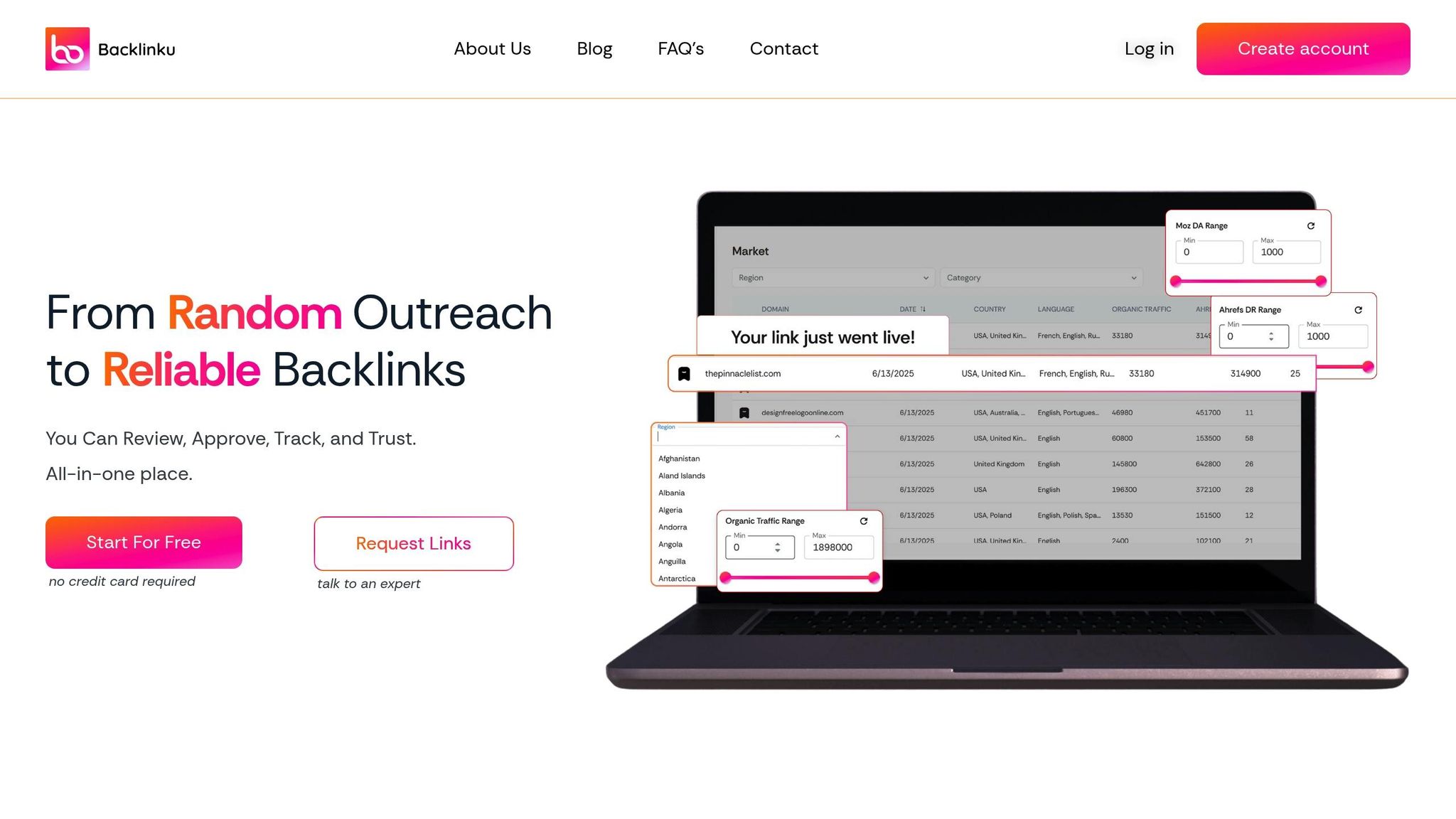
Manual outreach can be a time drain, but platforms like Backlinku simplify the process. The marketplace has 50,000 manually reviewed websites, helping you find prospects, manage communications, and track campaigns.
The platform offers advanced filters to identify link opportunities based on niche, region, and SEO metrics like Authority Score and organic traffic. This ensures you’re targeting sites that can deliver meaningful link equity.
Another time-saving feature is contact information retrieval. Instead of hunting down email addresses, Backlinku provides verified contact details automatically. The platform also features tools for direct content review and on-the-go link monitoring, so you’ll know as soon as a link goes live.
For journalist outreach, Backlinku connects you with bloggers and journalists actively searching for expert insights. This maximizes your chances of earning high-quality backlinks from news sites and industry publications. While beginners might see response rates of 1–3%, fine-tuned outreach systems can achieve rates as high as 7–20%.
| Outreach Platform | Best For | Avg Authority (DR) | Turnaround Time |
|---|---|---|---|
| Featured | Easy wins, building confidence | 66 | 18 days |
| MentionMatch | B2B content, SaaS brands | 72 | 14 days |
| HARO / Connectively | Broad topics, high volume | 84 | 32 days |
| Qwoted | High-authority media, finance | 70+ | Varies |
By focusing on vetted, high-quality sites, Backlinku helps you avoid spammy “link neighborhoods” and build a backlink profile that search engines reward.
Repurpose Content for More Visibility
Promotion doesn’t stop at outreach; repurposing your how-to guide into different formats can dramatically increase its reach. The more ways you present your content, the more opportunities you create for other sites to link to it.
Here are some ideas:
- Guest Posts: Adapt sections of your guide into guest posts for authoritative sites. For instance, UnderFit collaborated with luxury suit brand Black Lapel to create a guest post on “what to wear under a dress shirt.” This partnership not only built brand recognition but also led to 150+ sales over 12 months.
- Email Newsletters: Break your guide into a series of emails, each covering a specific step. Include links back to the full article for readers who want more details.
- Downloadable Resources: Turn your guide into a PDF or ebook and host it on a dedicated landing page. Promote it as a free resource to attract downloads and backlinks.
- Visual Assets: Create shareable visuals like charts, diagrams, or infographics based on your guide. These are highly linkable and often get embedded on other sites with attribution links.
“In 2026, backlinks still help search engines and people alike figure out what content is worth paying attention to.” – Backlinko
Conclusion
Creating effective how-to content requires a thoughtful approach and thorough attention to detail. It starts with selecting topics that resonate with your audience. This could involve analyzing competitors, focusing on timeless subjects, or tapping into trending discussions. Once you’ve nailed the topic, structure your guide with clear headlines, actionable steps, and reliable data that readers can depend on.
Keep in mind that the average word count for a Google top 10 result is 1,447 words, so providing comprehensive coverage is key. Pair this depth with engaging visuals and a solid promotion strategy to maximize impact.
Adding downloadable assets not only enhances the value of your content but also makes it more likely to be cited and shared.
However, even the best content needs promotion to gain traction. Without active efforts like targeted outreach, leveraging resource pages, and repurposing your guide into different formats, your content might not achieve its full potential. Backlinku’s outreach features and smart repurposing strategies can significantly boost your guide’s visibility and help it earn the backlinks it deserves.
Additionally, aligning your content with Google’s quality standards is critical. With Google’s helpful content updates reducing low-quality results in search by 45%, there’s now more opportunity for well-crafted guides that showcase genuine expertise.
“If you sell something, you make a customer today, but if you genuinely help someone, you create a customer for life.” – Jay Baer, Author and Marketing Expert
In short, the winning formula for how-to content includes choosing the right topics, presenting them with clarity, enhancing them with compelling visuals, and promoting them strategically. By following these steps consistently, you’ll attract quality backlinks and improve your search rankings.
FAQs
What’s the best way to find link-worthy topics for how-to content?
To find topics that naturally attract links for your how-to content, start by examining what’s already thriving in your field. Look for articles or resources that have garnered plenty of backlinks or sparked significant engagement. These often reveal the kind of subjects that resonate deeply with your audience. Think about areas where people are seeking answers or step-by-step guidance, like detailed tutorials, curated resource lists, or fresh perspectives.
Digging into competitor content can also offer valuable clues. Identify common themes they cover or gaps in the information they provide. Understanding what clicks with your audience allows you to craft content that goes above and beyond. By addressing their needs in a way that’s thorough and engaging, your how-to pieces are more likely to earn backlinks and make an impact within your niche.
How can I effectively promote my how-to content to increase visibility and backlinks?
To get your how-to content noticed and shared, focus on strategies that increase its visibility and encourage backlinks. Start by sharing it across social media platforms and actively participating in relevant online communities. This helps you connect with the right audience and sparks engagement. Another effective tactic is email outreach; reach out to influencers, bloggers, or well-known websites in your niche. A personalized pitch can inspire them to share or link to your content.
Make sure your content stands out by offering real value. Think along the lines of detailed guides, eye-catching infographics, or original research. Content that’s useful and visually engaging is more likely to be referenced and shared. Also, simplify sharing by including clear instructions, practical tips, and visuals that make your content easy to digest.
Don’t stop there and establish your site as a go-to resource in your field. Share well-researched, high-quality resources that your audience will trust. This not only builds credibility but also increases the chances of others linking back to your content.
By combining these efforts – active promotion, smart outreach, and creating content that’s both valuable and shareable, you can dramatically improve the reach and impact of your how-to articles.
How can visuals make my how-to guides more link-worthy?
Visuals are essential for making your how-to guides more engaging and easier to share. They break down complicated concepts, helping readers grasp ideas faster while keeping your content visually appealing. Tools like infographics, diagrams, and step-by-step images can grab attention right away, giving your guide a unique edge.
On top of that, high-quality visuals make your content more attractive for others to reference or link to. When your guide offers clear, visually rich information, it becomes a go-to resource that people are more inclined to share or cite, expanding its reach and credibility.