

Want your content to earn backlinks? The secret is creating linkable content, resources like in-depth guides, original research, or tools that others naturally cite because they solve problems or provide useful insights.
Here’s how to brainstorm ideas that attract links:
- Understand your audience: Identify their challenges using forums, customer feedback, and tools like Google’s “People Also Ask.”
- Spot trends early: Use Google Trends or Exploding Topics to find rising topics before competitors.
- Analyze competitors: Study what earns them backlinks through tools like Ahrefs or Semrush.
- Use brainstorming techniques: Methods like the 6-3-5 technique or SCAMPER can help generate and refine ideas.
- Validate your ideas: Check search volume, competition, and backlink potential before creating content.
The key is balancing creativity with data-driven insights. Focus on formats like original research, free tools, or visual assets, which are proven to attract links. Once you have your ideas, tools like Backlinku can streamline execution and maximize your outreach success.
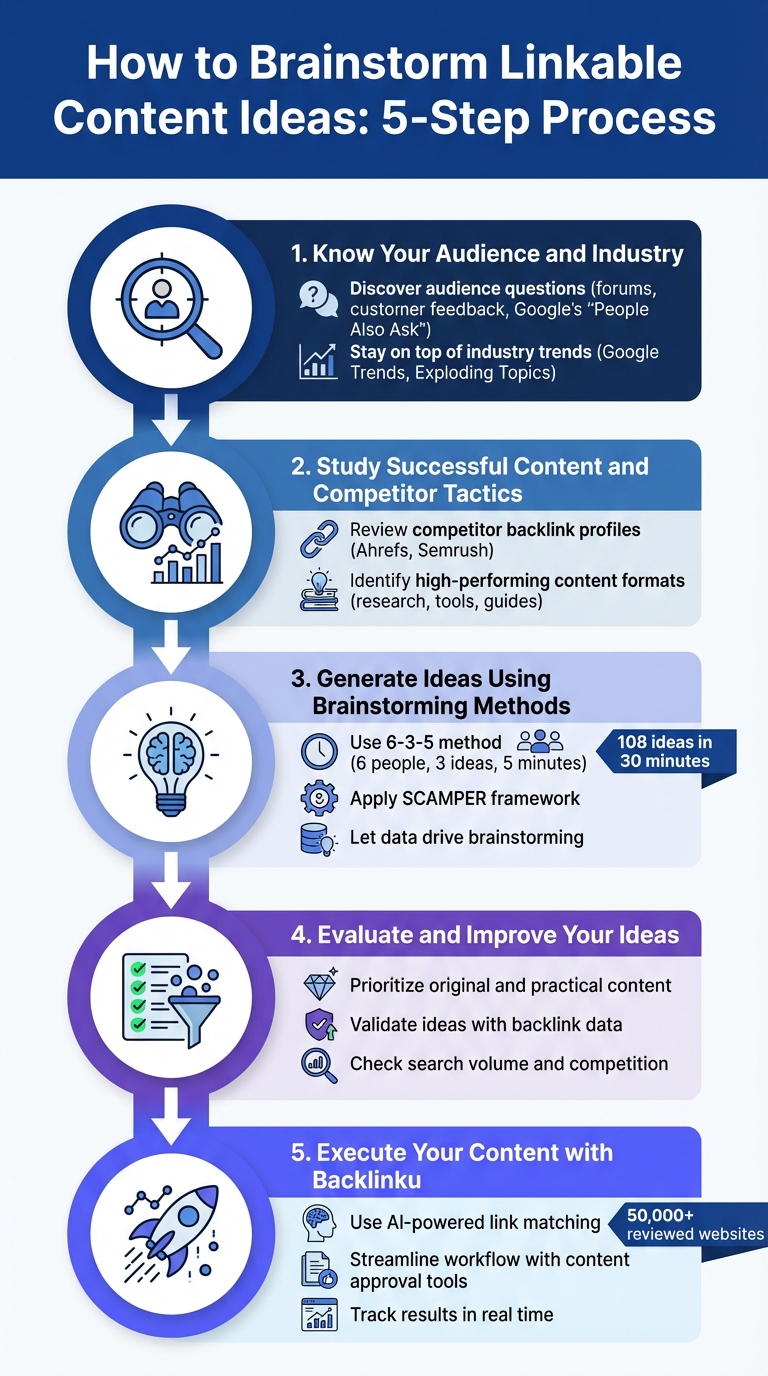
5-Step Process to Brainstorm Linkable Content Ideas
How to Generate Linkable Asset Ideas
Step 1: Know Your Audience and Industry
Creating linkable content starts with understanding your audience’s real struggles. The best content directly tackles the specific problems and questions your readers face. Once you know what they care about, find where these discussions are happening online.
Discover Your Audience’s Questions and Challenges
Your customer data is a goldmine. Your support and sales teams likely hear the same questions repeatedly during calls or through support tickets. Pay attention to these recurring inquiries; they highlight content gaps you can address.
Platforms like Reddit and Quora provide unfiltered insights. Browse subreddits by “Top” or “Hot” posts, and check the comment sections of competitor blogs to identify popular topics. Similarly, product review sites like G2 or Amazon can reveal common frustrations or missing details that your content could address.
Google’s “People Also Ask” and “People Also Search For” features are treasure troves of long-tail questions straight from searchers. Even Google Images can spark ideas – type in a broad topic and review the suggested tags for related subtopics. Want more direct input? Use LinkedIn, Instagram, or X to poll your audience and uncover what they want to learn about.
Once you’ve gathered these insights, shift your attention to industry trends to ensure your content stays relevant.
Keep up with industry trends
Knowing your audience is the first step to spotting emerging trends. The right timing is crucial. Tools like Google Trends let you compare topic popularity and identify rising terms before they become oversaturated. Exploding Topics scans the web for rapidly growing keywords, giving you the chance to create content before competitors catch on. Jumping on new topics early can give you a major edge.
Pay attention to where professionals in your industry gather. Conference agendas often highlight the topics people are willing to invest time and money to learn about.
To stay updated, subscribe to niche newsletters or use content curation tools like Feedly. Product launches on platforms like Product Hunt or TechCrunch can also reveal the problems users are actively trying to solve.
For breaking news, set up alerts with tools like Google Alerts or Buzzsumo. This allows you to quickly respond with analysis or data, a strategy known as newsjacking, which can attract backlinks and attention.
Step 2: Study Successful Content and Competitor Tactics
Generate ideas for linkable content by examining proven examples and adapting successful strategies to your unique perspective.
Then, dive into your competitors’ backlink profiles to uncover which topic and formats are driving their link-building success.
Review Competitor Backlink Profiles
Start by pinpointing your competitors’ most-linked pages.
Tools like Ahrefs Site Explorer and Semrush Backlink Analytics can help you sort their pages by the number of referring domains, revealing the content that attracts the most links. Pay close attention to informational content, such as blog posts, guides, and research, as these tend to naturally earn citations.
When multiple competitors focus on similar topics, it’s a sign that those subjects resonate with your shared audience.
For instance, in May 2022, SparkToro and Followerwonk conducted a study revealing that 19.42% of Twitter accounts were fake nearly four times Twitter’s estimate.
This analysis secured 1,600 backlinks from credible sites like Search Engine Land, Business Insider, and CNET.
“The goal isn’t to copy what competitors are doing. It’s to understand what topics resonate with your shared audience. And find related content gaps you can fill with your unique perspective and expertise.” – Backlinko
Look for backlink gaps to identify high-priority opportunities.
This involves finding domains that link to several of your competitors but not to your site. If a site links to all your competitors, it’s a strong indicator that creating similar or better content could earn you links as well.
Identify High-Performing Content Formats
After understanding what works for your competitors, focus on the content formats that deliver the best results.
Original research and data studies are highly effective because journalists and bloggers often rely on credible statistics. For example, Backlinko’s “Google Ranking Factors” study has amassed over 75,000 backlinks. Similarly, LinkedIn Learning’s “Workplace Learning Report” has attracted around 13,500 backlinks from 1,200 domains.
Free tools and calculators can also be major link magnets.
Fender’s free online electric guitar tuner has earned 424 backlinks and draws approximately 13,300 organic visits each month.
Authority Hacker’s detailed case study on building and selling an affiliate website gained 121 backlinks in under a year by offering transparent data and actionable insights.
Visual assets, like infographics and comprehensive guides, are another effective format. These are easily shareable and often credit the original source.
For example, Backlinko’s “Definitive Guide to Copywriting” has garnered over 1,000 backlinks from more than 300 domains.
Step 3: Generate Ideas Using Brainstorming Methods
Now that you’ve gathered insights about your audience and analyzed competitors, it’s time to dive into brainstorming. The goal here is to generate a variety of content ideas quickly while avoiding common pitfalls such as groupthink or dismissing ideas too soon. These methods will help you lay a solid foundation for refining and selecting the best concepts in the next steps.
Individual and Group Brainwriting
One effective technique is the 6-3-5 method, which can generate up to 108 ideas in just 30 minutes. Here’s how it works: six participants each jot down 3 ideas within 5 minutes.
Then, they pass their notes to the next person, who builds on the ideas. This cycle continues until everyone has contributed to each sheet. This approach ensures all voices are heard and prevents dominant personalities from overshadowing quieter contributors.
For better results, involve team members from various departments: sales, customer support, product development, and more. They can bring fresh perspectives and highlight overlooked opportunities.
During these sessions, focus on fostering creativity by adopting a “yes, and” mindset. Avoid critiquing ideas too early, as premature judgment can stifle creativity.
Combine and Evolve Existing Ideas
To make brainstorming more productive, break it down into two categories: Concepts (like tools, calculators, or guides) and Content (such as industry trends or product-specific topics). Then, mix and match these categories to create powerful combinations.
Once you have a list of ideas, use frameworks like SCAMPER to refine and improve them. SCAMPER encourages you to think differently by asking seven questions: Can you Substitute, Combine, Adapt, Magnify/Minify, Put to another use, Eliminate, or Rearrange elements of an idea? This method helps you take existing concepts and give them a fresh twist.
Let Data Drive Your Brainstorming
Data can be invaluable when narrowing down your ideas. Start by validating concepts with keyword metrics. Look for topics with high search volume and manageable competition. Google Search Console is another useful tool. It can help you identify high-impression, low-click queries, which often reveal audience pain points that haven’t been fully addressed.
For a competitive edge, track emerging trends using tools like Google Trends or Exploding Topics. These platforms can help you spot rising topics early, giving you the chance to be among the first to create content around them.
sbb-itb-566d57e
Step 4: Evaluate and Improve Your Ideas
Once you’ve brainstormed a list of potential ideas, it’s time to refine them by focusing on those with real potential to earn quality backlinks. As Moz puts it, “There is a big, big difference between a good idea and a good idea that gets links.”
This step is all about narrowing your options to the concepts most likely to attract links and build your authority.
Prioritize Original and Practical Content
The most link-worthy content addresses actual needs or fills gaps in existing resources. Evaluate each idea for two key factors: originality (such as unique data or a fresh angle) and usefulness (like answering specific audience questions or providing actionable tools).
Certain types of content are naturally better at earning backlinks. For example, original research, curated statistics, free tools, or frameworks with catchy names often perform well. A great example is Brian Dean’s “Skyscraper Technique”, which has earned over 14,000 backlinks. If your idea fits one of these formats and solves a meaningful problem for your audience, it’s likely worth pursuing.
Validate Ideas with Backlink Data
Before diving into content creation, use backlink data to confirm the potential of your ideas. Tools like Backlinku’s marketplace filters can help you see whether similar content has attracted links and gauge interest from authoritative websites.
Focus on high-quality opportunities by filtering for metrics like Domain Authority, Domain Rating, and Trust Flow.
Also, look for ideas that strike a balance between decent search volume and manageable competition. Study competitor pages that are earning significant backlinks and identify gaps you could fill with more detailed or comprehensive content.
When using Backlinku’s marketplace, pay attention to tags like “Recommended” or “Top Trust Flow” to understand the quality benchmarks your content needs to meet.
This approach ensures you’re prioritizing ideas that have real potential to attract authoritative links, saving you from wasting effort on topics with little payoff.
With validated ideas in hand, you’ll be ready to move forward and execute a winning content strategy.
Step 5: Execute Your Content with Backlinku
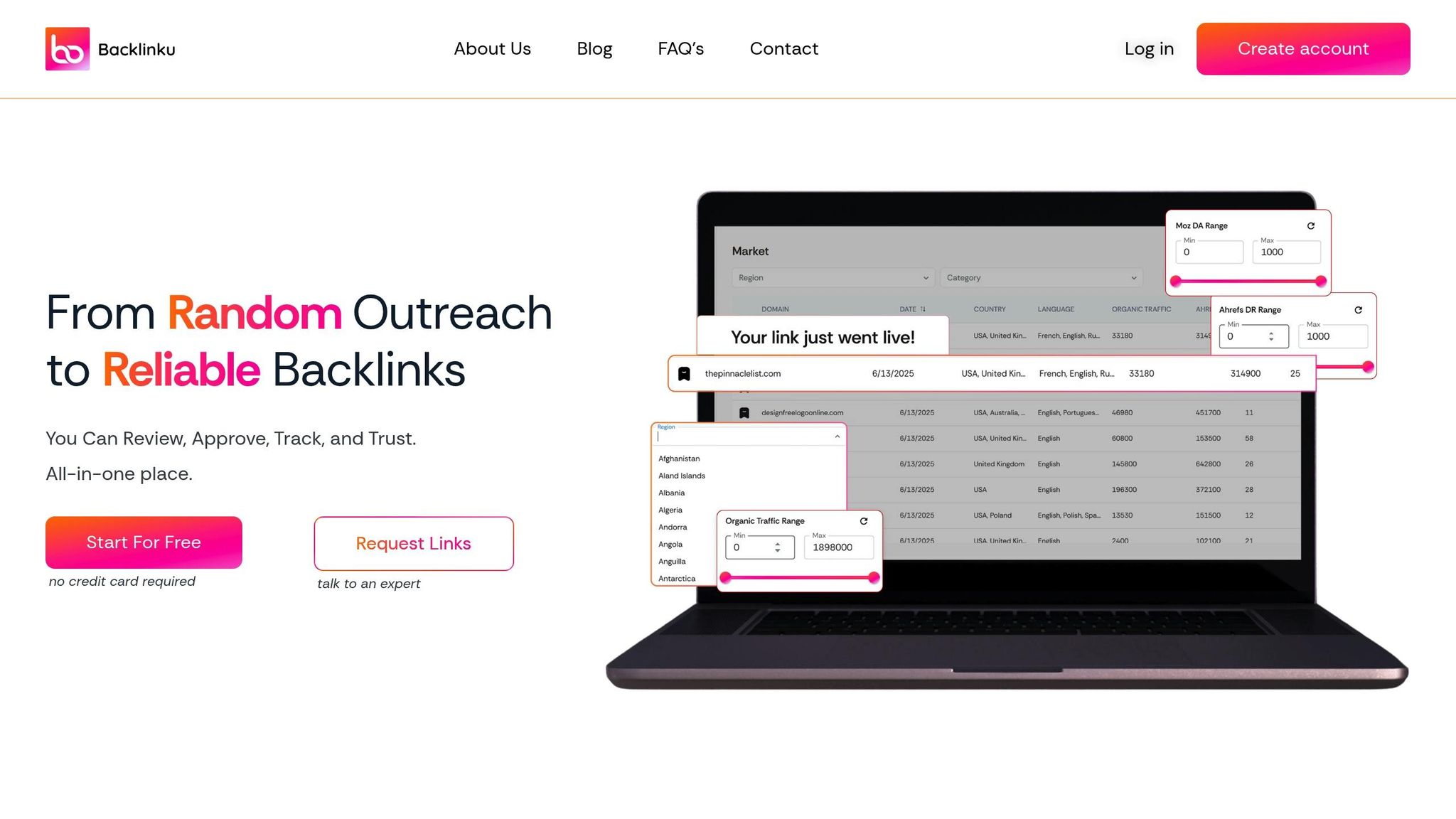
Once you’ve nailed down your content ideas, it’s time to bring them to life. Backlinku makes this process simple, turning your brainstorming into proven link-building success. With tools for website matching, team collaboration, and live tracking, Backlinku helps you move from planning to execution without falling behind.
Leverage Backlinku’s AI-Powered Link Matching
Backlinku’s AI takes the guesswork out of finding link opportunities.
By analyzing your topic, niche, and quality benchmarks, it connects your content with over 50,000 thoroughly reviewed websites, saving you countless hours of manual research. The platform evaluates potential linking sites by looking at metrics like referring domains, authority levels, and anchor text distribution.
You can also filter results by Domain Authority, Domain Rating, or Trust Flow to ensure you’re targeting high-value placements.
One standout feature is the link gap analysis, which compares your backlink profile against competitors. This uncovers opportunities where similar content has already earned links, helping you spot potential placements you might have missed. It’s like having a magnifying glass for hidden promotional opportunities.
Streamline Workflow with Content Approval Tools
Backlinku’s content approval workflows simplify team collaboration, reducing the usual back-and-forth that can delay progress. With clearly defined roles and deadlines, you can cut the average approval process from 8 days to something far more efficient.
Start with detailed content briefs that outline primary keywords, target audience, and search intent. These briefs act as a guide for your team, ensuring everyone is aligned before production begins. Once the outline is approved, feedback should focus on finetuning rather than reworking the direction entirely.
Track Results in Real Time
Backlinku’s real-time monitoring tools make it easy to monitor your campaign’s progress. Track critical metrics like email open rates, reply rates, link quality (measured by the Average Authority Score), and Link Velocity. Automated alerts keep you informed of any bottlenecks, allowing you to adjust your outreach strategy on the fly for maximum ROI.
Conclusion
Key Ideas for Generating Content
Successful link-building starts with truly knowing your audience. Dive into forums and online communities where your target audience hangs out to discover their most pressing questions and challenges. Analyze your competitors’ backlink profiles to identify what type of content naturally earns links in your niche. When brainstorming content ideas, use structured methods or frameworks to breathe new life into existing concepts. The trick is to balance creative thinking with data-driven insights, and validate your ideas by considering factors like search volume, competition levels, and the potential to attract backlinks.
Once you’ve polished your content ideas, the next step is to make the process more efficient with the right tools.
How Tools Make Link-Building Easier
After laying the groundwork with solid ideation techniques, tools like Backlinku can take your link-building efforts from good to great. Instead of spending weeks on manual outreach, you can tap into a database of over 50,000 manually reviewed sites in seconds. AI-powered matching connects you with high-authority opportunities specific to your niche and your quality standards. Built-in content approval workflows keep your team on the same page, while real-time monitoring alerts you to any changes to your backlinks.
Forget juggling spreadsheets and endless manual checks, manage everything in one streamlined dashboard, making it easier to move from brainstorming to securing live backlinks while keeping full visibility on performance.
FAQs
How can I find content gaps in my industry?
To spot content gaps in your industry, the first step is to conduct a content gap analysis. This involves researching the keywords and topics where your competitors are ranking, but you’re not. These gaps reveal areas where your content might be lacking or underperforming. Take it a step further by auditing your current content, look for pages that could be refreshed, expanded, or even merged to better meet user expectations.
Once you’ve pinpointed these gaps, it’s time to create content that not only fills them but is also worthy of earning backlinks. Tools like Backlinku can assist by identifying strong backlink opportunities tied to the topics you’ve uncovered. By blending competitor research, thorough content audits, and an effective backlink strategy, you can build a plan to create meaningful, linkable content that addresses those industry gaps effectively.
What are the best ways to brainstorm ideas for linkable content?
To generate ideas for linkable content, start with a brainstorming session where everyone can share freely; no idea is too rough or unconventional at this stage. Put everything down, then break each idea into two parts: its concept (like a guide, infographic, or tool) and its content (the specific topic or data). From there, look for ways to combine or tweak ideas to make them stand out. Prioritize them based on how relevant, original, and link-worthy they are.
You can also use techniques like creating mind maps, exploring Google’s “People also ask” section for popular questions, analyzing competitors to spot content gaps, or checking your analytics to see what’s resonated in the past.
Once you’ve narrowed down your ideas, tools like Backlinku can help you organize and refine them into assets designed to improve your search engine rankings and attract valuable links.
How can I check if a content idea will attract backlinks?
To gauge whether your content idea has the potential to attract backlinks, aim for it to be unique, helpful, and aligned with your niche. Write content that captures attention and resonates with a wide audience in your industry. Take the time to study successful content in your space. This can uncover trends or gaps in backlinks that you can address. You can also utilize tools like Backlinku to explore link-building opportunities and pinpoint websites that might be interested in linking to your content.