

Creating SEO-friendly content at scale involves producing high-quality, optimized articles consistently without sacrificing quality. The key is to treat content production as a system rather than a one-off task.
Here’s how to do it:
- Keyword Research: Build a long-term keyword list by analyzing search intent, relevance, and competition. Use tools like Semrush, Ahrefs, and Google Keyword Planner to identify opportunities and cluster keywords into related topics.
- Content Planning: Break workflows into smaller steps: keyword research, outlining, drafting, editing, and publishing. Plan content 6–9 months ahead to align with seasonal trends and give time for ranking.
- Automation: Use tools like ChatGPT or smart AI platforms for drafting, metadata generation, and internal linking. Use CMS plugins like Yoast SEO for technical optimizations.
- Content Briefs: Provide writers with detailed briefs, including primary keywords, search intent, outline, and competitor analysis to maintain consistency and quality.
- Link-Building: Strengthen content authority with strategic backlinks. Use platforms like Backlinku to find relevant link opportunities and manage campaigns efficiently.
- Performance Tracking: Use tools like Google Analytics 4 and Search Console to monitor organic traffic, engagement, and keyword rankings. Refine workflows based on bottlenecks and results.
Scaling content requires a balance between automation and human oversight to ensure efficiency and maintain quality. By creating structured processes, utilizing the right tools, and focusing on both content quality and authority, you can achieve consistent growth in organic traffic and conversions.
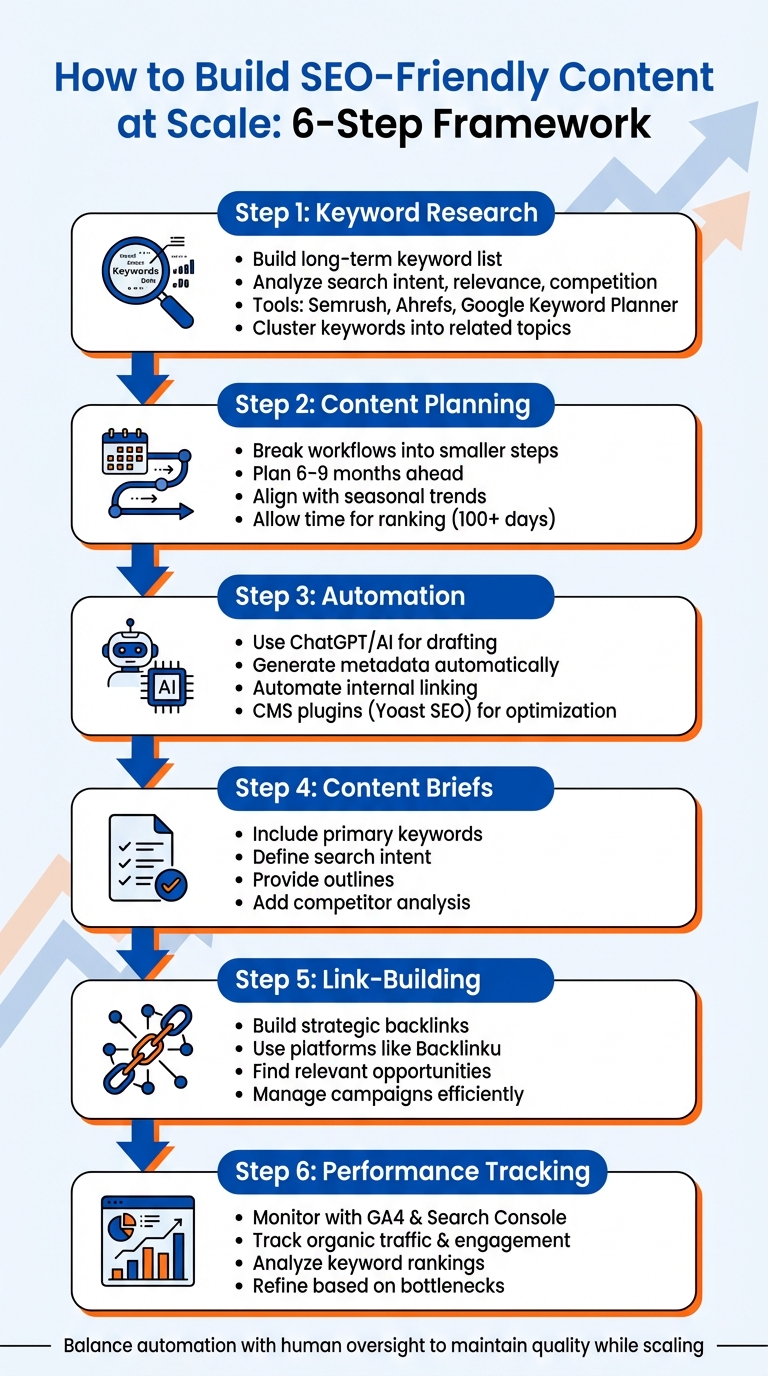
6-Step Framework for Building SEO-Friendly Content at Scale
Creating SEO optimised content at scale using AI and Automations
How to Conduct Keyword Research for Scalable Content
Keyword research for scalable content isn’t just about finding a few popular terms. It’s about building an extensive list of keywords that can fuel your content strategy for months, or even years. The key is to strike a balance; target keywords with high search volume that you can realistically rank for, and organize them into a system that keeps your content pipeline flowing. Let’s break it down.
Start by gathering seed keywords, which are the core terms tied to your business. These can come from three main sources: the keywords you want to rank for based on your offerings, the ones you already rank for (use tools to analyze your current performance), and the keywords your competitors are ranking for.
Tools like Semrush’s “Keyword Magic Tool” can expand these seeds into thousands of related terms, while the Google Keyword Planner provides search volume data straight from Google itself.
“The biggest mistake I see people making with keyword research is simply not doing it… we have to understand how potential customers are searching – and specifically, the intent of their search query.” – Greg Gifford, VP of Search, Search Lab
Once you’ve compiled your keyword list, it’s time to filter.
Not every keyword is worth pursuing. Focus on the business value and relevance. Group your keywords into categories: high-priority terms (those with strong intent and relevance), secondary terms (related but less critical), and others.
Pay attention to keyword difficulty; chasing highly competitive terms might not be the best use of your resources, especially if your site isn’t already ranking well for similar terms. And remember, most keywords aren’t high-volume “fat head” terms. Instead, long-tail keywords often offer better conversion potential because they capture more specific search intent.
Tools for Finding Keyword Opportunities
The right tools can simplify keyword research, especially when dealing with large datasets. Semrush’s “Keyword Strategy Builder” helps map and cluster keywords efficiently.
Ahrefs excels at competitor analysis with its “Top Pages” report, letting you reverse-engineer successful strategies. For handling massive lists, Serpstat offers clustering tools that can group up to 50,000 keywords based on SERP similarities.
Free tools like Google Search Console can help you spot opportunities; keywords where you’re already visible but could improve rankings.
KeywordTool.io is another option, pulling autocomplete data from platforms like Google, YouTube, Amazon, and TikTok. For question-based keywords, useful for FAQs or how-to guides, check out Google’s “People Also Ask” feature or tools like AnswerThePublic.
How to Prioritize Keywords by Intent and Relevance
Choosing keywords without understanding their intent is a waste of time and resources. Even with high search volume, traffic won’t convert if the intent behind a keyword doesn’t align with what your business offers. Keywords typically fall into four intent types: informational, commercial, transactional, and navigational.
“Choosing the wrong keywords means wasting your time and budget on content that will never gain visibility in search results.” – Cyrus Shepard, Founder, Zyppy SEO
Before committing to a keyword, ask yourself: Does this topic resonate with your audience? Can your business offer a solution?
To refine your list, use modifiers like location terms (e.g., “California”), time references (e.g., “2026”), or purchase intent signals (e.g., “cheap”, “deal”, “online”).
You can even calculate a priority score by combining metrics like search volume, keyword difficulty, and click-through rates to zero in on the best opportunities.
Organizing Keywords into Content Clusters
Randomly targeting keywords leads to a scattered strategy. Instead, use clustering to turn your keyword list into a structured content plan.
The pillar-cluster model is particularly effective. Start with broad “pillar pages” that cover main topics in depth, and support them with “cluster topics” that dive into specific subtopics. For example, a pillar page on “Link Building” could include clusters like “Guest Posting Strategies”, “Broken Link Building”, and “Digital PR Tactics.”
Zoe Ashbridge documented a case study for Fortune and Frame in December 2021, where clustering 50 related keywords into one article on “messages to write in a book” generated 9,370 clicks, 68,900 impressions, a featured snippet, and a 13.6% click-through rate. The average time on page? 6 minutes.
“Keyword clustering is the SEO tactic if you want to seamlessly optimize your SEO content and streamline your workflow at the same time.” – Zoe Ashbridge, Senior SEO Strategist
To validate your clusters, analyze the types of pages that rank for similar keywords. If the same kind of content (like articles versus product pages) ranks for multiple terms, those keywords likely belong to the same cluster.
Maintain a living keyword map; track primary keywords, variations, search volume, difficulty, and target URLs. This helps avoid keyword cannibalization and ensures every high-value term has a dedicated landing page.
While tools like Semrush and Serpstat can automate much of this process, human judgment ensures your content truly meets user needs.
How to Build a Content Planning Framework That Scales
Once you’ve organized your keywords, the next step is creating a planning framework that transforms them into consistent and engaging content.
A solid framework isn’t just a calendar; it’s a system that keeps content production running smoothly while maintaining quality. The difference between publishing a handful of articles a month and scaling up to dozens often comes down to how well your process is structured.
Start by setting SMART goals; objectives that are Specific, Measurable, Actionable, Relevant, and Time-bound. For example, you might aim to increase organic traffic by 25% in Q3 2026 by publishing 40 targeted how-to guides.
These specific goals will help you prioritize which topics to address first. Ahrefs uses a 0–3 scale to rank “business value”, indicating how naturally your product fits into the content.
A score of 3 means your product is essential to solving the reader’s problem, while a score of 1 suggests only a minor connection.
Break the production process into manageable steps. Don’t lump everything under “writing.” Instead, divide it into smaller tasks like keyword research, outlining, drafting, fact-checking, editing, design, SEO optimization, and distribution. This streamlined approach has been shown to improve both publication volume and organic traffic.
Plan 6–9 months ahead to account for seasonal trends and give content time to “mature” (it typically takes at least 100 days for content to reach its full ranking potential).
Use project management tools such as Monday.com, Notion, or Asana to track every stage of production. This ensures that tasks don’t stall and everyone knows their responsibilities.
Setting Up a Content Calendar
With your framework in place, a detailed content calendar helps keep everything on track. Think of it as your roadmap, showing what you’re publishing, when it goes live, who is responsible, and where it stands in the production process.
“Creating a content calendar allows you to ensure you’re reaching your users at the right time with the right content, thus squeezing the most juice out of your SEO strategies.” – Seer Interactive
Define clear criteria for each stage of production, such as a checklist to ensure drafts meet quality standards before moving forward.
Use the 70/20/10 rule to balance your content mix: 70% proven formats like how-to guides, 20% content aimed at new audiences, and 10% experimental ideas.
Regularly audit your content to update outdated material.
| Role | Responsibility |
|---|---|
| Content Strategist | Aligns content with overall strategy and goals |
| Editor | Reviews drafts and ensures consistency in tone |
| Writer | Creates content based on detailed briefs |
| SME | Provides technical knowledge and insights |
| SEO Specialist | Handles keyword research and on-page optimization |
| Project Manager | Keeps the project on track and manages the calendar |
Aligning Content with Your ICP and Business Goals
This framework works hand-in-hand with keyword clustering to ensure your content aligns with both user intent and your business objectives.
Keywords alone won’t carry your strategy; you need an audience-focused approach that identifies your “content tilt”, the intersection of your expertise and your Ideal Customer Profile’s (ICP) challenges.
Conversations with sales and customer service teams can reveal recurring questions that keyword tools might miss, helping you uncover content opportunities.
Organize your keywords according to the buyer’s journey stages: Awareness (informational content), Consideration (comparison guides), and Decision (product-focused content). This ensures you’re addressing your audience’s needs at every step rather than chasing high-volume keywords that don’t drive conversions.
For example, Kaplan Financial Education used this strategy for their “Career Corner” hub, targeting new financial professionals and generating over $1 million in sales from leads.
Each content brief should include a Reader Profile detailing the target audience’s experience level, pain points, and preferences.
This helps writers create content that resonates with your ICP. For instance, if your audience includes mid-level marketing managers dealing with budget constraints, your tone and examples should reflect their reality.
Creating Detailed Content Briefs for Writers
Clear content briefs are essential for maintaining consistency and quality, especially as you scale. Without them, writers may interpret topics differently, leading to inconsistent results and more editing. Detailed briefs were a key factor in helping Backlinko attract over 635,000 organic visitors each month.
Each brief should include core SEO elements: a primary keyword, secondary keywords (including variations and long-tail terms), and the target search intent (e.g., informational, commercial, or transactional).
Provide links to competing URLs; top-ranking pages for the target keyword, so writers can understand the quality benchmark and identify gaps to outperform competitors.
Include a suggested outline with H2 and H3 tags, an estimated word count based on competitor analysis, and a clear Call to Action (CTA).
Add internal links to strengthen site authority and external links to credible sources (like .gov or .edu sites) to build trust. For technical metadata, include instructions for crafting optimized title tags and meta descriptions.
Use the “Think, Feel, Do” model to guide writers, clarifying what you want readers to think, feel, and do after engaging with the content. This keeps the focus on outcomes rather than just delivering information.
Depending on the topic, choose between an “SEO-led approach” (structured and technical) or a “Writer-led approach” (more creative and flexible).
Create a 10–12 item editorial checklist to ensure drafts align with your brand guidelines before submission. This reduces the need for extensive revisions. Backlinko’s Lead Editor regularly reviews new articles to spot trends and update style guidelines as needed.
“If you want an article about unclogging a toilet, don’t hire a freelance writer. Hire a plumber.” – Brian Dean, Founder, Backlinko
For technical or specialized topics, involve Subject Matter Experts (SMEs).
Writers can interview these experts to add depth and authority to the content, especially when generic material won’t cut it.
Using Automation for Content Creation and SEO Optimization
Once your planning framework is in place, automation can ramp up your production without requiring a bigger team. It works hand-in-hand with your scalable framework, ensuring efficiency without compromising quality. The trick lies in figuring out which parts of your workflow benefit most from automation and where a human touch is still necessary. For instance, in 2024, businesses that scaled generative AI for marketing and sales saw a 15% surge in revenue, while teams leveraging AI for content automation reported a 40% increase in productivity within the first year.
The best use of automation follows a draft-and-refine approach rather than replacing human judgment entirely. Tools like ChatGPT, Gemini, and Claude can generate detailed outlines and pinpoint content gaps using the 5Ws and H Framework.
When using these tools, clearly define the task (What), context (Where), audience (Who), timing (When), purpose (Why), and format (How) to get high-quality drafts right away. Save successful prompts in shared tools like Google Sheets or Notion to ensure consistency across your team.
“I like to think of LLMs as partners – they handle the heavy lifting, and I guide the final result.” – Aleyda Solis, International SEO Consultant, Orainti
Automation is also useful for bulk metadata generation, creating SEO-friendly title tags, meta descriptions, and headers that match specific tones and keyword goals.
For businesses managing thousands of pages, like location-based services or product comparisons, programmatic SEO can use templates and structured data to scale efficiently. For example, Zapier manages over 8,000 pages detailing app integrations, while Yelp uses standardized templates to create directory pages for every city and service category.
Other time-saving uses of automation include internal linking and schema markup.
AI can analyze relationships between pages to suggest internal links and generate schema code for structured data without requiring technical expertise. These strategies work in tandem with your overall scaling efforts.
Automating Content Drafts and SEO Elements
AI writing tools are far advanced, capable of generating full-length, SEO-friendly drafts complete with optimized headers, keyword placements, and internal link suggestions. However, these drafts should be treated as starting points.
Use automation for repetitive tasks like generating first drafts, rewriting meta descriptions for different audiences, or classifying keyword intent across large datasets, and have editors refine the output to align with your brand voice and ensure accuracy.
For large-scale operations, tools like Numerous.ai integrate with Google Sheets to classify intent and rewrite templates across extensive datasets. This is particularly handy when optimizing hundreds of existing pages or launching a new content hub.
Automation can handle tasks like creating title tags, extracting primary keywords, or rewriting introductions to reflect updated search intent – all without manually editing each page.
Human oversight remains crucial for fact-checking and maintaining brand consistency. Automation can propose ideas and optimizations, but final approval should always come from your team to ensure quality and reliability. This balance between automation and human input transforms drafts into polished, publication-ready content.
Using CMS Plugins for SEO Quality Checks
CMS plugins simplify the process of ensuring on-page SEO elements are in place before content goes live. Tools like Yoast SEO (compatible with WordPress and Shopify) provide instant feedback on keyword usage, readability, and technical elements like sitemaps and robots.txt files. They flag issues such as missing title tags, duplicate meta descriptions, or keyword stuffing during the editing process.
Modern plugins also automate schema markup. With tools like All in One Schema, generate structured data for specific content types like “How-to” guides or “FAQ” pages without requiring manual coding. This improves your chances of earning rich snippets.
Schema Advisor GPT can even create structured data for “How-to”, “FAQ”, or “Product” schemas with minimal effort. Always validate schema markup to ensure it complies with Google’s guidelines.
Internal linking plugins are yet another groundbreaking feature. They analyze your site’s structure and suggest links from high-authority pages to new content, ensuring a healthy link equity flow. These tools also identify “orphan pages”, those without internal links, and alert you to address them before they become invisible to search engines. Automated alerts can help you catch and fix these issues quickly.
For image optimization, plugins handle tasks like generating alt text, creating descriptive filenames, and compressing images to improve page load times and accessibility. Many plugins can even flag whether your target keyword appears within the first 100–150 words of your content.
“Ahrefs gives you the specific data you need to make optimization decisions, not generic best practices.” – Lars Koole, RankYak
Establish clear governance rules to specify which elements can be fully automated (e.g., meta tags, alt text) and which require human approval (e.g., factual claims, product recommendations).
Automating Visual Content Creation
Visual content often slows down production, but automation tools are making it easier to create everything from hero images to infographics.
Ideogram 3.0 solves common issues such as text rendering in images, ensuring visuals align with your SEO goals and branding.
Recraft specializes in scalable vector graphics, while Getimg.ai offers tools like background removal, image resizing, and upscaling to meet Core Web Vitals standards.
Adobe Firefly integrates with Photoshop, enabling features like “Generative Fill” to adapt images for new layouts while maintaining consistent lighting and depth.
To avoid layout shifts, generate images with precise dimensions like 1,920×1,080 pixels for hero images or 16:9 thumbnails for blogs. Tools like Getimg.ai and Recraft can test how images scale on mobile headers, ensuring they look great across all devices.
Zapier integrations can automate the entire process by connecting tools like ChatGPT to platforms like Google Forms or HubSpot. This streamlines workflows by automatically generating visuals based on user input and saving them directly to your CMS or cloud storage.
AI-assisted tools can also insert checklists for image alt text during content creation. Batch-compress images and clear CDNs upon publishing to maintain fast page load speeds. By 2024, 93% of brands were using AI to speed up content creation, and 90% relied on it for planning. The key is to integrate these tools into a cohesive process rather than treating them as isolated solutions.
sbb-itb-566d57e
Adding Link-Building to Your Scalable Content Strategy
When scaling up content production, a strong link-building strategy becomes a must-have for establishing your online authority. Even the best content needs backlinks to expand its reach and strengthen credibility.
In 2026, link-building isn’t just about passing PageRank, it’s about building your brand’s presence and connecting it to key topics.
Co-citations, for example, help large language models (LLMs) like ChatGPT associate your brand with specific subjects, enhancing your visibility and relevance.
One effective approach is creating “citation magnets”, resources like original research, free tools, or templates that naturally attract backlinks over time.
The best ways to build links today are through strategic placements in highly relevant, trusted content. These include “Top Tools” lists, niche newsletters, or industry roundups. Generic guest posts are no longer the go-to.
Platforms like Featured.com or Help a Reporter Out (HARO) can help you become a source for journalists, earning authoritative links at scale.
Finding High-Quality Backlink Opportunities with Backlinku
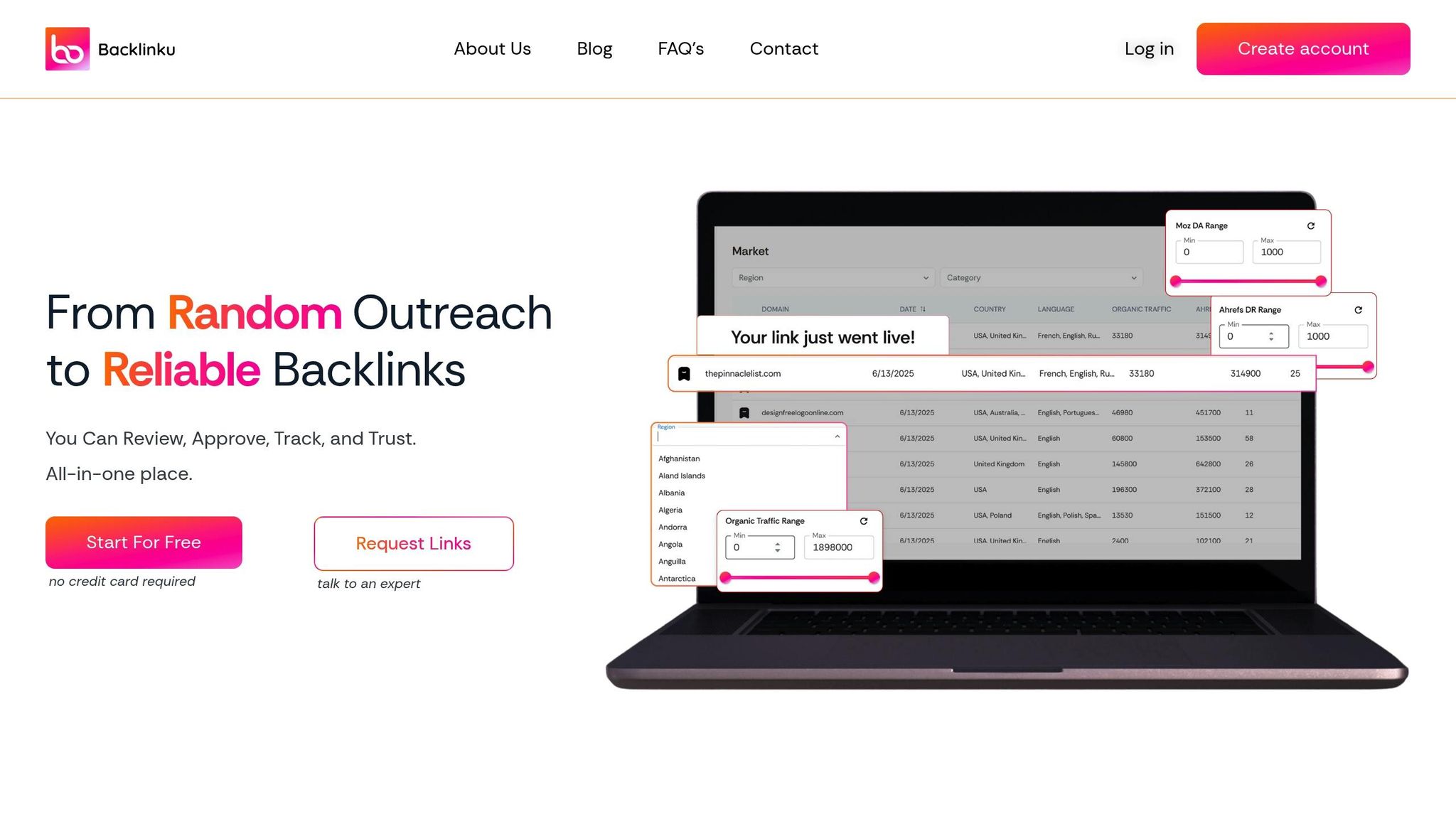
Incorporating strategic link-building into your content plan strengthens your SEO efforts even further. Backlinku simplifies this process by providing a marketplace of over 50,000 manually reviewed websites. Advanced filters let you zero in on opportunities based on niche, region, and key SEO metrics like domain authority or organic traffic, ensuring you focus on sites that align with your goals.
Using AI-powered link matching, Backlinku analyzes your content and suggests websites where your articles would be a natural fit. You can also sort opportunities by content type, audience demographics, or engagement levels.
For instance, if you’ve published a guide on email marketing automation, the platform might recommend marketing blogs, SaaS review sites, or industry newsletters that cover related topics. This targeted approach saves time and boosts success rates.
It’s not just about metrics; prioritize relevance. A link from a smaller, niche-focused blog with an engaged audience often has more impact than one from a high-authority site with little connection to your topic.
Managing Campaigns with Content Approval Workflows
Scaling link-building campaigns requires solid organization and clear communication. Backlinku’s content approval workflows make this easier by allowing you to submit guest post drafts, track revisions, and handle feedback all in one place. You can assign tasks to your team, set deadlines, and monitor progress, keeping everything streamlined.
The platform also offers tools for project management, bookmarking, and blacklisting. You can create separate projects for different content goals, bookmark high-priority opportunities, and blacklist sites that don’t meet your quality standards.
Plus, transparent reporting lets you see exactly where your content has been published, when links go live, and which campaigns are delivering the best results. This clarity helps you fine-tune your outreach efforts and focus resources on what works best.
Tracking and Improving Link-Building Performance
Once your campaigns are up and running, ongoing monitoring is essential for optimizing results. Backlinku provides real-time link monitoring and alerts, notifying you the moment a new backlink goes live or if an existing link is removed. This allows you to address any issues quickly.
Keep an eye on backlink growth to ensure steady progress. Sudden spikes or drops might indicate problems with your outreach methods or changes in publisher behavior. Backlinku’s dashboard presents this data clearly, helping you identify trends and adjust your strategy as needed.
But don’t just count backlinks, pay attention to the traffic and conversions they generate. Track organic search visibility and referral traffic from specific links to see which placements bring in the most qualified visitors.
Backlinku’s integrated reporting tools help you focus on quality over quantity, enabling you to fine-tune your campaigns for maximum impact.
Measuring Performance and Improving Your Content Workflow
To make the most of your automated production and planning strategies, you need a solid approach to tracking performance. This helps fine-tune your workflow and ensure your efforts pay off. Different teams focus on specific key performance indicators (KPIs): executives prioritize ROI and revenue, marketing leaders track lead generation, and content teams zero in on engagement metrics.
Let’s dive into the metrics and processes that help your scalable content strategy succeed.
Tracking Content Metrics with Analytics Tools
Tools like Google Analytics 4 and Search Console are essential for measuring how well your content performs. While traffic numbers are a good start, you’ll want to dig deeper.
For instance, tracking non-branded traffic shows how effectively you’re reaching new audiences. Examining session sources can also reveal which promotion channels are working best. Keep in mind that organic sessions typically last around 2–3 minutes, so ensure your pages load quickly, ideally within 2–5 seconds, to reduce bounce rates.
Don’t just focus on how many people engage with your content; look at how they engage. Metrics like average engagement time and scroll depth can tell you if readers are actually consuming your content.
Additionally, track keyword rankings and click-through rates to see which topics resonate most. On the technical side, monitoring Core Web Vitals and indexing status is crucial, as technical issues can derail even the best content efforts.
Set clear, measurable goals like “Increase email subscribers by 15% this quarter” instead of vague targets. It’s also worth tracking your AI visibility, keeping tabs on how often your brand appears in tools like ChatGPT, Perplexity, or Google AI Overviews, which can help you adapt as search habits evolve.
Using Data to Optimize Your Content Process
Data isn’t just for measuring success; it can also pinpoint inefficiencies in your workflow. For example, an industry case study highlighted a team that scaled to producing 50 articles per month by breaking their process into 12 distinct stages, all tracked via Monday.com. This detailed approach helped them identify bottlenecks in areas like writing, editing, and distribution, leading to a 30% increase in organic traffic and a 77% revenue surge over the year.
Keep an eye on how long it takes to move content from ideation to publication and how many revision rounds each piece requires. If some articles take longer or need more edits, dig into the reasons behind it.
As one lead editor put it:
“Articles requiring extra revisions or taking longer than expected usually have a root cause. It’s something we can improve in our resources or an opportunity to coach team members”.
Integrating data from GA4, Search Console, and project management tools into a single dashboard makes it easier to spot trends and patterns.
Compare your performance to competitors using share-of-voice metrics and keyword gap analysis to identify areas for improvement. Regular audits conducted at least twice a year by one-third of marketers can also help you refine your strategy and stay on track.
Maintaining Quality While Scaling Content Production
Scaling up your content production doesn’t mean sacrificing quality. Treat your workflow like a product that’s always evolving. Start with detailed content briefs that include primary keywords, search intent, audience insights, and unique angles to ensure your content stands out. Provide your team with style guides and checklists to maintain consistency across all pieces.
A draft-scoring system focused on tone, structure, and accuracy can make feedback more constructive and consistent, even for large teams.
One industry leader, for instance, updates its editorial style guide regularly. The lead editor reviews new articles, gathers input from team members like writers, designers, and SEO specialists, and incorporates feedback into quarterly updates.
Pair skilled writers with subject matter experts (SMEs) to ensure accuracy and deepen expertise in your content. This collaboration also strengthens E-E-A-T signals.
Consider using a hybrid approach where AI handles repetitive tasks like drafting or formatting, while human editors refine messaging and verify information for accuracy and emotional resonance.
As Moz Staff succinctly put it in The SEO’s Guide to Content Marketing:
“Everything is iterative. In a nutshell: There’s always more work to be done, a better result to be attained”.
| Metric Category | Key KPIs to Track | Primary Stakeholder |
|---|---|---|
| Business Impact | ROI, Revenue from Organic, CPA, Customer Lifetime Value (CLV) | C-Suite |
| Content Performance | Organic Traffic, Keyword Rankings, CTR, Conversion Rate | Marketing Directors |
| User Engagement | Avg. Engagement Time, Bounce Rate, Pages per Session | Content Teams |
| Workflow/Scale | Publishing Volume, Time to Publish, Revision Rounds | Content Managers |
| Technical/Authority | Domain Authority, Backlink Growth, Core Web Vitals, Indexing Status | SEO Specialists |
Conclusion
Scaling SEO-friendly content is about creating systems that deliver bigger results without demanding a matching increase in effort or resources. The strategies outlined here, from planning keyword research 6–9 months in advance to breaking workflows into smaller, manageable steps, help set the stage for producing more content without sacrificing quality. These methods are designed to align smoothly with your overall SEO goals.
Think of your content operation as a product that evolves over time. Well-documented processes can drive significant growth in organic traffic and revenue. By clearly outlining each step, incorporating expert insights, and keeping your style guide up to date, you can see impressive results. Companies using this method have reported a 167% boost in organic traffic and a 10× increase in content production.
While automation can streamline repetitive tasks, the role of human expertise cannot be overstated. Automation speeds up the process, but human input is vital for maintaining strategic direction and ensuring your brand’s voice stays consistent.
Another key element of a scalable content strategy is link building. Even the best content can struggle to gain visibility without strong backlinks. Tools like Backlinku can help you identify link opportunities, manage approvals, and monitor performance, ensuring your content builds the authority it needs to rank well.
As Brian Dean aptly states:
“In today’s search landscape – especially with large language models (LLMs) like ChatGPT and AI Mode – context beats the <href> tag”.
Start small by adopting one framework at a time. Document your workflows, measure your results, and refine your approach based on the data. The real key to scaling lies in developing systems tailored to your team’s specific needs, rather than trying to replicate someone else’s strategy.
FAQs
How can I balance automation with human input when creating content?
To strike the right balance between automation and human creativity, let automation take care of the repetitive, time-consuming tasks like keyword research, drafting content, and tracking performance metrics. This frees up people to focus on the creative and strategic aspects that require a human touch. For instance, you can use tools to generate content outlines or initial drafts, but a skilled writer should step in to refine the tone and make sure the final piece resonates with your audience.
Build review checkpoints into the workflow to maintain quality and consistency. After gathering research, verify that the insights align with market needs. Once a draft is complete, an editor can step in to polish the content, ensuring it’s clear and stays true to your brand’s voice. Finally, an SEO expert can review the piece to confirm that optimization aligns with best practices before it goes live. This method keeps the process efficient while preserving both quality and authenticity.
What’s the best way to organize keywords into effective content clusters?
To build effective content clusters, start by pinpointing a core pillar topic that matches your primary search intent. From there, gather related keywords that connect to this pillar. Focus on semantic relevance, search volume, and competition to ensure your clusters are well-structured. Each cluster should revolve around specific, long-tail keywords, keeping the content tightly focused and purposeful.
When organizing keywords, always consider user intent. Break your clusters into categories like informational, navigational, and transactional to address different audience needs. Keep your clusters manageable; aim for 5 to 10 keywords per group to avoid overlaps or creating isolated content silos. Use a spreadsheet or content management tool to map out your strategy, including a target keyword, URL, and internal linking plan for each piece.
To make your clusters even more effective, consider tools like Backlinku to secure quality backlinks for your pages. Regularly review their performance and adjust your clusters as search trends shift, helping you maintain authority in your niche.
How can I create content that meets user needs while supporting my business goals?
To get started, dive into keyword research to uncover what your audience is actively searching for and the intent behind their queries. This step is key to aligning those keywords with your business goals, whether that’s generating leads, boosting sales, or increasing engagement. Once you’ve identified the right keywords, focus on creating content that meets user needs while weaving in measurable objectives like clear calls-to-action or elements designed to drive conversions.
For a smoother workflow, consider using tools like Backlinku. These can help you organize your efforts, track performance, and ensure your content remains optimized for both user intent and your business priorities.