

If you’re working on SEO, you’ve probably wondered: Should I focus on guest posting or directory submissions? Here’s the short answer:
- Guest posting is best if you want to build authority, get high-quality backlinks, and drive targeted traffic. It’s ideal for long-term growth but takes more time and effort.
- Directory submissions are better for local SEO and citation consistency. They’re simpler and faster but have a limited impact on rankings.
Key Takeaways:
- Guest Posting: Strong backlinks, builds authority, drives traffic, but requires significant time (10–15 hours per post) and costs ($214–$1,459 per link).
- Directory Submissions: Good for local businesses, improves Google Maps rankings, and is affordable ($20–$300 per listing), but risks penalties if done poorly.
Quick Comparison:
| Factor | Guest Posting | Directory Submissions |
|---|---|---|
| SEO Impact | High (contextual backlinks) | Low to moderate (citations) |
| Traffic Potential | High (targeted audience) | Low (niche traffic) |
| Time Investment | High (10–15 hours/post) | Low (simple submissions) |
| Cost | High ($214–$1,459 per link) | Low to moderate ($20–$300/listing) |
| Best for | Authority & brand building | Local SEO & citation consistency |
Both strategies have their place, but your choice depends on your objectives. For long-term growth, guest posting is the clear winner. For local businesses or quick visibility, directory submissions are effective. Want the best of both? Combine them strategically.
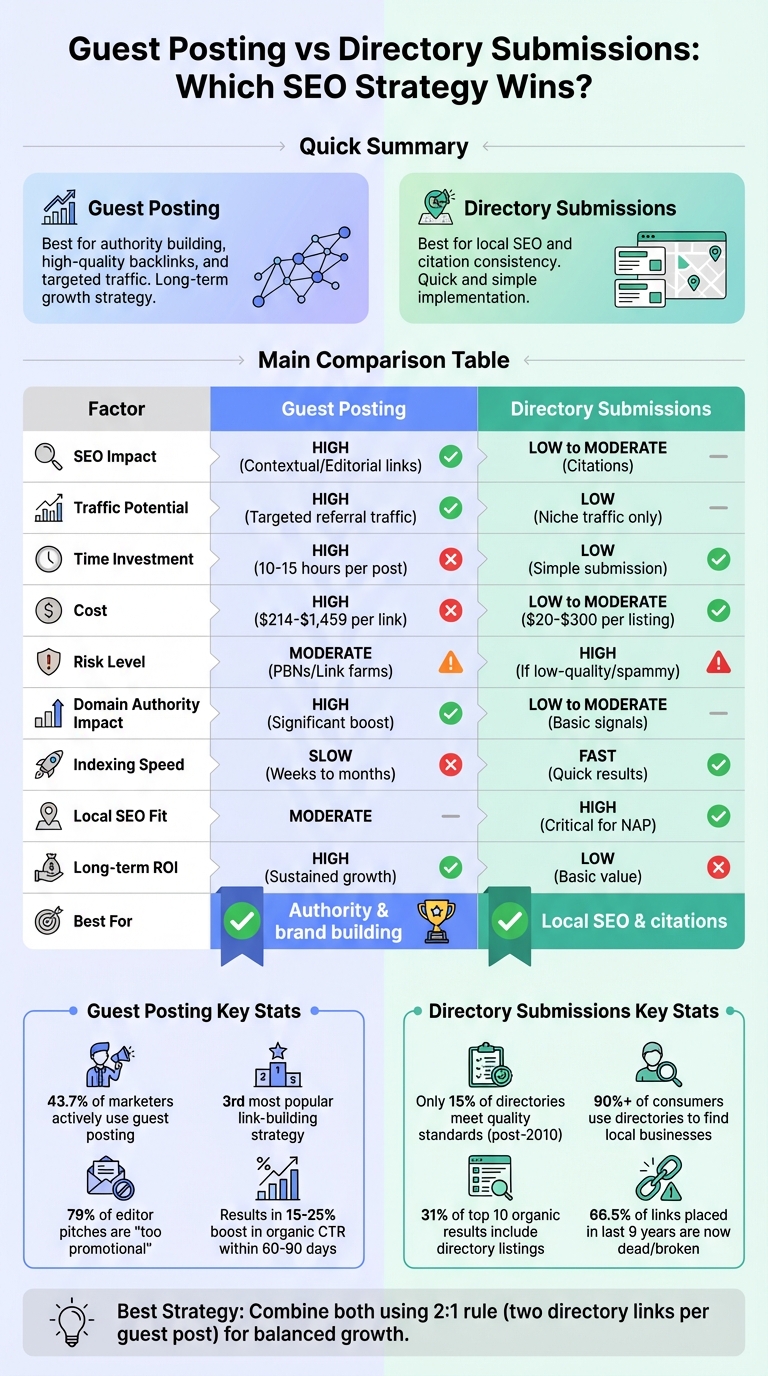
Guest Posting vs Directory Submissions: Complete SEO Comparison
Does Guest Posting Still Work for SEO?
What is Guest Posting?
Guest posting, also known as guest blogging, involves writing and publishing articles on someone else’s website. This practice helps build credibility and earns high-quality backlinks. Unlike paid ads or directory listings, guest posting works as a value exchange: you provide well-crafted, expert content, and in return, the host site gives you visibility to their audience and a backlink to your website.
The true value of guest posting lies in contextual backlinks, links embedded naturally in the article or included in the author’s bio. These links transfer “link equity” to your site, improving your search engine rankings. But today, successful guest posting requires more than just link-building; it demands genuine expertise and thoughtful relationship-building. As one industry expert notes:
“Today, expertise must precede link-building in successful guest blogging.”
This shift stems from Google’s efforts to penalize low-quality content. The era of churning out generic articles for any site willing to accept them is behind us.
In fact, 79% of editors say the guest post pitches they receive are “too promotional”. To stand out, you need to provide meaningful value, not just a thinly veiled attempt to gain links. Done right, guest posting can lead to long-term partnerships, collaborations, and community connections that go far beyond a single backlink.
Guest posting is currently the third most popular link-building strategy, trailing only content marketing and digital PR. Beyond traditional SEO perks, it’s also becoming a tool to strengthen brand visibility in AI-driven tools like ChatGPT and Perplexity, as unlinked brand mentions on authoritative sites can improve recognition in these platforms.
Understanding these basics is the first step toward mastering guest posting.
How Guest Posting Works
The guest posting process involves finding opportunities, pitching ideas, and publishing articles with backlinks. Here’s a breakdown of how it typically works:
Start by identifying niche websites that accept guest contributions.
Assess their quality using metrics like Domain Rating (DR) above 50 and at least 5,000 monthly visits. You can find these sites using Google search operators such as "[keyword] + 'write for us'" or "[keyword] + 'contributing writer'".
Another effective strategy is to reverse engineer your competitors’ backlinks using SEO tools to determine where they’ve successfully placed guest posts. Avoid sites that openly sell guest post placements, as these are often flagged by Google’s spam detection systems.
Next, focus on your pitch. With 76% of editors publishing up to 10 guest posts per week, competition is fierce. To stand out, use the “Content Gap” method: identify keywords the target site’s competitors rank for, but they don’t, and propose a post that fills that gap. This shows you’ve done your research and are offering something valuable.
If your pitch gets accepted, you’ll write the article following the site’s editorial guidelines. Writing an effective guest post typically takes 10–15 hours, including research, writing, and pitching. You’ll include one or two contextual links in the article or a link in your author bio pointing back to your website.
Many high-authority sites have removed public “Write for Us” pages due to the rise of AI-generated spam. As a result, building genuine relationships with editors has become essential for securing top-tier placements.
Engage with editors on social media, leave thoughtful comments on their posts, and establish recognition before sending your pitch.
This structured approach not only earns quality backlinks but also creates opportunities for long-term SEO and branding benefits.
Benefits of Guest Posting
Guest posting is more than just a backlink exchange. Its range of advantages highlights why quality content and authenticity remain crucial to SEO success today.
Here are the key benefits:
1. Improves Brand Authority and Credibility
Being featured on reputable sites enhances your brand’s trustworthiness. When a respected publication publishes your content, its endorsement helps transfer credibility to your brand.
As Leury Pichardo, Senior Director of Digital Marketing and PR at Digital Ceuticals, explains:
“I care less about someone’s paper credentials and more about whether they are a genuine partner in promotion.”
2. Drives Targeted Referral Traffic
Guest posting places your content in front of an audience already interested in your niche. For example, in 2024, marketer Dana Nicole wrote a guest post for the Buffer blog. By including a contextual link to a key page on her site, she generated significant traffic and raised conversions over the next 11 months.
3. Improves SEO with High-Quality Backlinks
Links from authoritative, relevant sources are far more valuable for SEO than directory or comment links. Guest posts provide these high-quality backlinks, which can significantly impact your site’s rankings.
4. Enhances Visibility in AI Search Tools
As tools like ChatGPT and Perplexity grow in prominence, guest posting offers a way to increase your “share of model.” Mentions on authoritative sites help these platforms recognize and reference your brand, boosting your visibility in AI-driven search results.
What are Directory Submissions?
While guest posting uses content to build authority, directory submissions focus on creating citations and improving local visibility.
In simple terms, directory submission involves listing your website’s URL and business details in an online directory to generate a backlink.
Think of it as adding your business to a digital phone book, making it easier for potential customers to find you based on your category or location.
In the early days of SEO, webmasters flooded hundreds of directories with their site details, believing that more links meant better rankings. But this changed dramatically with Google’s 2012 Penguin update, which penalized low-quality directories lacking proper editorial oversight.
As Samuel Edwards, Chief Marketing Officer at SEO Company, aptly noted:
“The 90’s called and they want their SEO strategies back… this link building strategy, while not dead, should represent a VERY small sliver of your overall focus for quality link acquisition.”
Today, the focus has shifted from quantity to quality. Directory submissions are now about building branded links and diversifying your link profile.
Reputable directories with Domain Authority (DA) above 50, editorial review processes, and niche or geographic relevance are the ones to target. For local businesses, these listings, often referred to as citations, are vital for ranking in Google’s local 3-pack.
A single listing on a trusted, well-reviewed directory can positively impact your search rankings within 30–45 days. On the other hand, automated submissions to low-quality directories can lead to penalties and harm your SEO efforts.
How Directory Submissions Work
The process of directory submission typically involves 3 main steps:
- finding quality directories,
- preparing your business information,
- and going through an editorial review.
First, identify directories that meet modern SEO standards.
Look for platforms with a DA above 50, clear editorial guidelines, and relevance to your industry or location. Use search operators like “[your industry] + directory” or analyze where your competitors are listed.
Avoid sites that promise instant approvals, are overloaded with ads, or lack a proper review process.
Next, prepare your business details for submission.
Consistency in your NAP (Name, Address, Phone number) across all listings is critical. Inconsistent information can confuse search engines and hurt your local rankings. For example, a local plumbing company significantly improved its search rankings after correcting inconsistent NAP details across 15 major directories.
Finally, submit your information following each directory’s guidelines. High-quality directories usually involve a manual editorial review, which can take anywhere from a few days to several weeks. This review process signals trust and credibility to search engines.
To streamline the process, structure your efforts into 3 phases:
- research,
- submission,
- and performance tracking.
Small businesses might spend $300 to $800 monthly on managed directory programs, while enterprises may allocate $1,500 to $3,000.
Unlike guest posting, which relies on content, directory submissions take a citation-driven approach to increase visibility.
Benefits of Directory Submissions
Directory submissions offer several key advantages, particularly for local businesses and those in niche industries:
- Improves Local SEO and Map Pack Rankings
High-quality directory listings are essential for local search visibility. They help your business show up in Google’s local 3-pack. Research shows that over 90% of consumers use online directories to find local businesses, and directory listings account for about 31% of the top ten organic search results. - Contributes to a Natural Link Profile
Reputable directories provide a mix of nofollow and dofollow links with branded anchor text, creating a diverse and natural link profile. Businesses often see a 15 to 25% raise in organic click-through rates within 60–90 days. - Straightforward Process
Once you’ve prepared consistent business details, the same core information can be reused across multiple directories, making the process relatively simple. - Fast Results with High-Authority Listings
Listings on reputable directories (typically with a DA of 50–80) can start improving rankings in just 30–45 days. For instance, in September 2025, a Manchester-based accounting firm saw a 180% increase in directory-driven leads after adding niche services like Tax Preparation and Business Advisory to its listings. - Better Visibility in Voice and AI Search
As directories increasingly feed data to voice assistants and AI-driven searches, optimized listings can lead to up to 42% more calls and requests for directions.
Guest Posting Pros and Cons
Expanding on the earlier discussion about the process and advantages of guest posting, let’s take a closer look at its benefits and challenges. While guest posting offers substantial rewards, it also comes with its share of obstacles.
Pros of Guest Posting
Guest posting delivers contextual backlinks from credible websites, which carry genuine link equity to your site. These links, naturally embedded within high-quality content, signal to search engines that your site is trustworthy and authoritative. Unlike directory links or comment links, these backlinks stand out for their strength and relevance.
Publishing on respected industry platforms also serves as a powerful endorsement for your brand. Having your byline featured on a well-known blog positions you as a trusted voice and expert in your field. As Backlinko points out:
“If you want to crush it with guest blogging today, you’ve got to be an expert first, link builder second.”
Beyond SEO, guest posts can drive consistent referral traffic and help grow your subscriber base, as highlighted in a recent case study.
Plus, the networking opportunities are invaluable, and building relationships through guest posting often leads to future partnerships and collaborations.
From an SEO perspective, backlinks from relevant, high-quality sites provide long-term benefits. They improve your rankings for target keywords and strengthen your domain authority over time. It’s no surprise that guest posting ranks as the third most popular link-building strategy, behind content marketing and digital PR.
Cons of Guest Posting
Despite its advantages, guest posting has some notable downsides. The most significant is the time commitment. Writing a single high-quality guest post can take anywhere from 10 to 15 hours. For small teams or individuals, this makes it challenging to scale guest posting efforts effectively.
Rejection rates are another hurdle. Many top-tier blogs now limit public submissions due to an influx of low-quality pitches and AI-generated content.
Even when submissions are accepted, they often come with strict guidelines, demanding 2,000–3,000 words, specific formatting, and stringent link policies. This can lead to multiple revisions or outright rejections.
There’s also the risk of search penalties. Engaging with “link farms”, private blog networks, or sites that openly sell backlinks can lead to manual penalties or devaluation by Google’s SpamBrain AI.
For example, 94 sites were recently removed from major “guest post lists” after being penalized by Google’s Helpful Content Updates. As Brian Dean notes:
“Also, if you can just buy a link from a site, then anyone can. So those domains tend to get degraded over time if they aren’t already.”
Lastly, results take time. Unlike link insertions in existing content, newly published guest posts need to be indexed by Google before they begin to impact rankings.
This process can take weeks or even months, which can be frustrating if you’re looking for quicker outcomes.
For context, the average cost of a guest post from vendors is $1,459.06, based on an analysis of 26,000 sites.
Directory Submissions Pros and Cons
When it comes to link-building strategies, directory submissions come with their own set of advantages and disadvantages. Understanding these can help you decide if this approach aligns with your overall plan.
Pros of Directory Submissions
One of the biggest draws of directory submissions is their affordability.
Unlike guest posting, which can take up to 10–15 hours per article, directory submissions are simpler and often automated.
For small businesses, monthly investments in quality directory programs typically range from $300 to $800, while larger enterprises might spend $1,500 to $3,000. High-quality directories generally charge between $20 and $300 per listing.
For local businesses, directory listings are a cornerstone of local SEO. They improve visibility in local search results and can yield noticeable benefits.
High-authority directories (with domain authority scores of 50–80) can influence rankings within 30–45 days and increase organic click-through rates by 15–25% within 60–90 days. As ActiveMarketing explains:
“Quality directories with established domain authority can boost your search position by passing link equity and topical signals that reinforce your site’s expertise.”
Niche-specific directories are another plus. They attract users actively searching for services in your industry, driving qualified referral traffic. These platforms also enhance your credibility with search engines by signaling your expertise in a specific field.
Despite these benefits, directory submissions aren’t without their risks.
Cons of Directory Submissions
The most significant risk? Penalties from low-quality directories. Many directories are viewed by search engines as “link farms” or spammy “bad neighborhoods”, which can result in penalties under Google’s Penguin algorithm for artificial link-building.
Samuel Edwards, CMO at SEO Company, doesn’t mince words:
“The 90’s called and they want their SEO strategies back… this link building strategy, while not dead, should represent a VERY small sliver of your overall focus.”
Post-2010, only about 15% of web directories meet the editorial standards needed to provide real SEO value. Many directories accept submissions without any human review, which means search engines often ignore or devalue these links.
Low-authority directories (DA 20–40) may take 60–120 days to show any impact or may not deliver results at all.
There’s also no guarantee your site will be listed. Some directories charge non-refundable “review fees” (historically around $299) without promising approval.
And even if your link gets placed, it might not last. With 66.5% of links placed in the last nine years now dead or broken, link rot is a pressing concern. Directories filled with ads, plagued by broken navigation, or requiring reciprocal links are especially risky and often offer little value. ActiveMarketing Analysis sums it up well:
“Search engines now distinguish between editorial directories that serve users and link farms designed solely for SEO manipulation.”
Guest Posting vs Directory Submissions: Comparison Table
Let’s break down how guest posting and directory submissions compare across key SEO metrics. This side-by-side look will clarify their strengths, limitations, and how they align with your goals.
Guest posting requires a longer time and financial commitment, but delivers stronger SEO benefits and greater traffic opportunities.
On the other hand, directory submissions are quicker and more affordable, though they come with higher risks and limited rewards for today’s SEO.
| Factor | Guest Posting | Directory Submissions |
|---|---|---|
| SEO Impact | High (Contextual/Editorial links) | Low to Moderate (Foundational/Citations) |
| Traffic Potential | High (Referral & Branded searches) | Low (Qualified niche traffic only) |
| Risk Level | Moderate (Risk of PBNs/Link farms) | High (If low-quality/Spammy) |
| Time Investment | High (10–15 hours per post) | Low (Simple submission) |
| Cost | High ($214–$1,459+ per link) | Low to Moderate (Free to ~$300) |
| Primary Goal | Authority & Brand Building | Citation Consistency & Local SEO |
Guest posting is widely regarded as a powerful link-building method, ranking as the third most popular strategy after content marketing and digital PR.
In fact, 43.7% of marketers actively incorporate guest posting into their SEO efforts. Meanwhile, directory submissions are often favored by local businesses or newer websites aiming to secure foundational citations.
Ultimately, your decision between these two approaches will depend on your specific objectives, available budget, and risk tolerance. This comparison provides a clear foundation for understanding when each strategy might be the right fit.
sbb-itb-566d57e
Head-to-Head Comparison
Side-by-Side Metrics Table
Here’s a breakdown of how guest posting stacks up against directory submissions across key SEO metrics:
| Metric | Guest Posting | Directory Submissions | Winner |
|---|---|---|---|
| Domain Authority Impact | High. Contextual, editorial links from trusted sites significantly boost link equity | Low to Moderate – Offers basic trust signals but limited improvement to domain authority | Guest Posting |
| Indexing Speed | Slow. New content may take weeks or months to be indexed | Fast – Links on existing, indexed pages show quicker results | Directory Submissions |
| Referral Traffic Quality | High. Attracts targeted readers through relevant, engaging content | Minimal – Directory listings typically see few referral clicks | Guest Posting |
| Local SEO Fit | Moderate. Works well with geo-specific blogs but isn’t a primary local SEO tool | High – Critical for maintaining consistent citations and NAP details | Directory Submissions |
| Long-term ROI | High. Builds authority, sustained traffic, and brand visibility over time | Low – Offers basic value but rarely drives meaningful growth | Guest Posting |
Guest posting takes the lead in three major areas, making it a powerful tool for driving organic growth. That said, directory submissions shine when it comes to indexing speed and supporting local SEO efforts, especially for businesses focused on keeping citation data consistent.
This comparison highlights a central takeaway: quality matters more than quantity in link building. Guest posting provides high-value backlinks that outperform the foundational but limited benefits of directory submissions.
“Guest posting is the strategy that delivers long-term, compounding benefits. It drives rankings, authority, and traffic in a way few other SEO services can match.” – alexagrahamm, SEO Contributor
While directory submissions are effective for quick indexing and local SEO, the right choice depends on your objectives. Are you aiming for immediate results or sustainable growth? Next, let’s go over when and how to use each strategy effectively.
When to Use Guest Posting
Guest posting works best as a long-term strategy to build authority rather than chasing quick results. For B2B or SaaS companies looking to reach key decision-makers like product managers or developers, guest posting on respected industry sites puts your expertise directly in front of the right audience.
Similarly, for niche-specific businesses, appearing on blogs where your target audience already spends time helps establish credibility that directory listings simply can’t match. Beyond authority, this approach also opens the door to meaningful audience engagement, as evidenced by numerous case studies.
This method is especially effective when you offer unique insights or original data, something publishers actively seek over generic content.
In 2026, Kristaps Brencans demonstrated this with a guest post on Backlinko. By including detailed original screenshots and step-by-step systems, the post achieved high engagement and earned a valuable backlink from a leading SEO authority.
Guest posting also allows you to target specific demographics that generic directories often miss. For instance, a B2B startup contributing to a design blog can reach a highly focused audience segment more effectively than through a generic business directory.
With 67.5% of digital marketing experts agreeing that backlinks significantly influence search rankings, the contextual links gained through guest posts carry far more weight than those from directories.
To maximize results, focus on high-authority sites with a Domain Authority above 30 and at least 5,000 monthly organic visits.
Before pitching, ensure the site has a clear editorial team, an active social media presence, and stable or growing traffic. Save your best, most impactful thought leadership pieces for the top 10–20 authority sites in your niche, rather than spreading your efforts across lower-quality blogs.
When to Use Directory Submissions
While guest posting helps build long-term authority, directory submissions are perfect for gaining quick local visibility. They work best when launching a new website or targeting local customers. For service-based businesses like dental practices, plumbing companies, or legal firms, being listed in directories can help you show up in Google Maps’ local 3-pack, making it easier for potential customers to find you.
As Samuel Edwards, Chief Marketing Officer at SEO Company, puts it:
“Local companies have perhaps the most to gain from building links from local business directories. These types of local link citations help to enhance your exposure in the local 3-pack in Google Maps”.
For new websites, directory submissions can quickly establish a foundational backlink profile and increase local search visibility. This early credibility lays the groundwork for broader SEO strategies. For instance, a bakery in Bristol that wasn’t showing up in local search results listed itself in 15 quality local directories.
Within just two months, it began appearing in the local pack for “bakery near me” searches, which led to a 45% increase in foot traffic.
Certain industries, such as healthcare, addiction treatment, and finance, benefit from niche directories that have strict editorial standards. Similarly, B2B SaaS companies can use industry-specific directories to highlight their technical expertise and certifications.
When searching for quality directories, focus on platforms with a Domain Authority of 30 or higher and ensure they rely on human reviewers instead of automated approvals.
To check if a directory is indexed, use the search operator site:domain.com; if no results appear, the directory may have been penalized.
Relevance is key; Gombos Atila Robert, CEO of Jasmine Business Directory, emphasizes:
“a listing in a highly relevant, industry-specific directory with moderate authority will outperform a generic high-authority directory submission 9 times out of 10”.
Consistency in your NAP (Name, Address, Phone Number) details across all listings is critical. For example, a dental practice in Manchester saw a 67% increase in Google My Business views and a 40% rise in new patient inquiries within three months by maintaining consistent NAP information across 20 local and healthcare-specific directories. To avoid triggering spam filters, stagger your submissions over several weeks. This approach typically results in a 15-25% boost in organic click-through rates within 60-90 days.
How Backlinku Helps with Link Building

Backlinku takes the hassle out of link building by offering a streamlined platform that simplifies and enhances your efforts.
Scaling guest posting and directory submissions can be overwhelming, with tasks like finding quality sites and tracking live links. Backlinku solves this by providing access to a marketplace of over 50,000 pre-vetted domains.
You won’t have to manually search for websites or check their authority anymore.
With advanced filtering options, you can sort domains by Domain Rating (DR), Domain Authority (DA), organic traffic, niche, language, or geographic location, making it easier to align placements with your SEO goals.
For guest posting, Backlinku simplifies the entire process. Automated content approval workflows ensure your brand voice remains consistent, while its AI-powered outreach system handles repetitive communication with publishers. Plus, a centralized dashboard gives you real-time updates on all your campaigns.
As Backlinku explains:
“You don’t need another tool to manage 5, 10, or 50+ clients. You need a backlink system that saves time, automates grunt work, and impresses your clients with real, trackable wins.”
The platform also tackles the issue of link decay with real-time monitoring and health alerts, so broken links are fixed quickly. Tools like domain blacklisting and whitelisting give you full control, ensuring your links don’t end up on spammy or irrelevant sites.
Whether you’re targeting multiple regions or focusing on a local business, the transparent reporting dashboard helps you track performance metrics with ease.
For agencies managing multiple clients or in-house teams scaling their efforts, Backlinku’s centralized system is invaluable. It allows you to filter targets based on technical SEO metrics like Trust Flow (TF) and Citation Flow (CF), ensuring you prioritize high-quality opportunities.
From prospecting to live link monitoring, everything is managed through one integrated interface. This approach supports both long-term authority building and immediate local SEO needs, making your link-building efforts more efficient and impactful.
Which Strategy Should You Choose?
The right strategy depends on your business type, timeline, and available resources. Each approach serves different purposes, as shown in the comparison table.
Guest posting is ideal for B2B companies, SaaS brands, and established businesses aiming to build long-term authority and industry recognition. While it demands a significant time commitment, about 10–15 hours per post, it delivers high-quality referral traffic and fosters genuine relationships within your industry.
On the other hand, directory submissions are particularly effective for local businesses needing consistent citations or new websites looking to establish a foundational link profile. These are quicker to implement, often yielding results within 30–90 days, making them a great option for improving local search visibility quickly.
Your choice of strategy also influences how you balance quality with speed. For most, a hybrid approach works best. For example, using a 2:1 rule – two directory links for every high-quality guest post can maintain an organic link profile while ensuring both quick wins and sustained authority.
Paddy Moogan, Co-founder of Aira, emphasizes this idea:
“Arguably, link building these days is more akin to great marketing, and the organizations who understand this are usually the ones who win long term”.
However, not all opportunities carry equal weightage.
Avoid low-quality directories that lack editorial oversight, as they can lead to penalties. Similarly, steer clear of guest posting on sites that openly sell placements or churn out excessive daily content filled with outbound links. Quality should always come first.
As Zack Chambers from Sure Oak puts it:
“A single high-quality guest post on a relevant niche site can do more for a website than dozens or hundreds of low-quality guest posts on content farms”.
To streamline your efforts, tools like Backlinku’s centralized dashboard can simplify the process. This platform eliminates the need for manual vetting and link monitoring, allowing you to focus on strategic decisions.
It tracks both guest post campaigns and directory placements in real-time, helping you manage both strategies efficiently without unnecessary administrative work.
Ultimately, most businesses benefit from combining these approaches. Local service providers should prioritize directory submissions, while national brands and B2B companies should focus on guest posting.
For new websites, a balanced mix of both strategies works best; directories build credibility, while guest posts establish authority through meaningful content.
By integrating these methods and focusing on quality, your business can achieve sustainable growth across search channels.
FAQs
Which is better for my business: guest posting or directory submissions?
Choosing between guest posting and directory submissions comes down to your business objectives, budget, and how quickly you want to see results.
If you’re aiming for a faster SEO boost and better local visibility, directory submissions can be a smart move. Prioritize directories with strong domain authority (DA) and a solid editorial review process to ensure quality. For small businesses, the cost typically ranges from $300 to $800 per month, while larger companies might allocate $1,500 to $3,000. With niche-specific directories, you could start seeing results in as little as 30 to 90 days.
On the other hand, if your focus is on building brand authority, attracting referral traffic, and creating content with staying power, guest posting is the way to go. This involves contributing articles to reputable websites in your industry. While it requires more effort and investment in outreach and content creation, guest posts can deliver consistent traffic and help establish credibility over time. Just make sure to target high-quality opportunities to avoid potential SEO pitfalls.
For a quicker impact, directory submissions are a great starting point. But if you’re thinking long-term and want to grow your brand, put your energy into well-planned guest posting.
What are the potential risks of using directory submissions for SEO?
Directory submissions can be a double-edged sword if not handled carefully. Submitting your site to low-quality or “pay-to-list” directories often results in spammy backlinks that add little value to your SEO efforts. These directories typically lack any real editorial standards, meaning your submission might be approved with no review at all, or worse, you could end up paying for a listing only to have your submission rejected, with no refund. Even worse, search engines could penalize your site for associating with such directories, which can hurt your rankings instead of helping them.
On top of that, directory submissions can quickly drain your time and budget. Spending hundreds of dollars every month on generic directories rarely delivers meaningful traffic or measurable results. A better approach is to focus on niche directories that are highly relevant to your industry and have strong domain authority. Another common pitfall is over-relying on directories, which can lead to duplicate content issues if the same descriptions or anchor text are reused across multiple listings. This repetition can weaken your link profile instead of strengthening it.
The best way to avoid these risks? Be selective. Treat directory submissions as just one small piece of a larger, well-rounded link-building strategy that prioritizes quality over quantity.
How does guest posting build brand authority and trust?
Guest posting is a powerful way to establish your brand as a trusted voice in your industry. By contributing well-researched, high-quality content to respected websites, you align your business with platforms that already have credibility. This not only enhances your reputation but also helps you connect with a broader audience, earning their trust along the way.
One of the key benefits of guest posting is the inclusion of contextual backlinks to your website. These links signal to search engines that your site is a reliable source, which can improve your SEO rankings. Beyond the technical perks, regularly sharing meaningful insights with new audiences helps reinforce your brand’s expertise and builds lasting trust. Over time, this consistent effort can set your business apart in a competitive market.