

Want to improve your site’s authority and search rankings?
A well-structured link-building campaign is the key.
This checklist breaks down the process into 15 actionable steps across 4 phases: setting up your campaign, qualifying link opportunities, executing outreach, and measuring success.
Key Takeaways:
- Phase 1: Preparation
- Audit your current backlinks to identify strengths and remove harmful links.
- Study competitor backlinks to uncover strategies and opportunities.
- Set measurable goals (like increase referring domains by 20% in 6 months).
- Phase 2: Finding Opportunities
- Create high-quality content (like guides, research, or tools) that others want to link to.
- Build a targeted list of prospects using competitor research and search techniques.
- Evaluate potential links for site quality, relevance, and authority.
- Phase 3: Outreach
- Set up email infrastructure to avoid spam filters.
- Write personalized, concise pitches with clear value propositions.
- Track responses and follow up strategically.
- Phase 4: Monitoring and Optimization
- Regularly check if secured links are live and accurate.
- Measure success using metrics like referring domains, traffic, and rankings.
- Refine strategies based on performance data and scale with repeatable processes.
Bottom Line: Success in link building comes from consistent effort, clear objectives, and a focus on quality. Follow this checklist to streamline your approach and achieve lasting SEO growth.
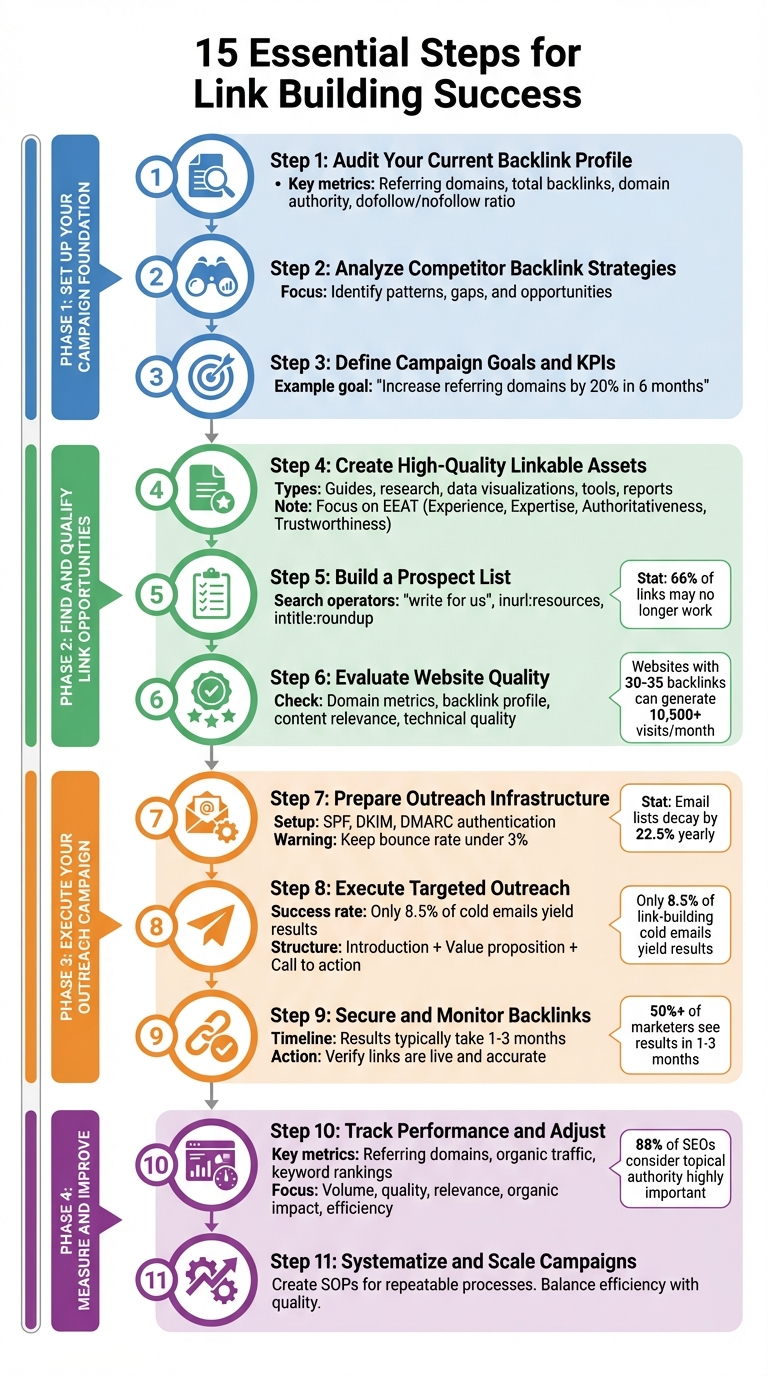
15-Step Link Building Campaign Checklist: From Audit to Optimization
Steal Our Agency’s Link Building Strategy (Template Included)
Set Up Your Campaign Foundation
Before getting into link-building efforts, it’s crucial to evaluate your current backlink profile and set attainable objectives. These foundational steps will help structure your campaign and ensure you’re building on a rock-solid foundation.
Start with a backlink audit to assess the external links pointing to your site. This process highlights your strengths, identifies harmful links, and uncovers opportunities for improvement. Conducting this audit before launching your campaign helps you clean up problematic links that could harm your rankings, leaving you with a strong base for acquiring high-quality links. Experts suggest running a backlink audit monthly or every two months to keep your profile in good shape.
Next, focus on competitor backlink analysis. By studying your competitors’ backlinks, you can uncover their strategies, identify sites that enhance their authority, and spot trends in how they acquire links. This analysis not only reveals potential link opportunities but also provides insights into what’s working in your industry.
Lastly, define your campaign goals and KPIs. These metrics should go beyond vanity numbers to measure the real impact of your efforts. KPIs help track success and guide adjustments, ensuring your strategy supports broader business goals like increasing revenue, expanding market share, or boosting brand visibility. Start by auditing your current backlink profile to establish a baseline for monitoring progress.
Step 1: Audit Your Current Backlink Profile
The first step in your campaign is to take a close look at your existing backlinks. Your backlink profile is a key indicator of your site’s authority and trustworthiness. An audit helps you identify which links are helping your rankings and which ones might be dragging you down.
Export your backlink data and analyze it for quality, anchor text usage, and diversity of referring domains. Pay special attention to low-quality links from spammy sites, as these can negatively impact your rankings.
Document baseline metrics to track throughout your campaign. This includes your current number of referring domains, total backlinks, domain authority score, and the ratio of dofollow to nofollow links.
If relevant, note your monthly organic traffic value in U.S. dollars.
Look for gaps and opportunities in your profile. Are you missing links from authoritative industry sites? Do your competitors have backlinks from resource pages or other valuable sources that you haven’t targeted yet?
These insights can shape your outreach strategy moving forward.
Step 2: Analyze Competitor Backlink Strategies
Your competitors’ backlink profiles can offer a wealth of information about what works in your niche. Start by identifying competitors who rank for your target keywords and have a comparable or higher domain authority.
Study their backlink profiles to uncover patterns. Do they rely on guest posts, resource pages, or digital PR campaigns? Take note of the types of sites linking to them most frequently.
Also, look for gaps in their strategies. There may be high-authority sites or resource pages they haven’t tapped into yet. These overlooked opportunities could give you a competitive advantage.
Step 3: Define Campaign Goals and KPIs
Setting clear goals is essential for a focused and effective link-building campaign. Your KPIs should reflect measurable outcomes that tie directly to your business objectives.
Set SMART goals: specific, measurable, achievable, relevant, and time-bound. Instead of a vague goal like “get more backlinks,” aim for something concrete, such as increasing referring domains by 20% within six months.
Choose KPIs that align with your goals. For instance, track the number of new referring domains and monitor organic traffic growth over time. If revenue is a priority, measure the financial impact of organic traffic to assess ROI and refine your approach accordingly.
Find and Qualify Link Opportunities
With your groundwork in place, the next step is identifying where your links will come from and ensuring those opportunities are worth pursuing. This stage is crucial for creating focused campaigns that avoid wasting time on low-value prospects.
The golden rule here? Quality beats quantity every time. Links from reputable, relevant sources can greatly improve your website’s authority and credibility with search engines.
In fact, industry data shows that 88% of SEOs consider topical authority highly important, and websites with 30–35 backlinks can generate over 10,500 visits per month.
This highlights how selective link-building can yield better results than chasing after hundreds of mediocre links.
To get started, focus on creating content that naturally attracts links. Then, build a targeted list of prospects and evaluate each opportunity against clear quality standards. This structured approach ensures your outreach efforts deliver maximum impact.
Step 4: Create High-Quality Linkable Assets
Before reaching out for links, you need something worth linking to. These linkable assets are content pieces that provide real value, encouraging other sites to link back to you.
Some of the best-performing linkable assets include comprehensive guides, original research, data visualizations, interactive tools, and reports.
These types of content resonate particularly well with U.S. audiences, who value actionable insights supported by data. For instance, if you’re in the marketing industry, publishing an annual report with key statistics on trends gives journalists and bloggers something concrete to reference in their own articles.
Google uses EEAT – Experience, Expertise, Authoritativeness, and Trustworthiness to assess content quality. Your linkable assets should reflect these qualities.
Include author credentials, cite trustworthy sources, and present your information in a polished, professional format that showcases your expertise.
Think about the questions your target audience asks most often. A well-researched answer to a common problem in your industry is far more likely to attract links than generic content. The goal is to create resources that other websites feel compelled to reference because they add genuine value to their readers.
Step 5: Build a Prospect List and Segment Opportunities
Once your content is ready, it’s time to build a prospect list using competitor research and advanced search techniques. Start by analyzing your competitors’ backlinks to identify domains that have already shown interest in your niche.
Next, use advanced search operators to uncover additional opportunities. For example:
- Search for
[your keyword] + "write for us"to find guest posting options. - Use
inurl:resources [your industry]to locate resource pages. - Try
intitle:roundup [your topic]to discover link roundup posts where editors highlight relevant content.
Organize your prospects by tactic type and priority level. Group them into categories like guest posts, resource page additions, broken link replacements, or digital PR targets.
Assign priority ratings based on factors like domain authority, relevance, and likelihood of success. For example, high-priority targets might include sites with strong metrics that have recently linked to competitors, while lower-priority ones could be newer sites with less established authority.
Keep everything organized in a spreadsheet. Include details like URLs, contact information, domain metrics, content type, outreach status, and notes.
Don’t overlook broken links; over 66% of links may no longer work, making this a valuable area to explore. With a well-segmented list, you’re ready to evaluate each opportunity’s potential.
Step 6: Evaluate Website Quality and Relevance
Now, it’s time to assess the quality of each site on your list. Thorough vetting helps you avoid wasting effort on low-quality links and protects your backlink profile.
Start with domain metrics. Use tools that provide data on Domain Authority (DA), Domain Rating (DR), or Authority Score (AS). Instead of relying on a single metric, consider them collectively for a fuller picture. Also, check the website’s age and organic traffic trends to ensure it’s an established, active site.
Next, review the site’s backlink profile. Look for diversity in referring domains, natural link growth patterns, and a low percentage of spammy links. A clean, credible backlink profile is a strong indicator of authority. Sites with steady organic traffic and engaged audiences are also more likely to drive qualified referral clicks.
Evaluate content relevance and editorial quality. The site should cover topics closely related to your industry and demonstrate expertise through well-researched articles. Look for proper source citations, clear distinctions between facts and opinions, and transparency about sponsored content. Check author bios and credentials to gauge the credibility of the content creators.
Finally, assess technical quality and user experience. Look for SSL certification, fast loading times, mobile responsiveness, and a professional design. Poor technical standards often go hand-in-hand with lower editorial quality.
Advanced filtering tools can simplify this process, allowing you to sort prospects by niche, region, and SEO metrics. This helps you quickly identify the best opportunities without manually reviewing each domain.
Focus on domains that align with your audience and industry. Links from these sites are more likely to add contextual value and drive traffic that converts. Also, remember that links placed within the main content body carry more weight with search engines than those buried in footers or sidebars.
sbb-itb-566d57e
Execute Your Outreach Campaign
With your prospect list ready to go, it’s time to launch your outreach campaign. This involves setting up a strong base, writing relevant messages, and keeping track of every backlink you secure.
Here’s the hard truth: only 8.5% of link-building cold emails yield results.
Ahmad Benny, CEO of Growth Partners Media, doesn’t sugarcoat it:
Email outreach has completely changed in the past few years. If you’re still blasting messages from a generic Gmail account, you’re in big trouble
Modern email systems weigh factors like sender reputation and domain authenticity to decide whether your emails land in inboxes or get dumped into spam. Success comes down to three key steps: preparation, execution, and monitoring.
Step 7: Prepare Outreach Infrastructure
Your email setup plays a huge role in whether your messages even get seen. Without the proper groundwork, even the most compelling pitch can end up in spam.
Start with email authentication. Implement SPF (Sender Policy Framework) to verify your emails are legitimate, set up DKIM (DomainKeys Identified Mail) to ensure your messages remain intact during delivery, and configure DMARC (Domain-based Message Authentication, Reporting, and Conformance) to protect your domain from being spoofed.
Next, warm up your email accounts. Gradually increase your sending volume to build a positive sender reputation. Automated tools can simplify this process.
Managing email bounces is just as important. Email lists can decay by up to 22.5% every year. If your bounce rate exceeds 3%, email providers may flag you as a spammer. Keep your list clean by removing invalid or deactivated addresses before hitting send.
To scale safely, consider using multiple inboxes and domain variations. For instance, you might use “info@yourwebsite.co” for one campaign and “outreach@links.yourwebsite.com” for another.
Also, create standardized templates that allow for personalization. Keep your messages short, highlight the value you’re offering, and include placeholders for specific details about the recipient. Before sending, use spam-checking tools to ensure your language won’t trigger filters, and double-check compliance with CAN-SPAM regulations.
Once your infrastructure is ready, shift gears to writing personalized, engaging pitches.
Step 8: Execute Targeted Outreach
With your setup complete, it’s time to focus on writing outreach emails that actually get responses. The focus should be on authenticity; building genuine connections instead of mass-blasting generic messages.
Structure your emails with 3 key elements: a clear introduction, a compelling value proposition, and a straightforward call to action.
In the introduction, mention why you’re reaching out, referencing something specific like a recent article or project that caught your attention.
The value proposition should briefly explain your content and highlight the benefits you’re offering. Finally, the call to action should be low-pressure, such as inviting the recipient to review your resource for inclusion on their site.
If you don’t get a response, follow up once or twice. Experiment with different subject lines and messaging styles to see what resonates.
Run your campaigns in phases instead of sending everything at once. Start with smaller batches, analyze open and response rates, and tweak your approach based on what’s working. Use A/B testing to refine subject lines, messaging angles, and timing. If your response rates are low, consider offering something useful upfront, like a resource or tip, before asking for a link.
Backlinku can simplify outreach management and tracking. Keep detailed records in spreadsheets or CRM systems like HubSpot to track who you’ve contacted, responses, and next steps. Project management tools like Trello, Notion, or ClickUp can help organize tasks, contacts, and deadlines across multiple campaigns.
After sending your emails, ensure every secured link is live and accurate.
Step 9: Secure and Monitor Backlinks
When a prospect agrees to link to your content, confirm that the link is live and correct. Double-check that it points to the right URL and uses the agreed-upon anchor text. Regularly monitor your backlink profile using Google Search Console or third-party SEO platforms to ensure links remain active and continue driving traffic.
Backlinku offers real-time link monitoring, notifying you when links go live or disappear, saving you from constant manual checks. Track overall SEO performance metrics like organic traffic, domain authority, and keyword rankings to measure the broader impact of your efforts. Keep in mind that over 50% of marketers report it takes one to three months to see results from link-building campaigns.
Document every secured backlink, including details like the date it was obtained, the anchor text used, and any ongoing relationships with site owners. This will be invaluable for future reporting and potential collaborations.
Measure and Improve Campaign Performance
Getting your links live is just the beginning. The real challenge lies in measuring how well your campaign performs and fine-tuning your approach.
By focusing on the right data and building reliable systems, you can ensure your efforts lead to long-term success. Let’s break this down into 2 key steps.
Step 10: Track Performance and Adjust Strategies
Start by monitoring referring domains (RDs), which represent the unique websites linking back to you. This metric carries more weight than the sheer number of backlinks because search engines prioritize link diversity over volume.
While tracking total backlinks can give you an idea of scale, it’s crucial to combine this with quality indicators like Domain Authority to assess whether your new links are actually enhancing your site’s credibility.
When reviewing your link acquisition efforts, pay attention to these factors:
- Volume: How many links are you gaining?
- Quality: Are these links from authoritative and trustworthy sites?
- Relevance: Do the links align with your industry or niche?
- Organic Impact: Are your rankings and organic traffic improving?
- Efficiency: How much effort does it take to secure these links?
If your organic traffic or keyword rankings hit a plateau, take it as a sign to dig deeper. Are you targeting the right websites? Does your content resonate with your audience? Are your outreach messages effective?
Use both traditional metrics and AI visibility tools to get a full picture. Based on your findings, adjust your strategies. This could mean refining your content, shifting your focus to different prospects, or tweaking your outreach messaging.
Step 11: Systematize and Scale Campaigns
Scaling isn’t just about doing more; it’s about doing better with a repeatable process. Once you’ve analyzed your performance data and made necessary adjustments (as outlined in Step 10), it’s time to create systems that make scaling easier. Developing standard operating procedures (SOPs) for tasks like prospecting, outreach, follow-ups, and monitoring ensures your team can replicate successful campaigns efficiently.
Prioritize building genuine relationships and maintaining consistent efforts to gain trust and sustain your SEO progress. Backlinku’s project management and reporting features can help you stay organized.
Use them to segment campaigns, bookmark strong prospects for future outreach, and blacklist sites that don’t meet your standards. Real time reporting tools can help you identify what’s working so you can focus your energy on strategies that deliver results.
To scale effectively, you’ll need the right tools, a skilled team of link builders (whether in-house or outsourced), and a strong network of partners. Strive to maintain a balance between efficiency and quality to ensure your campaigns continue to deliver.
Conclusion
Running a successful link-building campaign isn’t about luck, it’s about following a clear and consistent plan. The 15 steps in this checklist offer a clear path, from reviewing your current backlink profile and studying competitors to executing targeted outreach and refining your approach over time.
Preparation sets the stage. Start by setting SMART goals, identifying strong linkable assets, and pinpointing your link gap. These steps help you focus on strategies that deliver meaningful results.
But remember, link building is not a one time thing, it’s an ongoing process. Building high-quality, relevant backlinks creates the foundation for lasting SEO growth.
Once the groundwork is laid, the real work begins, with continuous refinement. Keep a close eye on your backlink profile, monitor key metrics, and tweak your strategy to maintain link quality. Deal with spammy or broken links promptly, and turn unlinked brand mentions into valuable backlinks.
This ongoing cycle of monitoring and adjusting helps you stay ahead of potential penalties and ensures your efforts yield the best return. By combining thorough preparation, smart execution, and continuous optimization, your link-building campaign can consistently drive SEO success.
FAQs
What are the best types of content to create for earning high-quality backlinks?
When it comes to earning backlinks, some content types consistently perform well. Original research, in-depth guides, and visual assets like infographics stand out because they offer unique information and are easy to share.
Other effective options include tools and calculators, templates, case studies, and interactive content such as quizzes or surveys. The key is to create content that addresses specific problems, piques curiosity, or provides practical takeaways, this is what naturally encourages others to link to it.
What can I do to make sure my outreach emails don’t get flagged as spam?
To make sure your outreach emails land in inboxes and not spam folders, focus on personalization. Start by addressing recipients by their name and mentioning something specific about their work or content; it shows you’ve done your homework. Choose subject lines that are clear and directly tied to the email’s purpose, steering clear of spammy elements like excessive punctuation or ALL-CAPS.
Keep your email frequency manageable, and always include an unsubscribe option to stay compliant with email regulations. These simple steps not only help your emails avoid spam filters but also increase your chances of getting a positive reply.
What are the key metrics to track for evaluating a link-building campaign’s success?
To gauge how well your link-building campaign is performing, it’s essential to track key performance metrics that shed light on both the quality and the effectiveness of your efforts. Some critical areas to monitor include:
- Domain Authority and Page Authority: Assess the strength and credibility of the domains and pages linking back to your site. Higher authority often correlates with better results.
- Anchor Text Diversity: Keep an eye on the variety of anchor texts used in your backlinks. A natural mix helps avoid penalties for over-optimization.
- Relevancy: Ensure that the backlinks originate from websites that are closely related to your niche or industry. Relevant links carry more weight in search rankings.
- Referral Traffic: Measure how many visitors are being directed to your site through the acquired links. This indicates the practical impact of your campaign.
- Total Backlinks and Referring Domains: Track both the total number of backlinks and the unique domains linking to your site. A diverse range of referring domains is often a positive signal.
- Trust Flow: Evaluate the trustworthiness of the sites linking to yours. Links from reputable sources can significantly boost your SEO.
Regularly reviewing these metrics allows you to see what’s effective, make necessary adjustments, and fine-tune your strategy to achieve better SEO outcomes.