

Link building takes time, but a clear timeline can make the process more efficient and goal-driven. Without proper planning, you risk poor results or penalties from search engines.
Here’s what you need to know:
- Timeframes Matter: Results typically take 3–6 months to show, with full impact visible after 6–12 months. For new websites, expect delays due to Google’s "Sandbox" period.
- Phased Approach:
- Month 1: Plan goals, audit backlinks, analyze competitors.
- Month 2: Build a prospect list and identify link opportunities.
- Months 3–4: Focus on content creation and outreach for backlinks.
- Months 5–6: Track performance, scale successful strategies, and refine efforts.
- Consistency Is Key: Regular link-building efforts (e.g., 1–2 high-quality links per week) promote steady growth and avoid penalties.
- Focus on Quality: Prioritize links from relevant, authoritative sites over sheer volume.
A structured, long-term strategy ensures steady progress and avoids the pitfalls of shortcuts.
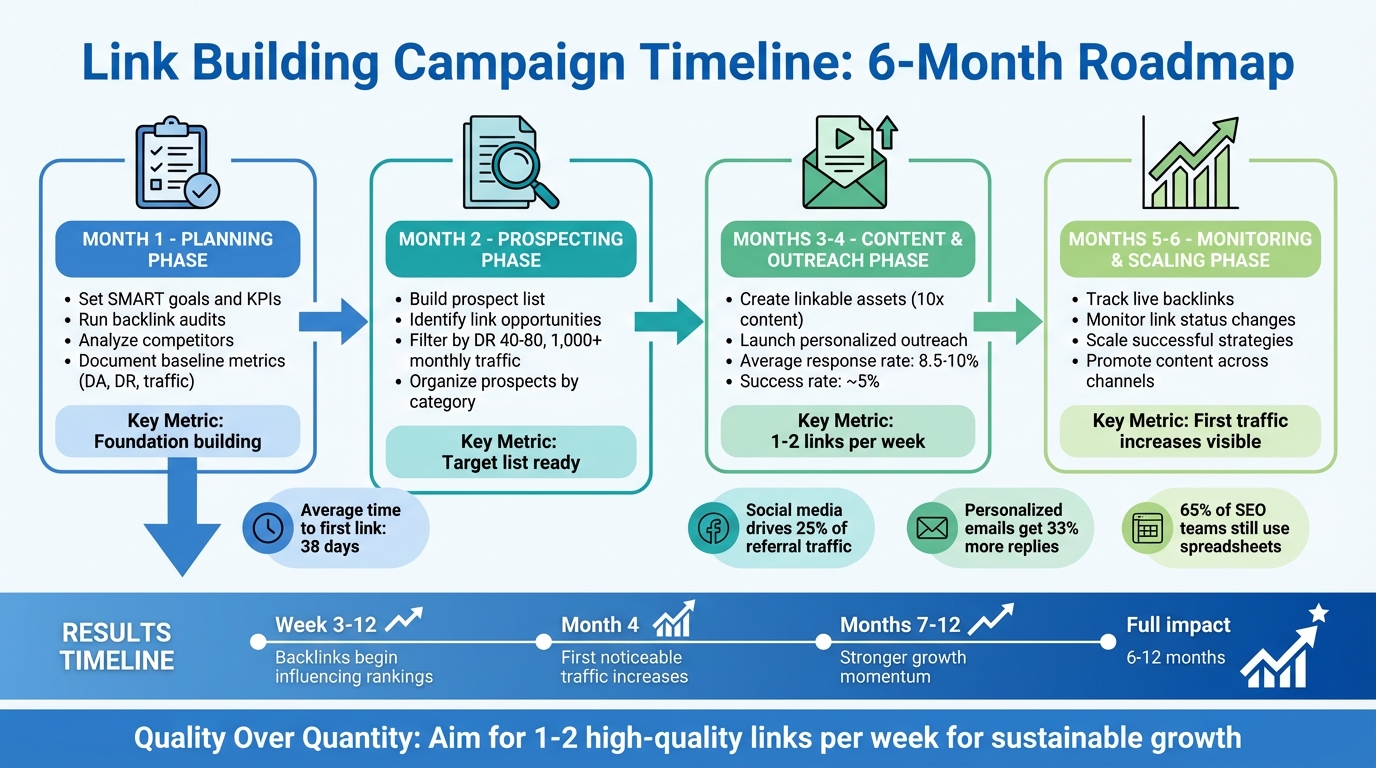
6-Month Link Building Campaign Timeline and Milestones
Link Building For A New Website: How To Rank Your Site In Less Than A Month
Planning Phase: Setting Up Your Campaign (Month 1)
The first month involves laying the groundwork for your link-building campaign. A well-thought-out plan ensures you’re not just spinning your wheels but moving strategically toward measurable outcomes. This phase focuses on gathering data and making informed decisions before reaching out to potential link partners.
Setting Campaign Goals and KPIs
Your campaign goals should align directly with your business objectives. Using the SMART framework (Specific, Measurable, Achievable, Relevant, and Time-bound) can help ensure your goals are actionable.
As Moz puts it:
"The goals need to tie into real organizational goals and ultimately have a positive impact on the bottom line of your business. For example, ‘build 10 links’ is not a good goal to hit if building 10 links doesn’t have any impact on the overall success of the business."
Start by documenting your current metrics, such as keyword rankings, Domain Authority, and organic traffic. This gives you a baseline to measure progress.
James Wirth from Citation Labs emphasizes:
"Comparing link metrics against top competitors helps us size up the competition. Layered against estimated traffic, Page Authority, and SEO ‘difficulty,’ we’re able to better understand the opportunity."
It’s also critical to set expectations early. Many campaigns fail because tasks are done out of order, and stakeholders often underestimate the time required for meaningful results.
Keep in mind that most campaigns take 2 to 4 months to show real impact.
| KPI Category | What to Track | Why It Matters |
|---|---|---|
| Authority | Domain Authority (DA), Domain Rating (DR) | Measures overall site strength and competitiveness |
| Visibility | Keyword rankings, organic traffic growth | Tracks how links improve search performance |
| Quality | Unique referring domains, link relevance | Ensures a natural, diverse backlink profile |
| Business Impact | Referral traffic, assisted conversions, revenue | Ties SEO efforts to business outcomes |
Running Backlink Audits and Competitor Analysis
Before diving into outreach, assess where you currently stand. A thorough backlink audit will help you identify harmful or spammy links that could be dragging your site down. Use Google Search Console to check for penalties under the "Security & Manual Actions" report.
Next, take a close look at your competitors, especially those with similar domain authority. A link gap analysis can uncover websites that link to your competitors but not to you.
These sites are prime targets since they already have an interest in your industry.
For instance, Taylor Scher, an SEO consultant, conducted a backlink audit after a site migration caused a 50% drop in backlinks. By implementing proper redirects, the site’s traffic grew from 3,000 to 6,000 monthly visitors in just three months.
Analyzing competitor content can also reveal which formats attract the most links. Whether it’s original research, statistics roundups, or detailed guides, identifying what works can guide your own content strategy.
For example, Backlinko found that their statistics roundup pages were among their most linked-to content. Acting on this insight, they created and updated over 50 statistics pages, significantly increasing valuable backlinks.
Evelina Milenova, SEO and Growth Manager at Opinion Stage, explains:
"Running such audits allows me to build a list of websites where we can also aim to get a link. You don’t want to copy a competitor’s backlink profile. But you can create a diversified list of websites by comparing multiple brands."
Building Your Link-Building Strategy
With your goals and competitive analysis in place, it’s time to map out your approach. Start by identifying your linkable assets, the unique aspects of your business that can attract links, like proprietary data, expert opinions, or industry research.
Plan for a mix of link types, including both homepage links and "deep" links to specific product or category pages.
Pay attention to anchor text distribution, healthy profiles often include a mix of branded terms and keyword-rich variations. For example, one audit showed that 17.4% of backlinks used branded anchor text like "Backlinko".
Choose tactics that align with your goals and resources, whether that’s guest posting, broken link building, digital PR, or niche edits.
Document your processes in Standard Operating Procedures (SOPs) to ensure consistency and scalability.
Most importantly, prioritize relevance over sheer volume. Links from authoritative, niche-specific sites will always have more impact than a large number of low-quality links.
Ashot Nanayan, CEO of Digital World Institute, advises:
"Link building is slow, and the benefits often come later. Be patient, but stay focused."
Tools like Backlinku can simplify prospecting, manage campaigns, and track performance, keeping your efforts aligned with your strategy.
With your plan in place, you’re ready to move into the prospecting phase and start securing high-quality links.
Prospecting Phase: Finding Link Opportunities (Month 2)
In Month 2, it’s time to build your prospect list. This step combines manual research, competitor analysis, and strategic filtering to identify sites that are both relevant to your content and likely to link back to it.
Finding Quality Link Opportunities
Think beyond your immediate industry.
As Aoife O’Connor from Aira puts it:
"Understanding your client is the first piece of the puzzle in finding your target audience for any link-building campaign."
For example, if you run a bakery, don’t limit yourself to food blogs. Look into related niches like parenting blogs, recipe websites, or party planning sites.
Broadening your focus can uncover a wealth of potential link opportunities.
Competitor backlink analysis is another powerful tactic. Using link intersect tools, you can identify domains that link to multiple competitors but not to your site. These sites are already interested in your niche, making them ideal targets.
Chima Mmeje, Senior Content Marketing Manager at Moz, emphasizes:
"Topical links are the key to success – suspecting links that are more topically aligned are given higher priority when assessing their value."
To dig deeper, use advanced search operators like inurl:resources or intitle:resources "cupcakes" to locate resource pages, or search for terms like "guest article" + inanchor:contact to find sites accepting guest contributions.
For a more streamlined approach, use Backlinku. With access to a curated marketplace of over 50,000 websites across 50 countries and 20 languages, you can filter prospects by niche, Domain Rating (DR), organic traffic, and location, saving time on manual vetting. Plus, its AI-powered matching flags opportunities as "New", "Recommended", or "Top Trust Flow".
When evaluating prospects, don’t rely solely on automated metrics. Ahrefs suggests targeting sites with a DR between 40–80, at least 1,000 monthly organic visitors, and a traffic value of $1,000 or more.
However, a manual review is just as important; watch out for issues like poor design, excessive ads, generic author names (e.g., "Editorial Team"), or the absence of an "About" page.
| Metric | Recommended Benchmark | Purpose |
|---|---|---|
| Domain Rating | 40–80 | Measures backlink profile strength |
| Organic Traffic | 1,000+ per month | Indicates site quality and visitor interest |
| Traffic Value | $1,000+ | Reflects commercial potential of traffic |
| Relevance | Topical or Geographic | Ensures alignment with business goals |
Once you’ve identified promising opportunities, organize them for efficient outreach.
Structuring Your Prospect List
A disorganized list can derail even the best campaigns.
John Michael, Senior Manager of Search & Analytics at Beacon Digital Marketing, highlights the importance of staying organized:
"Organization is critical for maximizing your link building efforts and the return on the time you’re spending. By knowing exactly which stage of your link building process is your lowest performing, you can dramatically increase your overall efficiency."
While many SEO teams still rely on spreadsheets (65%, according to recent stats), these tools fall short when it comes to tracking live link removals or real-time updates. Instead, consider using a centralized dashboard that categorizes prospects into clear stages like "Need to Reach Out", "Email Sent", "Received Response", "Topic Approved", and "Link Acquired."
Group your prospects by site type, blogs, news outlets, review platforms, wikis, or forums. Tailor your outreach to each category and prioritize based on metrics like Domain Authority (DA), Authority Score (AS), or Trust Flow (TF). This ensures your efforts focus on high-impact opportunities.
To refine your list further, use features like blacklists to exclude low-quality or irrelevant domains permanently and bookmarks to save high-priority targets for quick access. For regional campaigns, filter by Top-Level Domain (TLD), such as .uk or .ca, or focus on high-authority extensions like .edu and .gov.
Finally, evaluate each site’s "likelihood of linking" on a scale from 1 to 5. Base this score on how closely their niche aligns with your content and whether they’ve linked to similar material in the past. This scoring system helps you focus your outreach where it’s most likely to pay off.
With a well-organized, high-quality prospect list ready, you’re set to move into the content and outreach phase.
Content and Outreach Phase: Getting Backlinks (Months 3-4)
Now that your prospect list is ready, the focus for Months 3 and 4 shifts to creating content that attracts links and executing outreach campaigns. This phase builds on the groundwork you laid earlier, turning preparation into action.
Creating Content That Earns Links
To earn backlinks, your content needs to stand out. As outlined in Month 1, the goal is to create linkable assets, content so valuable and engaging that other sites want to reference it.
The gold standard here is "10x content", which means producing resources that are ten times better than anything else available on the topic.
Use the "Linkability Framework" to assess your content ideas. This framework evaluates content based on six factors: uniqueness, utility, scope, format, audience, and timing. For instance, instead of writing yet another "how-to" guide, consider creating something that delivers exclusive value, like an industry report with original data, a visually rich guide with custom infographics, or an interactive tool that solves a specific problem.
The key is to create content that other publishers find irresistible. Think about original research, detailed case studies with measurable outcomes, or data visualizations that simplify complex topics.
Comprehensive resource lists can also be highly effective. Always ask yourself: Why would someone link to this instead of any other resource out there?
Once your content is ready, the next step is to turn your prospects into backlinks through targeted outreach.
Running Personalized Outreach Campaigns
With your content live, it’s time to pitch it to the prospects on your list.
Outreach can be challenging; only 8.5% of outreach emails get a response, and for link-building pitches, the average reply rate is about 10%, with a success rate of roughly 5%. However, personalized emails perform much better, receiving about 33% more replies than generic ones.
Shannon McGuirk from Aira explains:
"Everything you’ve been working towards as part of your link building campaign has built up to the outreach; it’s the most nerve-wracking step in the process for a lot of us. But it doesn’t need to be".
The trick is to approach recipients as individuals, not just names on a list. Avoid generic greetings like "Dear Webmaster" or robotic-sounding language. Instead, reference something specific, such as a recent article they wrote or a social media post they shared, to show that your email is tailored to them.
Start your email with a strong hook and quickly explain the value you’re offering. Highlight what’s in it for them, whether that’s filling a gap in their content, providing exclusive data, or offering indirect benefits like audience engagement. Keep subject lines short and engaging; mentioning the recipient’s name or organization can raise open rates to 60%-80%. Avoid spammy terms like "link request" or "link exchange".
When it comes to follow-ups, space them out by 3–7 days and limit yourself to one or two. This approach keeps your outreach respectful and aligns with the gradual growth strategy outlined in your campaign plan. Backlinku can help manage outreach at scale while retaining a personal touch.
For better results, consider "social warming" before cold emailing. Engage with your prospects on platforms like LinkedIn or Twitter by commenting on their posts or sharing their work to make your name familiar.
As Gisele Navarro, CEO of NeoMam Studios, puts it:
"You’ve got nothing to lose so try something new".
Experiment with different strategies, track your results, and refine your approach as you learn what works best.
sbb-itb-566d57e
Promotion and Monitoring Phase: Tracking and Scaling (Months 5-6)
By the time you reach Months 5 and 6, your outreach work should be paying off with live backlinks. This phase focuses on scaling what’s working and addressing any issues that arise.
It’s all about promoting your content and keeping a close eye on its performance.
Promoting Content and Building Relationships
Getting a link published is just the beginning.
To maximize its impact, you need to amplify your content across multiple channels. Share it on social media, participate in niche communities like Quora or Reddit, and provide media-ready assets, such as videos with embed codes, to strengthen your relationships with publishers.
Did you know that social media drives about 25% of all website referral traffic worldwide? Use tools like Twitter bio search to find journalists and bloggers based on keywords or location.
By engaging with them beforehand, you can build familiarity, making them more receptive to your pitches.
As Ann Smarty, Co-founder of Smarty Marketing, points out:
"Link building cannot be scaled… Link building is not easy or fast".
To keep your audience engaged, focus on creating “always on” content, material that resonates with them and feels timely.
Think about repurposing your top-performing content into formats like infographics, downloadable whitepapers, or industry surveys. These assets give media contacts even more reasons to link back to your site.
Tracking Campaign Performance
Once your content is out there and relationships are in place, it’s crucial to track how your campaign is performing.
Surprisingly, about 65% of SEO teams still rely on spreadsheets to manage backlinks. While spreadsheets are useful, they won’t notify you if a live link is removed, switched to “nofollow,” or altered.
Backlinku can help by providing real-time monitoring and instant alerts for critical changes, ensuring you protect the ROI of your efforts.
Keep an eye on your conversion rates at every stage: Email Sent, Response Received, Topic Approved, and Link Acquired.
This data helps you estimate the number of prospects needed to hit your monthly link targets. If your contact-to-response rate is low, try experimenting with new email subject lines. If your response-to-link rate is underwhelming, tweak your content pitch or focus on better-aligned prospects.
John Michael, Senior Manager of Search & Analytics at Beacon Digital Marketing, emphasizes:
"Organization is critical for maximizing your link building efforts and the return on the time you’re spending".
Compare your current results to the KPIs you set back in Month 1, such as Domain Authority (DA), Domain Rating (DR), and organic traffic growth.
While it often takes 3 to 6 months to see noticeable improvements in rankings and traffic, some campaigns deliver results faster within 2 to 4 months, depending on the level of competition.
For instance, REPRESENT CLO saw a 407% jump in organic traffic over 20 months, going from 70,000 to 355,000 visitors.
They achieved this by earning guest posts on sites with a DR between 20 and 70, which helped grow their ranking keywords from 3,500 to 24,100.
Setting Milestones and Expectations
Timeline for Links, Traffic, and Rankings
Understanding when to see results is essential.
Building on earlier campaign phases, setting milestones for links, rankings, and traffic keeps everything aligned with your SEO goals.
The process begins with link acquisition. On average, a digital PR campaign takes about 38 days to land its first link.
Campaigns that eventually secure over 500 links often get their first link within 9 days, while smaller campaigns (fewer than 20 links) may take closer to 53 days.
Backlinks can influence rankings within 3 weeks to 3 months. For websites that are more established (3+ years old), this impact may be noticeable in as little as 3 to 6 weeks. However, newer sites might have to wait 2 to 3 months.
This isn’t because SEO agencies are slow; it’s because search engines take their time to establish trust, even with well-known brands.
Traffic increases tend to show up starting in Month 4, with more momentum building between Months 7 and 12. Before traffic spikes, you’ll often notice rising impressions and new keywords appearing in lower search positions; these are signs your campaign is moving in the right direction.
For brand-new domains, the focus during the first 1–2 months should be on local directories and building social profiles to establish trust. New sites often go through a "Sandbox" period where Google evaluates their credibility. Once trust is built (typically by Month 3), aim for 1 to 2 high-quality links per week.
These timelines illustrate the difference between short-term and long-term campaigns.
3-Month vs. 6-Month Campaign Comparison
| Feature | 3-Month Campaign | 6-Month Campaign |
|---|---|---|
| Primary Focus | Technical cleanup, audits, and strategy development | Active outreach, guest posting, and content promotion |
| Link Deliverables | 1–2 links per week; trust-building phase | Scaled volume; higher authority editorial links |
| Ranking Progress | Keywords entering positions 30–90; rising impressions | Keywords entering the top 20; stable indexing |
| Traffic Impact | Minimal changes; Google still crawling and indexing | First noticeable jumps in organic clicks and lead flow |
| Expected Outcome | Foundation for SEO; site ready for growth | Measurable authority gains; potential for viral link acquisition |
Ron De Vera, SEO Content Writer at WolfPack Advising, shares:
"Most businesses in 2026 can expect their SEO timeline to show early progress between Months 4 and 6, then stronger growth between Months 7 and 12".
This comparison shows how adjusting strategies over time can lead to steady progress, aligning with the KPIs set during the Planning Phase.
Conclusion
Link building isn’t something you can rush; it’s a steady, long-term process that demands careful planning and consistent effort.
Timothy Carter, Chief Revenue Officer at SEO.co, sums it up perfectly:
"SEO isn’t a race; it’s a long-term strategy that takes months, and sometimes years, to achieve peak ROI".
Trying to speed up the process or amassing links too quickly can backfire, especially for newer domains that haven’t yet earned Google’s trust. Instead, success comes from following a structured, phased approach.
A typical timeline might look like this: Month 1 focuses on planning and audits, Month 2 on prospecting, Months 3–4 on content creation and outreach, and Months 5–6 on monitoring and scaling. Results often start to appear within 2 to 4 months, and as your domain authority grows, your content will begin attracting links naturally. This step-by-step strategy not only keeps your efforts organized but also provides clear benchmarks for tracking progress.
Setting realistic milestones is key. For instance, tracking metrics like referring domains, keyword rankings, and content engagement can give you early signs of progress before you see big traffic increases. For newer domains, starting with 1 to 2 high-quality links per week and gradually scaling up as trust builds is a smart way to grow without risking penalties.
Modern link-building strategies are shifting away from one-off campaigns to a more integrated approach often called "Business as Usual" (BAU). Stopping campaigns can slow link acquisition, so it’s better to weave link building into ongoing PR, content marketing, and social media efforts. This ensures a steady stream of high-quality editorial links over time.
Set SMART goals that align with your business objectives, keep a close eye on your backlink profile, and execute consistently. With the right timeline and dedication, you’ll build the authority and trust needed to achieve long-term SEO success.
FAQs
How long does it usually take to see results from a link-building campaign?
The timeframe for seeing the impact of a link-building campaign usually falls between 3 to 12 months. This can vary based on factors like your website’s current authority, how competitive your niche is, and the quality of the backlinks you secure.
SEO growth takes patience and consistency because search engines need time to assess and incorporate your new links into their rankings. To get the best results, prioritize acquiring high-quality, relevant backlinks that fit seamlessly into your broader SEO strategy.
What are the main steps in a link-building campaign timeline?
A successful link-building campaign involves a few essential steps to achieve lasting results. Start by conducting an audit of your current backlinks and performing a competitor analysis. This helps you pinpoint gaps in your backlink profile and uncover opportunities to strengthen it.
Once you have a clear picture, set specific goals and craft a content strategy that focuses on producing link-worthy resources. These could be anything from in-depth guides to unique data studies, content that naturally attracts high-quality backlinks.
The next step is the outreach phase, where you actively reach out to relevant websites. This might include guest blogging, finding and fixing broken links, or leveraging digital PR to increase visibility. Keep in mind, earning backlinks is a process that requires consistent effort over several weeks.
Lastly, it’s crucial to monitor and tweak your campaign as you go. Regularly track your progress, measure the impact of your efforts, and refine your strategy to ensure your link-building aligns with your SEO goals and delivers steady, long-term benefits.
Why is it important to stay consistent with link-building efforts?
Consistency in link-building plays a key role in establishing and sustaining your website’s authority over time. When you regularly earn high-quality backlinks, it sends a clear message to search engines: your site is trustworthy and relevant. This can lead to better rankings and an increase in organic traffic.
Taking a steady approach also prevents unnatural surges or dips in your backlink profile, which could raise red flags with search engines. Gradual and consistent growth aligns with SEO best practices, ensuring a stable and long-term strategy for success.