

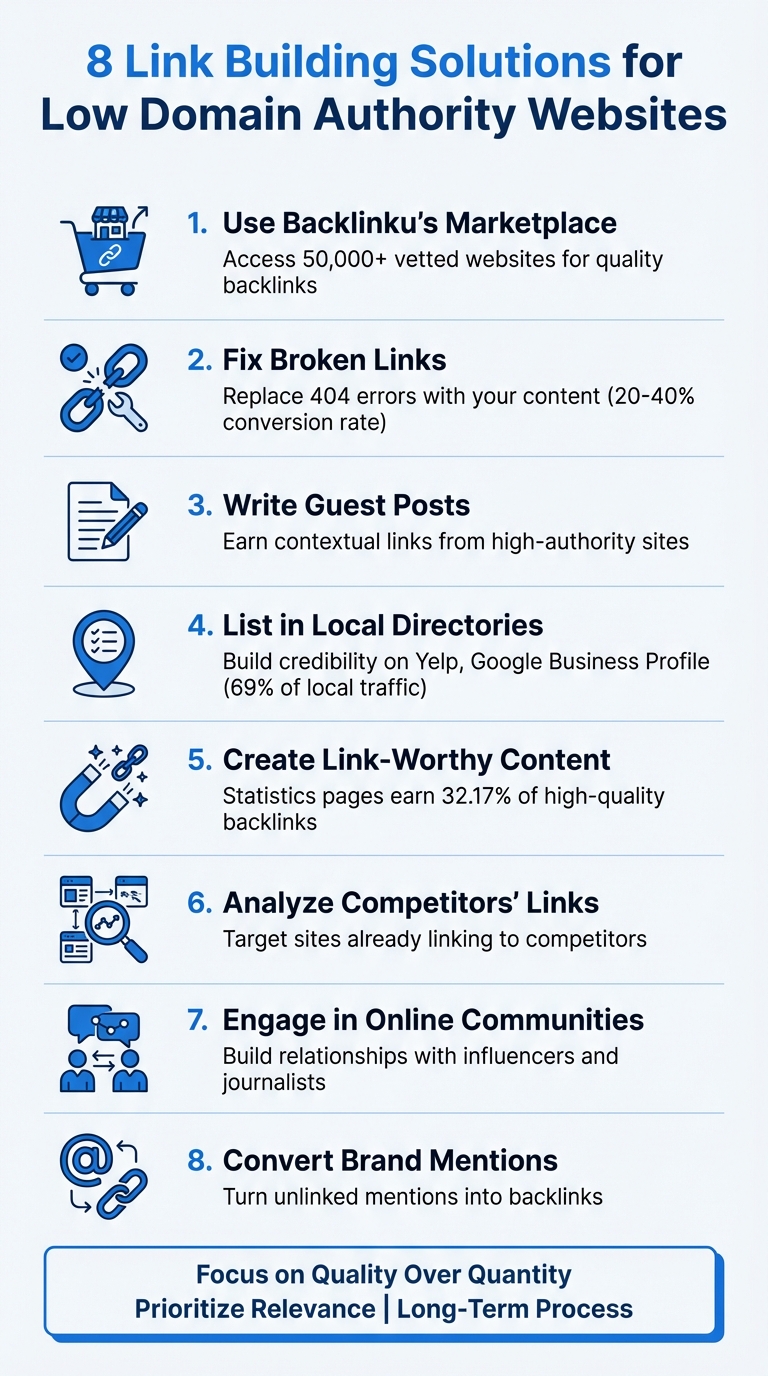
Struggling to build backlinks for a low-authority website? Here’s the good news: you don’t need to be a big player to improve your rankings. The right strategies can help you secure quality links, boost domain authority, and drive traffic. Below are eight practical solutions designed specifically for smaller sites:
- Use Backlinku’s Marketplace: Access over 50,000 vetted websites for high-quality backlinks.
- Fix Broken Links: Replace 404 errors on other sites with your content.
- Write Guest Posts: Publish on high-authority sites to earn contextual links.
- List in Local Directories: Build credibility through platforms like Yelp and Google Business Profile.
- Create Link-Worthy Content: Publish data-driven or resourceful content that attracts backlinks naturally.
- Analyze Competitors’ Links: Identify and target sites linking to your competitors.
- Engage in Online Communities: Build relationships with influencers and journalists for organic mentions.
- Turn Brand Mentions into Links: Convert unlinked mentions into backlinks with polite outreach.
Focus on quality over quantity, prioritize relevance, and remember that link building is a long-term process. Let’s dive into how each strategy works.
8 Link Building Strategies for Low Domain Authority Websites
1. Use Backlinku‘s Marketplace for Vetted Websites
Why It Works for Low-Authority Websites
When your website’s domain authority is low (typically in the DA 10–20 range), every backlink matters. But here’s the catch: quality beats quantity every time. One link from a trusted, relevant, and vetted website can do more for your rankings than dozens of low-quality directory links ever could. For websites still building their reputation and backlink profile, this kind of quality-focused approach is essential to start competing in the rankings.
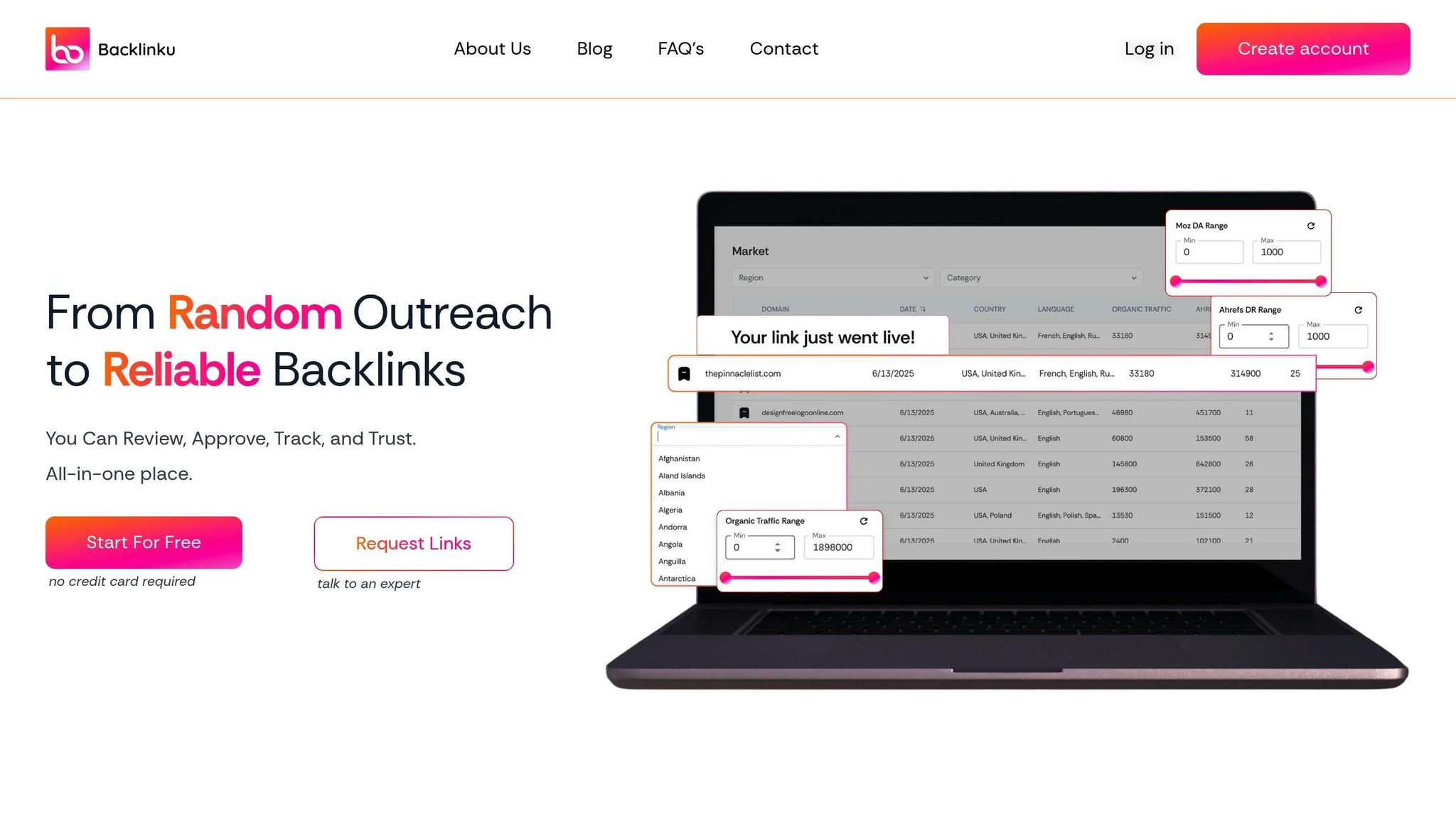
Backlinku’s Marketplace offers access to over 50,000 vetted websites. Each one is carefully reviewed for strong domain ratings and relevance to your niche. These links provide the "link juice" your site needs to build authority and set the stage for more advanced strategies down the road.
Simplifying the Process for Beginners
If you’re new to link building, tackling it on your own can feel overwhelming. That’s where Backlinku’s Marketplace steps in. Instead of spending hours hunting for potential link partners and second-guessing their legitimacy, you get direct access to trustworthy options.
The platform helps you focus your efforts where they matter most. By following the Pareto Principle, it prioritizes high-quality content and links, saving you from getting bogged down in endless technical audits. This means you can channel your energy into creating content that earns links, rather than wasting time on overly complex processes.
A Scalable Strategy for Small Teams
For small websites with limited resources, scalability is everything. Backlinku’s Marketplace allows you to manage outreach efficiently without stretching your team too thin. Unlike time-heavy tactics, such as one-on-one outreach, this approach is built for scale. It’s comparable to methods like broken link building or replicating competitor backlinks.
You can run multiple campaigns at once, monitor progress in real time, and keep everything organized with tools for projects, bookmarks, and blacklists. This level of efficiency is a game-changer for smaller teams that need to make every link-building effort count without hiring extra hands.
2. Find and Fix Broken Links
Why It Works for Low-Authority Websites
Broken link building is a powerful approach for websites with limited authority because it focuses on solving problems rather than relying on an established reputation. By notifying webmasters about 404 errors and offering a relevant replacement, you’re not just helping them improve their site – you’re also creating an opportunity to earn a backlink. It’s a win-win.
Here’s the kicker: while standard cold outreach often sees response rates below 1%, well-executed broken link campaigns can convert 20–40% of prospects. For example, in 2019, a client used this method to skyrocket their organic traffic from 5,000 to 156,000 visitors per month by simply recreating content that webmasters were already linking to.
"Broken link building can have a higher success rate than other link building tactics. Because you’re helping web admins solve an issue on their site. And providing a reason to link to you." – Rachel Handley, Senior Content Writer, Semrush
This strategy is not just effective – it’s also straightforward to put into action with the right tools.
How to Get Started
You don’t need a big budget to dive into broken link building. Free tools like the Check My Links Chrome extension can help you scan pages for broken links. For more in-depth crawling, Screaming Frog‘s free version allows you to check up to 500 URLs, making it perfect for finding niche resource pages. Once you’ve identified a broken link, use the Wayback Machine to see what the original content looked like, then create a better version.
To find resource pages with broken links, try using Google search operators like intitle:"resources" [your topic]. Another handy tool is WikiGrabber, which can pinpoint outdated Wikipedia citations. These citations often indicate that other sites might also be linking to outdated sources, giving you more opportunities to step in with updated content.
Scaling the Strategy
What makes this tactic even better is how easily it scales. Automated tools can uncover hundreds of broken link opportunities in no time. By analyzing competitor backlink profiles, you can zero in on dead pages that have the most inbound links, ensuring you focus your efforts where they’ll have the biggest impact.
With the right tools and a bit of effort, broken link building can transform your website’s backlink profile and traffic numbers. It’s all about turning problems into opportunities.
3. Write Guest Posts for Other Sites
Effectiveness for Low-Authority Websites
Guest posting is a smart way for smaller websites to tap into the credibility and trust of well-established sites. When you publish on a high-authority website, you earn a valuable backlink that not only helps with SEO but also boosts your reputation with both search engines and readers.
The trick? Aim for contextual links within the article itself instead of just relying on links in your author bio. Why? Contextual links pack more punch and are far more likely to get clicks. Neil Patel explains it well:
"Contextual links are way better than author bio links… readers are more likely to click a contextual link."
But guest posting isn’t just about backlinks. It’s also a chance to build real connections with editors and site owners. These relationships can lead to more collaborations and even natural link opportunities down the road. Plus, publishing on respected sites positions you as a credible voice in your field – something that’s becoming increasingly important as AI-driven search engines prioritize trustworthy sources. So, this strategy does more than just improve SEO; it sets you up for long-term success.
Ease of Implementation for Beginners
Guest posting works because it’s a win-win: you provide high-quality content for free, and in return, you get a backlink. To get started, use Google search queries like "[your niche] + 'write for us'" or "[your niche] + 'guest post'" to find sites open to guest contributors.
Skip the generic, mass emails – those rarely work. Instead, take the time to research your target site and craft a personalized pitch. Want to increase your chances? Engage with the site beforehand by leaving thoughtful comments or connecting with editors on social media. This small effort can double your response rate. A well-planned outreach campaign can yield an 8% conversion rate, meaning you could secure one backlink for every hour of focused work.
Scalability of the Solution
Once you’ve got the basics of guest posting down, scaling up becomes much easier. Tools can help you find relevant websites and collect contact details, saving time on repetitive tasks. However, don’t lose the personal touch – customizing your pitches is what makes this strategy work.
When scaling, aim for sites with a Domain Rating between 20 and 95. This range ensures your backlinks carry enough authority to make a difference. As Joshua Hardwick from Ahrefs puts it:
"We’re automating the boring stuff so we can spend more time on the things that matter, like personalizing emails and double-checking that our prospects are sound."
4. Get Listed in Local Directories
Why Local Directories Matter for New Websites
For websites just starting out, local directories can be a game-changer. They help establish credibility and provide a solid foundation for improving search rankings. Platforms like Yelp, Yellow Pages, and local Chambers of Commerce act as trusted sources for Google, linking your site to high-authority networks. Plus, when your business’s Name, Address, and Phone number (NAP) are consistently listed across these platforms, search engines see it as a sign of legitimacy [24, 27]. Given how often consumers rely on these directories, their importance can’t be overstated [26, 30].
A concept called "Barnacle SEO" highlights why this tactic works so well. By listing your business on directories that already rank highly for local keywords, you essentially "attach" your site to their established authority. Tilly Haines from Infinity Nation explains it best:
"As with all link building, relevancy is key. When looking for local directories to be listed on, you should ensure that you are listing your business under the right categories and that you are targeting directories that have listings for your area."
This makes directory listings a smart and reliable starting point for anyone new to SEO.
Easy for Beginners to Get Started
One of the best things about listing your business in local directories is how simple it is to do. It’s a beginner-friendly strategy that mostly involves filling out forms rather than dealing with complicated outreach or content creation. To find relevant directories, you can use Google search queries like "{your service} + {your city} + directory" or "{your city} business listings" [24, 25].
When choosing directories, look for those with a Domain Rating of 30 or higher and make sure they offer dofollow links, which help pass link equity to your site. Consistency is also critical – your NAP details must be identical across all platforms. Even small differences can confuse search engines and hurt your rankings [24, 29, 30].
Scaling Your Efforts with Tools
If manually submitting your business to directories feels too time-consuming, tools like Semrush Listing Management or Moz Local can help. These platforms distribute your information across multiple directories in one go, saving you time and effort [25, 27].
Focus on four key types of directories to maximize your reach:
- Major aggregators: Sites like Yelp and Foursquare.
- Local-specific platforms: Examples include your Chamber of Commerce or City-Data.
- Industry-specific directories: Think Angi for home services or TripAdvisor for hospitality.
- Search engine profiles: Google Business Profile and Bing Places are must-haves.
Together, these listings form a strong citation network. In fact, 69% of website traffic for local businesses comes from a mix of local and organic searches. By combining manual efforts with automated tools, you can build a solid directory presence while complementing other link-building strategies.
5. Create Content That Attracts Links with Backlinku Tools
Effectiveness for Low-Authority Websites
Creating content that delivers value is a game-changer for websites with low domain authority. Why? Because journalists and bloggers prioritize accurate, relevant data over sheer site authority when deciding what to link to. This means even smaller or newer websites can compete effectively if they focus on producing data-driven content.
Here’s some proof: Research shows that while statistics pages make up just 16% of published content, they account for a whopping 32.17% of all high-quality backlinks. For example, a TikTok statistics article generated 5,900 backlinks from 2,400 referring domains. Similarly, a page on Twitch growth statistics brought in 1,300 backlinks from 457 unique domains. These numbers highlight how providing valuable, citable information can level the playing field for low-authority sites.
Ease of Implementation for Beginners
You don’t need a big budget or a team of researchers to create link-worthy content. Instead, you can curate data from reliable sources like the U.S. Census Bureau, industry associations, or academic journals. This makes it much easier for beginners to create what’s often referred to as "linkable assets."
Backlinku’s tools simplify the process even further. They help you pinpoint the specific keywords journalists and bloggers use when searching for data, such as "[Industry] statistics" or "[Topic] trends". To maximize your chances of earning backlinks, structure your content so that key statistics are easy to find – this saves busy writers time and makes your page a go-to resource.
Scalability of the Solution
The best part? Once you’ve created a solid data asset or interactive tool, it can continue attracting backlinks for years with very little extra effort. Take Ahrefs, for example. In 2020, they launched a curated "SEO Statistics" page that earned 5,787 backlinks from 2,282 referring domains, with 37.7% of those links coming from high-authority sites. By simply updating the data annually, they’ve kept the content fresh and relevant.
Backlinku’s tools also help you spot "stale" evergreen topics that can be refreshed with updated data. For instance, after ChatGPT launched, Search Intelligence created a comparison of its popularity against platforms like TikTok and Instagram. This timely data-driven piece earned over 60 free link placements, including mentions in major outlets like Time and Yahoo News. The beauty of this strategy? It’s repeatable across different topics and niches.
Potential to Generate High-Quality Backlinks
Content that’s well-researched and thoughtfully presented naturally attracts high-quality backlinks. A single statistics page, for example, can generate over 1,100 backlinks over time. The trick is to create content that acts as a "citation magnet", offering journalists and bloggers credible figures they can use to support their work.
But don’t stop at statistics pages. Free tools like calculators or templates can also drive passive, long-term link acquisition. These resources provide ongoing value, making them highly shareable and frequently referenced in tutorials or resource lists. To maximize their impact, host these tools on dedicated URLs so they’re easy to link to directly.
It’s worth noting that Google typically takes 4–12 weeks to discover new backlinks, with noticeable ranking improvements often appearing after 6–12 months of consistent effort. So, patience and persistence are key to seeing results.
sbb-itb-566d57e
6. Analyze Where Your Competitors Get Links
Effectiveness for Low-Authority Websites
Digging into where your competitors earn backlinks can uncover websites already interested in your niche. Instead of sending cold emails to random sites – where 91.5% are ignored – you’ll be reaching out to prospects who’ve already shown they care about your industry. As Despina Gavoyannis, Senior SEO Specialist at Ahrefs, explains:
"If a site links to all your competitors and not to you, it’s likely worthwhile for you to get a link from it."
This strategy works because it leverages social proof. These websites have already vetted similar content, making them more open to linking to you. It also helps you focus on two key types of competitors: Search Competitors (those ranking for your target keywords) and Traditional Competitors (businesses offering the same products or services). This foundation sets you up for the next steps.
Ease of Implementation for Beginners
Competitor backlink analysis might sound complex, but tools make it surprisingly straightforward. For instance, link intersect tools allow you to compare your domain with a few competitors’ domains to find "link gaps" – websites linking to your competitors but not to you. To avoid getting overwhelmed, filter these results by quality metrics. Look for dofollow links from domains with solid authority (e.g., a Domain Rating of 50+ or Domain Authority of 30+) and sites with at least 1,000 monthly visits.
Once you’ve narrowed down the list, group the links by type – guest posts, product reviews, directories, or news mentions – to see what’s working best in your niche. This kind of organized approach makes it easier to turn insights into action.
Scalability of the Solution
Once you’ve identified your "link gap" opportunities, scaling becomes much easier. Assign the list to your outreach team to kick off guest posting or link insertion campaigns. The good news for local businesses? You don’t need thousands of links to compete. For local search queries, top-ranking pages often have fewer than 150 referring domains.
To keep the momentum going, set up monitoring tools to track when competitors get new mentions – this helps you spot fresh opportunities. Additionally, tools that find broken links on competitor sites can open the door for you to suggest your content as a replacement. These strategies not only streamline your efforts but also keep you ahead of the curve.
Potential to Generate High-Quality Backlinks
Competitor analysis often leads to high-quality links because the sites you’re targeting already engage with your industry. But relevance matters more than raw authority. As Traffic Think Tank points out:
"A backlink from a high-AS but unrelated site might not contribute as much to your SEO efforts as a link from a moderately-rated but highly relevant site."
In other words, a moderately-rated link from a relevant site can pack a bigger SEO punch than an unrelated link from a high-authority domain. When evaluating potential links, pay attention to anchor text and the surrounding content to understand why the link was placed. Contextual links within an article’s body tend to carry more weight than links in an author bio.
For a natural-looking backlink profile, aim for a mix of roughly 60% dofollow links and 40% nofollow links. This balance signals to search engines that your link-building efforts are organic. These quality checks fit seamlessly into the broader link-building strategies discussed earlier, ensuring your efforts are both effective and sustainable.
7. Engage in Online Communities
Effectiveness for Low-Authority Websites
For websites struggling to build authority, online communities can be a game-changer. By engaging with influencers and journalists, you can turn them into advocates who may later highlight your expertise in their work. This approach shifts the focus from actively chasing links to earning them organically. Essentially, your content gains recognition as a trusted resource. Mentions from well-established communities like Reddit or niche forums can significantly enhance your brand’s credibility in the eyes of search engines and AI. As Paddy Moogan, Co-founder of Aira, puts it:
"Outreach can help you build long-term relationships with key influencers in your industry, and these relationships can mean that your business becomes highly regarded and trusted."
This initial involvement not only boosts credibility but also sets the stage for cost-effective and straightforward outreach efforts.
Ease of Implementation for Beginners
Getting started with community engagement is simple, especially for beginners. It’s a strategy that depends more on time and genuine interaction than on a hefty budget. To find relevant platforms, use Boolean searches like [keyword] + "forum" or [keyword] + "community". Platforms such as Quora, Facebook groups, and LinkedIn communities are excellent places to establish your expertise, even if your website lacks domain authority. Aoife O’Connor from Aira shares:
"Responding to requests from journalists on Twitter, or through HARO is also another quick and easy tactic – as long as you have your eye on the ball and are ready to turn any comments around with speed!"
These platforms make it easy to connect with others while building topical authority in your niche.
Scalability of the Solution
The secret to making community engagement work is consistency and a value-first approach. Focus on offering helpful advice and joining meaningful discussions without immediately promoting yourself. Once you’ve built trust, you can share standout content with influencers who can amplify it further. To streamline your efforts, monitor hashtags like #JournoRequest on X (formerly Twitter), where journalists often seek expert input. Platforms like Featured.com (formerly HARO) are also excellent for responding to journalist queries, which can result in high-authority backlinks. Personalized outreach, based on your community interactions, can significantly improve response rates – boosting open rates by 26% and tripling replies. This method not only builds backlinks but also reinforces your reputation through consistent, meaningful engagement.
Potential to Generate High-Quality Backlinks
Backlinks generated through community engagement are often high-quality because they arise from authentic relationships and relevant contexts. In fact, 67.5% of SEO professionals agree that high-quality backlinks play a major role in improving search rankings and link equity. Even when links are nofollow – common on Q&A sites – they still drive targeted traffic from users already interested in your niche, which can lead to valuable leads or sales. Georgi Todorov, Founder of Create & Grow, explains:
"Interacting with these communities, you are likely to get into a meaningful conversation and share content that may interest the audience while asking for backlinks in return."
Beyond the backlinks, active participation in these communities helps establish your expertise, authority, and trustworthiness. These qualities align with Google’s "helpful content" standards, ensuring your efforts contribute to long-term success.
8. Convert Brand Mentions into Links
Why This Works for Low-Authority Websites
If you’re running a newer or low-authority website, turning unlinked brand mentions into backlinks is a smart and straightforward way to build credibility. The logic is simple: someone has already written about your brand, which shows they know and likely think positively about it. As Mashum Mollah, Founder and CEO of Viacon, puts it:
"Unlinked brand mentions happen when people talk about your business online but forget to drop a link. This offers an easy opportunity to secure a link."
Because these writers are already familiar with your brand, they’re much more likely to respond positively to your outreach compared to reaching out cold. Even if the mention stays unlinked, it still boosts your brand’s recognition with Large Language Models (LLMs). Here’s how you can get started.
A Beginner-Friendly Tactic
Finding unlinked mentions of your brand is easier than you might think. A quick Google search is all you need. Use quotation marks around your brand name, domain name, or even the names of your founders (e.g., "Brand Name"). If your brand name is common, refine your search by including your industry (e.g., "Brand Name" + "software") to weed out unrelated results. Once you spot an unlinked mention, reach out to the author with a polite email asking them to add a link .
Rand Fishkin, Founder of Moz, emphasizes how simple this process can be:
"You don’t have to worry about Domain Authority… You can do this manually by yourself with Google as your only tool, and that will get you some of those first early links."
Scaling the Process
As your brand grows, so do your opportunities to find mentions. Tools like Google Alerts can notify you whenever your brand is mentioned online . For a more advanced approach, platforms like Semrush’s Brand Monitoring app let you filter mentions to focus on those without backlinks and prioritize ones with positive sentiment.
Don’t forget to search for common misspellings of your brand name – most webmasters are happy to fix these errors. Kristina Radosavljevic, Content Strategist at Mentionlytics, explains why this approach works so well:
"The outreach process is much easier because you don’t start from square one – you already have mentions."
For better results, personalize your outreach emails. Personalized messages are three times more likely to get a reply, and even adding a simple personal greeting can boost open rates by 26%.
How This Leads to Quality Backlinks
When your brand is already mentioned in a relevant context, adding a backlink feels natural to both the author and search engines. These contextual links – especially when placed within the body of an article rather than in an author bio – carry more SEO weight and can even drive extra referral traffic. Timothy Carter, Chief Revenue Officer at SEO.co, highlights the broader benefits:
"Large Language Models don’t rely solely on backlinks; they learn from context, frequency, and credibility of brand mentions across the web."
So, while this strategy helps with traditional SEO, it also positions your brand for success in AI-driven search, making it a smart long-term play for building authority.
What Are LOW AUTHORITY Links Good For?
Conclusion
Building links for a low-authority site doesn’t have to drain your resources or demand expert-level skills. The eight strategies outlined here – like using Backlinku’s marketplace or turning brand mentions into links – are straightforward and practical for websites at any growth stage. As Paddy Moogan, Co-founder of Aira, wisely states:
"Arguably, link building these days is more akin to great marketing, and the organizations who understand this are usually the ones who win long term."
To build credibility, focus on these targeted strategies. Whether it’s fixing broken links, listing your site in local directories, or reaching out to authors who’ve already mentioned your brand, start with what aligns best with your workflow. Keep in mind that relevance often outweighs sheer authority. Each link you earn strengthens your foundation, making future efforts that much easier. By refining your approach, you’ll lay the groundwork for long-term SEO success.
Search engines today value the context of your links and the credibility of your brand. Every step you take not only boosts your site’s visibility but also positions you to outperform traditional SEO methods. For example, a sustained link-building effort by Page One Power led to an impressive 104% average annual growth in organic traffic for one client over five years.
Pick one or two strategies and commit to them over the next 30–60 days. Consistent effort and testing will yield measurable results over time. Track your progress, adapt based on what works, and gradually explore additional methods. Building authority is a gradual process, but with persistence and the right tactics, you’ll see tangible improvements in your backlink profile and search engine rankings.
FAQs
How can I use Backlinku’s Marketplace to build high-quality backlinks?
Backlinku’s Marketplace makes it easier to secure top-notch backlinks for your website. To get started, browse the platform for opportunities that match your niche or industry. Focus on reputable websites that resonate with your target audience and meet key quality criteria, like relevant content and a strong domain authority.
After pinpointing the right opportunities, follow the platform’s instructions to submit your content or collaboration requests. Take the time to write personalized, engaging outreach messages – this can significantly improve your chances of getting a positive response. With consistent effort and a clear strategy, you can steadily build a solid backlink profile that enhances your site’s authority and search engine performance.
What are the advantages of turning brand mentions into backlinks?
Turning casual brand mentions into backlinks is like turning a simple nod into a meaningful handshake – it’s a game-changer for your SEO. When reputable websites link back to your domain, they pass along link equity, which can enhance your site’s authority and improve its ranking in search results. Search engines see these links as trust signals, making them a crucial factor in establishing your site’s credibility and relevance.
But the benefits don’t stop there. These backlinks also bring referral traffic, funneling visitors directly to your site. This can result in more conversions, increased return visits, and heightened visibility. For websites with lower domain authority, turning mentions into backlinks can be a fast-track strategy to build a stronger online presence and grow more effectively.
How can participating in online communities help low-authority websites build links?
Joining online communities – whether it’s niche forums, industry-specific groups, or even lively comment sections – can be a smart way for smaller or newer websites to gain quality backlinks. By diving into conversations, offering useful insights, and sharing relevant content, your site can become a go-to resource within those spaces. This kind of engagement often results in editorially-earned backlinks, which search engines tend to prioritize.
But the benefits don’t stop at link-building. Being active in these communities also boosts your site’s visibility and brings in highly targeted traffic. When you consistently provide value, people start to see your site as a reliable source, making them more likely to share or reference your content. Over time, this not only drives more visitors your way but also signals to search engines that your site is credible – helping improve your overall domain authority.