

When you’re investing thousands monthly in link building, tracking ROI is non-negotiable. Why? Because link building directly affects rankings, traffic, and revenue.
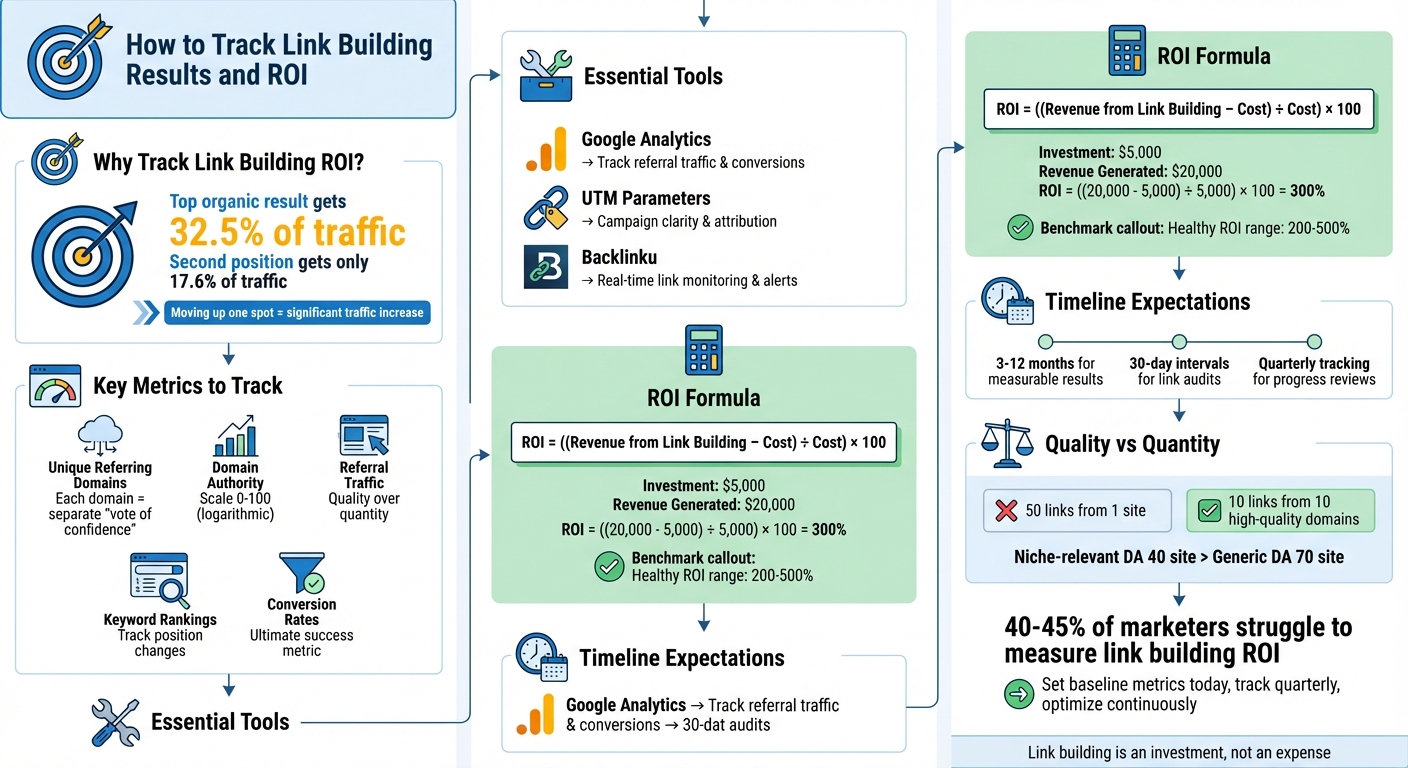
For instance, the top organic search result gets 32.5% of traffic, while the second gets just 17.6%. Moving up even one spot can make a huge difference, but only if you’re measuring success properly.
Here’s how you can track and improve your link-building ROI:
- Key Metrics to Track: Focus on unique referring domains, domain authority, referral traffic, keyword rankings, and conversions, not just the number of backlinks.
- Tools You’ll Need: Use Google Analytics for tracking referral traffic and conversions, UTM parameters for campaign clarity, and tools like Backlinku for real-time link monitoring.
- ROI Formula: ROI = ((Revenue from Link Building – Cost) ÷ Cost) × 100. For example, a $5,000 investment that generates $20,000 in sales yields a 300% ROI.
- Long-Term Gains: Link building takes time; expect results within 3–12 months. High-quality links from niche-relevant sites often outperform general high-authority domains.
Tracking tools, proper metrics, and a clear ROI formula ensure your efforts directly contribute to revenue and search performance.
Link building isn’t just about rankings; it’s about measurable growth.
Complete Guide to Tracking Link Building ROI: Metrics, Tools, and Formula
How to Track SEO ROI in 5 Minutes (I Tracked $1,597,828.33 Easily)
Key Metrics for Measuring Link Building Success
Tracking the right metrics can make the difference between guessing and knowing whether your link-building efforts are paying off. While it might be tempting to celebrate every new backlink, the real question is whether those links are contributing to your business goals. Too often, marketers focus on metrics that don’t directly impact results.
The most impactful metrics generally fall into three categories: unique referring domains, domain authority scores, and user engagement data. For example, a campaign that builds 50 links from one site won’t perform as well as one that secures 10 links from 10 different high-quality domains. Why? Because search engines treat each unique domain as a separate “vote of confidence” in your site’s credibility.
Other crucial metrics include referral traffic volume and its quality, keyword ranking improvements, and conversion rates from referred visitors.
As Aoife O’Connor from Aira explains:
“With link building campaigns, links and the Domain Authority of linking sites are frequently used as KPIs… but we can go beyond this too… by looking at Google Analytics we can also see how much traffic a campaign drives”.
In 2025, a new focus has emerged: AI visibility. Adobe, for instance, optimized its content for generative AI shopping assistants and saw a staggering 1,200% increase in traffic from AI platforms. These AI-driven visitors were 8% more engaged and browsed 12% more pages than traditional organic visitors.
Let’s get into how these metrics translate into actionable insights.
Measuring Referral Traffic with Google Analytics

Referral traffic is a direct indicator of which backlinks are delivering engaged visitors to your site. You can track this by navigating to Acquisition > All Traffic > Referrals in Google Analytics. This report reveals which external sites are sending traffic and how much. But raw numbers alone don’t tell the whole story. Look at engagement metrics like bounce rate, pages per visit, and time on page to assess link quality. For instance, if visitors from a specific backlink leave immediately, it could mean the link is on an irrelevant site.
For more precise tracking, use UTM parameters. These small snippets of text added to your URLs (e.g., ?utm_source=guestpost&utm_medium=referral&utm_campaign=january2025) help you distinguish between traffic you’ve actively driven (like from outreach campaigns) and organic links others have built.
Don’t stop at traffic; focus on conversions. Set up specific actions in Google Analytics, such as form submissions, newsletter signups, or purchases, to measure the business value of each backlink.
As Debbie Chew, Global SEO Manager at Dialpad, puts it:
“If a link you built drives relevant traffic to your website, that link could essentially ‘pay for itself’ if it results in conversions”.
Keep in mind that link-building results take time. Aira’s research shows that it typically takes 1–3 months to see measurable outcomes.
Tracking Domain Authority and Referring Domains Growth
Metrics like Domain Authority (DA) and similar scores (e.g., Authority Score or Domain Rating) are useful for predicting a site’s ranking potential. These scores operate on a logarithmic scale from 0 to 100, meaning it’s much easier to move from 10 to 20 than from 80 to 90.
However, unique referring domains are even more critical. A single link from 10 high-quality domains is far more impactful than 10 links from the same domain.
Search engines treat each unique domain as a separate endorsement, so multiple links from one site offer diminishing returns.
To gauge progress, monitor your referring domain growth month over month. Consistency is key; a healthy campaign should show steady increases.
Additionally, track link velocity, or the rate at which you’re acquiring new referring domains compared to competitors, to understand the competitiveness of your niche.
| Metric | What It Measures | Why It Matters |
|---|---|---|
| Total Backlinks | Raw link volume | Can be inflated by sitewide footer/sidebar links |
| Referring Domains | Unique site “votes” | Reflects genuine popularity |
| Domain Authority | Overall site strength (0–100) | Predicts ranking potential |
| Page Authority | Strength of the linking page | Indicates the quality of the hosting page |
While authority scores are helpful, don’t rely on them exclusively.
A niche-relevant site with a DA of 40 can often outperform a generic site with a DA of 70. Be cautious of red flags like thin content, excessive “write for us” pages, or unnatural outbound link patterns, as these could lead to penalties.
Laura Slingo, Outreach Manager at Sage, emphasizes:
“Link building is a key lever in any holistic SEO strategy and so the ultimate KPI for links is to drive revenue via organic performance”.
Analyzing Conversion Rates and Bounce Rates
When it comes to measuring backlink effectiveness, conversion rate is the ultimate benchmark. High referral traffic and improved domain authority mean little if visitors aren’t taking meaningful actions, like signing up for newsletters, making purchases, or downloading resources.
Use Google Analytics to track conversions and determine the value of each referral.
Bounce rate offers additional insights. A bounce rate above 70% often indicates that the backlink isn’t relevant to the audience, while lower bounce rates paired with higher pages-per-visit metrics suggest that visitors are genuinely engaged.
Other metrics like time on page and scroll depth can further confirm whether visitors are interacting with your content.
Interestingly, AI search visitors tend to show better engagement, 8% higher than traditional users, and boast a 23% lower bounce rate. They also convert 23 times better than standard organic visitors.
To isolate these trends, create a custom segment in Google Analytics specifically for referral traffic. This ensures that fluctuations in other channels don’t obscure your progress with referral growth.
Setting Up Tools for Tracking Link Building Results
When it comes to measuring link-building success, having the right tools in place is non-negotiable. A well-configured setup transforms raw data into practical insights, removing the guesswork from your strategy.
Interestingly, between 40% and 45% of marketers find it challenging to evaluate their link-building efforts, often due to poorly configured tools.
A proper setup not only fills in the gaps but also saves precious time.
Configuring Google Analytics for Campaign Tracking
Google Analytics 4 (GA4) is a powerhouse for tracking link-building campaigns, offering tools like Key Events and detailed referral traffic insights.
To get started, head to Reports > Acquisition > Traffic Acquisition and filter for the “Referral” channel. This will show you which external websites are driving traffic to your site. For a deeper dive, add a secondary dimension like “Session source/medium” to pinpoint specific traffic sources.
Next, focus on tracking the actions that matter most. Whether it’s purchases, form submissions, or newsletter sign-ups, you can set up Key Events to monitor these activities. Navigate to Admin > Property Settings > Data Display > Events to enable the relevant actions.
After creating a new event, use GA4 DebugView to ensure everything is working as expected. Don’t forget to use UTM tags to differentiate traffic sources, and apply filters to block self-referrals and spam traffic.
High bounce rates from certain sources could indicate low-quality backlinks, so keeping these filters in place is essential. Once GA4 is configured, it’s time to add a layer of real-time tracking with specialized tools.
Using Backlinku for Real-Time Link Monitoring
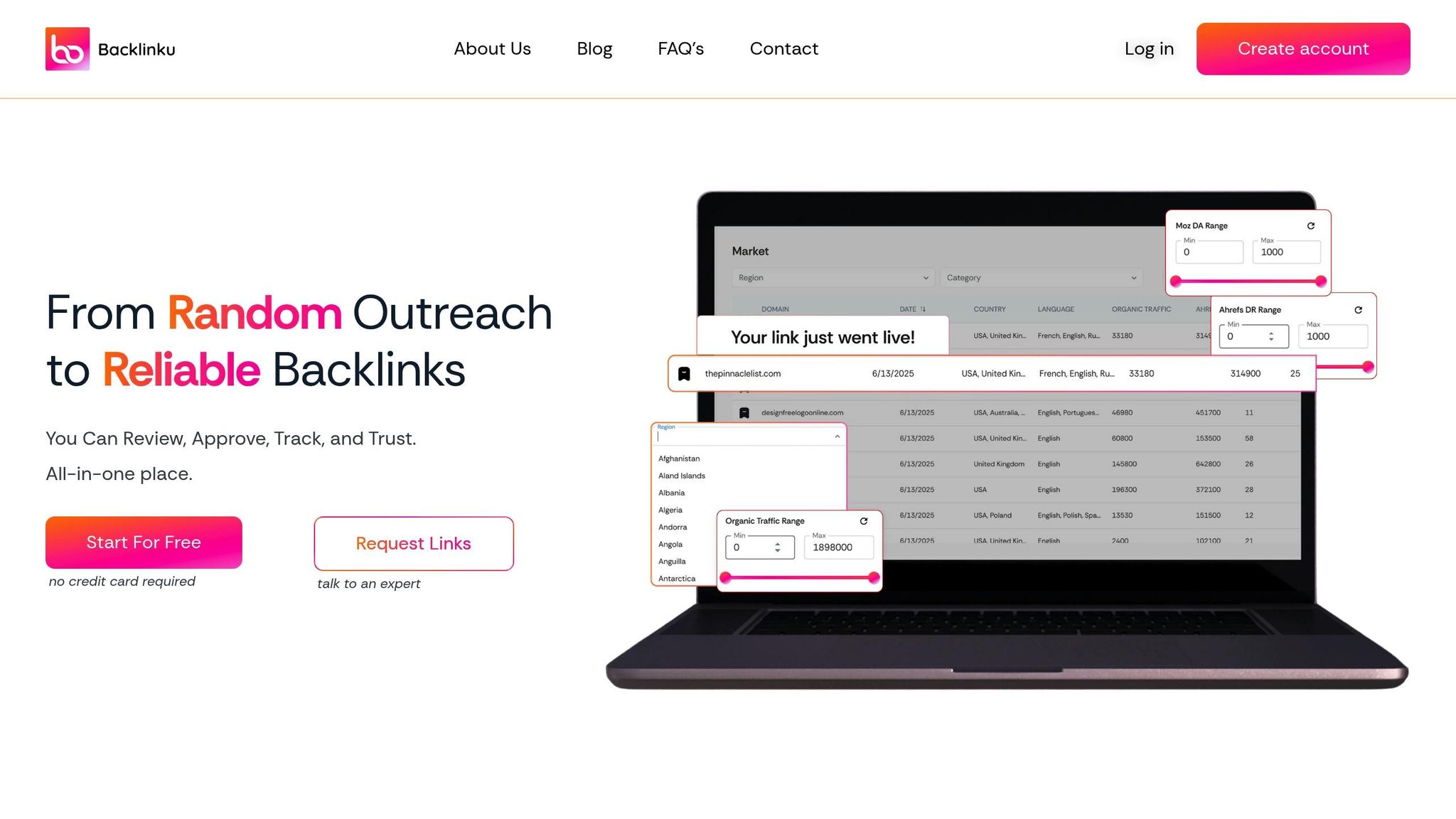
For instant backlink updates, Backlinku’s Link Crawler & Tracker is unbeatable. It alerts you if a link is removed or its quality drops.
The tool’s dashboard consolidates critical metrics like Domain Authority (DA), Page Authority (PA), and link velocity into one place.
Additionally, its Link Building CRM simplifies partnership management and tracks outreach progress, eliminating the need for clunky spreadsheets. With features like custom reporting and instant alerts, you’ll always stay ahead of potential issues.
Integrating Backlinku Campaign Management Dashboards
Backlinku’s campaign management dashboards bring all your link-building data into one unified view. By integrating with Google Analytics using UTM parameter tagging, these dashboards categorize traffic into “owned” and “earned” segments.
For a complete picture, connect your CRM data to track revenue attribution. This integration bridges the gap between marketing and sales, showing the financial impact of each link. The automated data flow ensures that updates sync promptly, perfectly aligning with Google Analytics insights.
With 61% of marketers prioritizing SEO and organic growth, having a clear, unified view of your campaigns is more important than ever. These tools ensure your link-building efforts support your broader business objectives and deliver measurable results.
How to Calculate Link Building ROI
Turning link-building efforts into measurable business investments starts with understanding the numbers behind it. By tracking key metrics and applying a simple formula, you can quantify the return on investment (ROI). Interestingly, about 40–45% of marketers find this process challenging because they skip these basic calculations.
Determining Revenue Per Visit (RPV)
Revenue Per Visit (RPV) helps you gauge the value of each referral. To calculate it, divide your total organic revenue by the total number of organic sessions over six months. For instance, if your site pulled in $45,000 in organic revenue from 50,000 sessions, your RPV would be $0.90.
If direct revenue tracking isn’t possible, you can estimate RPV by multiplying your conversion rate by your average sale value. For example, a 2% conversion rate with an average order value of $200 would give you an RPV of $4.00.
Another useful method involves Traffic Value, which estimates what your organic traffic would cost if purchased through Google Ads. To calculate this, multiply your total organic visits by the average cost-per-click (CPC) for your ranking keywords.
Once you’ve nailed down the value of each visitor, you’re ready to move on to calculating ROI.
Applying the ROI Formula
The ROI formula is straightforward: (Total Value Gained – Total Cost) ÷ Total Cost × 100. This provides a clear picture of profitability.
Take this example: In 2024, a SaaS company analyzed by Ranking Raccoon spent $3,000 monthly ($36,000 annually) on link building, which generated $42,000 in revenue from referral traffic.
Using the formula, their ROI was ((42,000 – 36,000) ÷ 36,000) × 100 = 17%. While this seems modest, the long-term benefits became evident as the site’s authority grew.
Another case from Outreach Monks showed a $5,000 investment that brought in $20,000 in sales, resulting in a 300% ROI using the same formula.
Generally, a healthy ROI for link building ranges between 200% and 500%, mainly due to organic growth compounding over time.
When calculating costs, make sure to include everything: content creation, outreach tools, agency fees (often $2,500 to $5,000 monthly, or up to $12,000+ for more complex campaigns), and in-house labor.
Ignoring these indirect expenses could lead to an inflated ROI.
Using Projections for Future ROI
Projecting ROI can help justify ongoing investments and set realistic expectations.
Start by estimating the monthly search volume for your target keywords, then apply an estimated click-through rate (CTR) for your desired ranking position.
For reference, the first organic result typically gets around 32.5% of the traffic, while the second captures about 17.6%. Multiply the estimated traffic by your conversion rate and average value per sale or lead to get your projected revenue.
Keep in mind that link building takes time, usually between 3 and 12 months, to significantly impact organic traffic and rankings.
For example, in 2018, Kevin Rowe of PureLinq managed a campaign for an ecommerce client with 550,000 baseline sessions and a session value of $0.09.
By growing sessions by 27% through link building, the immediate ROI was modest, but the long-term benefits became clear as growth sustained.
“In the short-term, your ROI may be quite small or even negative. It’s only when you start considering the lifetime value of your customers and other long-term effects that the true value of link building shows.”
– Kevin Rowe, Founder, PureLinq
To forecast long-term returns, use historical monthly ROI data. Tools that link Google Sheets with Looker Studio can simplify this by automatically pulling cost and conversion data. When modeling ROI based on competitor analysis, study the backlink profiles of the top 3–5 ranking sites. Focus on the number and quality of links they have, while filtering out low-value or spammy placements to avoid overestimating your needs.
These calculations and projections can help you refine your link-building strategy and focus on the most profitable opportunities.
sbb-itb-566d57e
Advanced Strategies to Improve Link Building ROI
Once you’ve nailed down your baseline metrics and ROI calculations, it’s time to fine-tune your campaigns for better results. This involves digging deeper into your data to identify which backlinks truly make an impact and where your efforts should be focused. The goal? To move beyond basic tracking and uncover the links that deliver real value.
Comparing Referral vs. Organic Traffic Contributions
A backlink’s value is not the same for everyone, and its contribution to your ROI can vary significantly. Referral traffic brings immediate, short-term returns by driving direct clicks from the linking site. On the other hand, organic traffic offers long-term SEO benefits by strengthening your website’s domain authority.
Understanding this difference is essential; it helps you see which links act as “votes of confidence” for search engines and which function more like direct marketing channels.
For example, a backlink from a high-profile site might drive a noticeable spike in referral traffic and conversions right away.
Over time, though, its influence on your organic rankings could become even more apparent. Tools like UTM parameters are essential here; they allow you to track and attribute traffic accurately. Using Google Analytics, you can monitor referral conversion rates, revenue, and organic growth to identify the links that are truly pulling their weight.
“Building links improves page-level authority, which improves rankability, drives rankings, organic traffic, and finally, revenue.” – Laura Slingo, Outreach Manager, Sage
A backlink that generates substantial referral traffic often indicates strong topical relevance and alignment with your audience.
By mapping the dates of link acquisitions against organic performance changes, you can better understand how specific campaigns are driving ranking improvements.
This level of insight lays the groundwork for applying advanced tools and strategies to further enhance your link-building efforts.
Using Backlinku AI-Powered Insights
Once you’ve analyzed traffic contributions, advanced AI tools like Backlinku can take your strategy one step further. Backlinku’s AI-powered link matching evaluates backlinks based on factors like domain authority, topical relevance, traffic potential, and placement quality.
It also flags low-value links such as those from spammy networks, irrelevant sites, or sitewide footer placements, so you can focus on links that actually pass authority.
This is substantial, especially when you consider that 40% to 45% of marketers struggle to measure link-building efficiency.
The platform’s campaign management dashboards let you segment your outreach by link tier. For instance, prioritize Tier 1 editorial links from sites with a domain authority above 70. These links typically cost between $750 and $1,250 but deliver the strongest SEO benefits. Additionally, monitoring link velocity is critical for maintaining natural growth. Top-performing pages often see a 5–14.5% monthly increase in referring domains.
Backlinku also provides real-time monitoring to alert you when links go live, are removed, or change status. This allows you to address potential issues quickly, protecting your ROI. Its reporting tools extend beyond basic metrics, offering weighted link scores that take multiple factors into account. This gives you a clearer, more detailed view of link value and helps you make smarter decisions.
Interpreting Results and Adjusting Campaigns
Once you’ve tracked your metrics, the next step is making sense of the data to refine your strategy. Regularly analyze your performance to identify what’s working and what’s falling short.
This feedback loop allows you to tweak your tactics to better align with your overall objectives. Start by looking for patterns that reveal which strategies are driving results.
For example, compare the dates when your links went live with changes in your organic traffic using Google Analytics. This can help pinpoint which types of placements such as contextual body links versus author bios are making the biggest impact on your SEO efforts. If guest posts on niche SaaS blogs consistently improve keyword rankings, double down on that approach and phase out less effective tactics.
Keep an eye out for red flags that signal the need for adjustments. A consistent drop in traffic or rankings, despite active link-building efforts, might mean you’ve accumulated low-quality or irrelevant backlinks that need to be removed or disavowed.
Similarly, if your keyword rankings remain static or decline even as you build new links, the issue could be stiff competition or insufficient link quality. And if you already have more referring domains than your competitors but still lag in rankings, the problem might lie in areas like content quality, user experience, or topical relevance.
“Using previous campaign successes and failures will help you improve on the next one.” – Willem Rogers, Content & Outreach Specialist, Resolve
Another key factor to monitor is link velocity, your rate of acquiring backlinks. Aim for steady, natural growth, as most high-performing pages gain between 5% and 14.5% more dofollow backlinks each month. Sudden spikes in link acquisition can lead to penalties or ranking instability, so investigate any abrupt changes in your link-building patterns.
In addition to traditional metrics, pay attention to search behavior shifts. In 2025, more users skipped traditional search engines and turned to AI tools like ChatGPT or Perplexity for recommendations.
Interestingly, visitors arriving via AI search convert 23 times better than those from traditional organic search, while also showing an 8% higher engagement rate and a 23% lower bounce rate.
If your organic traffic drops but conversions and leads increase, it might mean your links are gaining visibility in AI-generated citations or summaries.
Update your reporting to include metrics like AI Overview Citations and Topical Authority Backlinks instead of focusing solely on raw traffic numbers.
Conclusion
Tracking link-building efforts is essential for connecting your SEO strategies directly to business results. By keeping an eye on critical metrics like referral traffic, domain authority growth, and conversion rates, you can clearly show how link building contributes to revenue, not just higher search rankings.
Using the standard ROI formula – ((Revenue from Link Building – Investment Cost) / Investment Cost) × 100, you can gauge whether your campaigns are paying off.
Successful link-building campaigns often yield impressive returns, ranging from 200% to 500%. These numbers prove that link building does more than just raise rankings; it can directly impact revenue.
It’s important to remember that link building is a long-term commitment. Results typically take anywhere from 3 to 12 months to materialize. With these insights, you can shift resources toward the most effective tactics.
As Outreach Monks aptly puts it:
“Link building is an investment, not an expense.” – Outreach Monks
Prioritizing quality is key; conducting link audits every 30 days helps you catch potential issues and maintain a strong backlink profile.
A single link from a highly relevant, niche-specific site can often deliver more SEO value than several links from unrelated high-authority domains.
Start by setting baseline metrics today, then track your progress on a quarterly basis. Redirect resources to the tactics that deliver the best results and maximize your ROI. With the right tools and a data-driven approach, you can achieve compounding gains and clearly demonstrate how link building contributes to your bottom line.
FAQs
How long does it take to see results from link-building efforts?
It typically takes 3 to 6 months to start seeing noticeable results from link-building efforts. This timeframe can shift based on several factors, including the quality of the links you acquire, how competitive your industry is, and the existing authority of your website. Consistency and patience are key here.
What metrics should I track to measure the success of my link-building efforts?
To determine how well your link-building campaigns are working, keep an eye on metrics that provide a clear picture of performance. Start with referral traffic from the backlinks you’ve earned, along with the number of referring domains and backlinks themselves. Pay attention to shifts in domain authority as well. Beyond these, track changes in keyword rankings, organic traffic growth, and conversion rates to understand how link building supports your overall business goals.
Google Analytics or dedicated SEO platforms can simplify the process of monitoring these metrics. Regularly analyzing this data ensures your link-building efforts stay aligned with your goals and deliver tangible results.
How do I measure the ROI of my link-building campaigns?
To figure out the ROI of your link-building campaigns, you can use this straightforward formula: ROI = [(Revenue − Cost) / Cost] × 100. Start by calculating the revenue earned from referral traffic, such as sales or leads, and subtract the total expenses of your link-building efforts. Then, divide the resulting profit by the cost, and multiply by 100 to get your ROI as a percentage.
Some important metrics to keep an eye on include referral traffic, conversions, and the revenue they bring in. Google Analytics makes it easier to track these numbers and measure how your campaigns are performing. By comparing these results to your business objectives, you can get a clearer picture of how much value your link-building investment is delivering.