

When it comes to backlinks, traffic metrics matter more than you might think. A link from a high-traffic site not only boosts your rankings but also drives real visitors to your page. Here’s why:
- High-traffic backlinks pass more SEO value: Search engines trust sites with consistent, organic traffic.
- Low-traffic links often fall flat: If a site isn’t getting visitors, it’s likely ignored by Google.
- Engagement and trends matter: Metrics like bounce rate, time on site, and steady traffic growth signal quality.
- Bad backlinks can hurt: Links from spammy or penalized sites can damage your rankings.
To evaluate backlink quality, focus on:
- Organic traffic volume: Prioritize sites with at least 1,000 monthly visitors.
- Engagement metrics: Look for low bounce rates and strong user interaction.
- Traffic trends: Avoid sites with sudden spikes or drops in traffic.
Using tools like Ahrefs, Semrush, or Backlinku can help you filter and monitor backlinks effectively. Bottom line? Prioritize traffic metrics to build links that deliver real results.
The Truth About Backlinks: Traffic vs. Relevance (Traffic, DR, & More)
The Problem: Overlooking Traffic Metrics in Link Building
Many SEO professionals focus on vanity metrics like Domain Authority or Domain Rating when pursuing backlinks. The issue? These metrics can be manipulated and don’t necessarily reflect whether Google trusts the site. Ignoring traffic data when building links can lead to connections with content that search engines have already devalued. This highlights why traffic metrics should be a key part of any link-building strategy.
Low-Traffic Backlinks Offer Little to No Benefit
Backlinks from websites with no visitors hold little value. If a site isn’t attracting organic traffic, it’s a clear sign that Google doesn’t trust or prioritize its content. Links from such domains pass minimal link equity and fail to generate referral traffic, meaning you’re missing out on potential customers or subscribers.
"A website without traffic is, in most cases, not worth your time. High traffic generally indicates legitimacy and the potential to attract more readers to your site."
– Nick Zviadadze, Founder, MintSEO
How Poor Backlink Choices Can Harm Your SEO Efforts
Making poor backlink decisions doesn’t just waste resources – it can actively hurt your rankings. Links from sites with unnatural traffic patterns or sudden traffic drops may indicate penalties from Google. Associating with these sites aligns your content with what search engines view as low quality.
"Today, Google is outright devaluing and ignoring many of the links out there… It all comes down to getting links from websites with traffic."
– Authority Builders
Using links from link farms or private blog networks can lead to manual penalties, causing your site to plummet in rankings – or disappear entirely. Even without a formal penalty, Google often disregards these low-quality links, leaving you with little to show for your investment. A study of search engine results pages revealed that 88% of results had no more than four out of ten backlinks coming from sites with actual traffic. The takeaway is clear: quality matters far more than quantity.
Traffic Metrics That Determine Backlink Quality
Key Traffic Metrics for Evaluating Backlink Quality
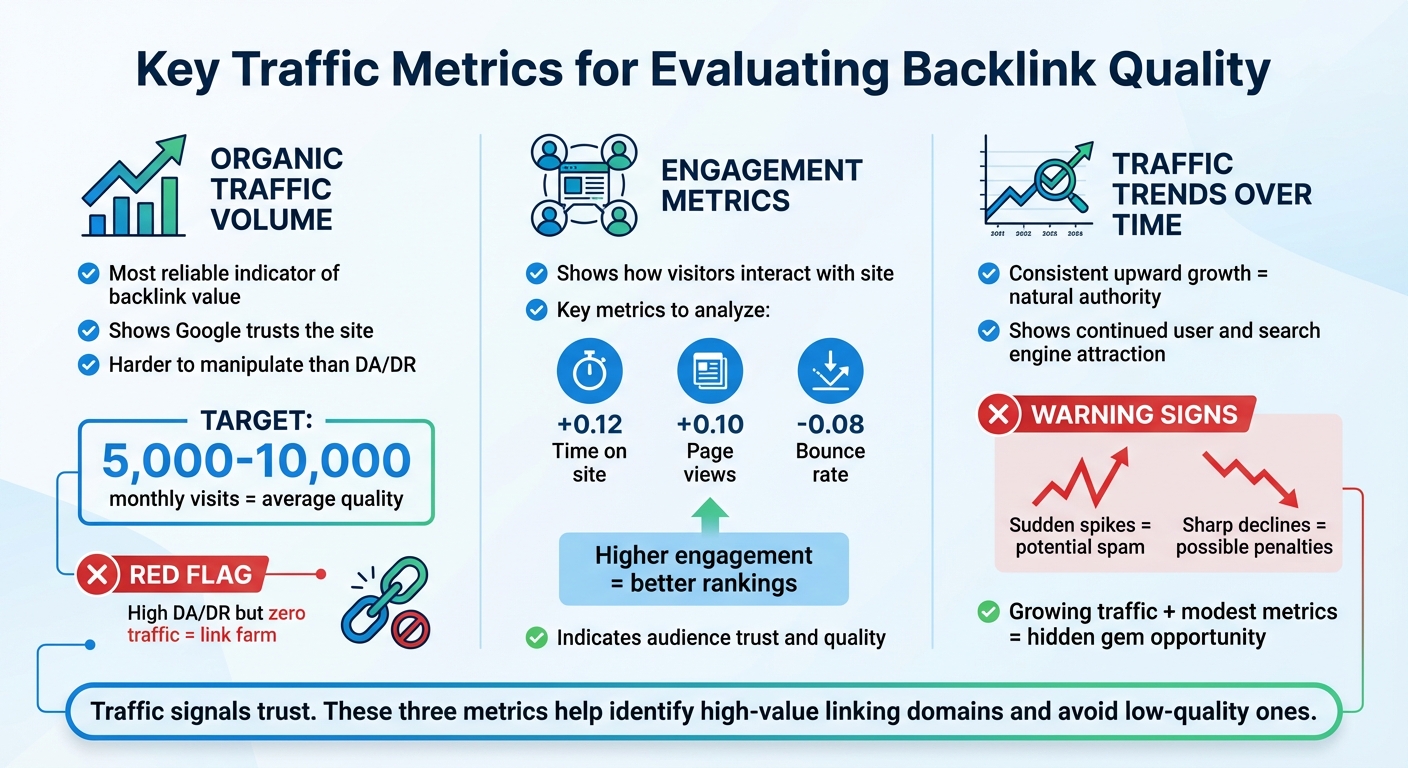
When evaluating backlink sources, it’s essential to focus on metrics that show Google’s trust in a website. Here are three key traffic metrics that can help you identify high-value linking domains and steer clear of low-quality ones. These metrics provide a solid foundation for assessing backlink potential.
Organic Traffic Volume
Organic traffic is one of the most reliable indicators of a backlink’s value. It shows that Google considers the site worthy of ranking. Unlike third-party metrics like Domain Authority (DA) or Domain Rating (DR), which can be artificially inflated, organic traffic is much harder to manipulate.
"Organic traffic validates a site. It means that Google likes the website’s link profile and content, making for an ideal link-building opportunity."
– Josh, Digital Marketer, MarketingLogiq
Generally, websites with monthly organic traffic between 5,000 and 10,000 visits are considered to be of average quality. On the other hand, a site with high DA or DR but no organic traffic is often a red flag – it might be a link farm or a penalized domain that could harm your SEO efforts instead of helping them.
Engagement Metrics
Traffic volume alone doesn’t paint the full picture. You also need to understand how visitors interact with the site. Engagement metrics like bounce rate, time on site, and pages per session provide valuable insights into audience trust and the site’s overall quality.
Studies have found that metrics such as time on site and page views are positively linked to higher rankings. Meanwhile, bounce rate has a negative correlation of -0.08, meaning that sites with lower bounce rates tend to perform better in search results. These engagement signals help search engines gauge the "health" of a domain, suggesting that links from highly engaging websites may pass on more link equity.
Traffic Trends Over Time
Looking at traffic trends over time adds another layer of insight. A trustworthy domain typically shows consistent, upward traffic growth, signaling natural authority building and content that continues to attract both users and search engines.
Be cautious of sudden traffic spikes, which might indicate spammy practices, or sharp declines, which could signal penalties. Interestingly, a site with growing organic traffic but modest third-party metrics can often be a hidden gem – a strong link opportunity before its DA or DR catches up.
How Traffic Metrics Affect Backlink Value and SEO Results
Grasping the connection between traffic metrics and SEO value is key to making the most of quality backlinks.
High-Traffic Sites Pass More Link Equity
Backlinks from websites with significant traffic carry greater weight in Google’s ranking system compared to those from low-traffic or inactive sites. Why? Because traffic signals trust. A link from a high-traffic domain essentially tells Google, "This site is credible."
"The sum of organic traffic to referring pages has a higher correlation than the number of referring pages with traffic. This suggests that links from ‘powerful’ referring pages… have more weight than links from pages with ‘a bit’ of search traffic."
– Tim Soulo, CMO, Ahrefs
A massive study analyzing over 1 billion pages found that only 9.37% of them received organic traffic, proving that the majority of web pages (90.63%) don’t contribute much to SEO. Building links from these low-traffic pages is often a wasted effort, as Google tends to ignore them. Authority Builders, a service that focuses on traffic-based link building (requiring a minimum of 1,000 monthly visitors), reported that 95% of pages using this approach saw ranking improvements.
The distinction between high-traffic and low-traffic backlinks becomes even more critical when considering Google’s spam detection. Each day, Google flags over 25 billion pages as spam. Links from domains with steady organic traffic are far less likely to be dismissed, ensuring that your link-building efforts contribute to your rankings instead of being filtered out. This trust factor not only boosts link equity but also lays the groundwork for additional benefits like referral traffic.
Driving Referral Traffic Through Quality Backlinks
High-traffic backlinks do more than pass link equity – they also bring real, engaged visitors to your site. These links can drive referral traffic, which adds another layer of value to your SEO strategy.
"If a page gets real visitors, a link on that page carries more weight than a link on a dead page. Traffic shows the page is used and trusted by users."
– Semantic Mastery
When users click through from a relevant, high-traffic backlink, they’re more likely to stay on your site and engage with your content. Studies highlight the connection between user engagement and rankings, showing positive correlations with metrics like time on site (0.12), page views (0.10), and a negative correlation with bounce rate (-0.08). These engagement signals tell Google that your site is valuable and relevant, creating a ripple effect that amplifies the direct SEO benefits of the backlink.
sbb-itb-566d57e
Solution: How to Evaluate Traffic Metrics for Backlinks
Now that we’ve covered why traffic metrics are important, let’s dive into how to assess them when analyzing backlink opportunities.
Tools for Measuring Traffic Metrics
Several tools can help you evaluate traffic metrics effectively:
- Ahrefs: With a database of over 35 trillion backlinks, Ahrefs offers a Batch Analysis feature that lets you analyze up to 200 domains at once.
- Semrush: Known for its integrated Authority Score, Semrush can highlight sites with high authority but low organic traffic.
- Moz: Combines Domain Authority with Spam Score to provide deeper insights into link quality.
- Majestic: Offers Trust Flow, which measures trustworthiness based on proximity to trusted seed sites.
- Backlinku: Filters more than 50,000 manually reviewed backlink opportunities by traffic, niche, region, and SEO metrics. It also tracks links in real time.
Using these tools alongside broader SEO metrics ensures a more thorough evaluation of backlink quality.
Combining Traffic Data with Other SEO Metrics
Traffic metrics alone don’t tell the whole story. Pair them with other SEO indicators like Domain Rating (DR) and URL Rating (UR) to get a clearer picture of a site’s quality. While DR and Domain Authority (DA) measure link popularity, they shouldn’t be used in isolation to assess legitimacy or quality.
"We don’t recommend using Domain Rating as a standalone metric. It’s merely a measure of ‘link popularity’ and not a good indicator of a website’s quality or legitimacy. A better practice is to pair DR with other metrics like domain level traffic or UR."
– Andrei Țiț, Product Marketer, Ahrefs
To refine your analysis, use tools like Semrush or Ahrefs to check the "Top Pages" report. This helps confirm that the keywords driving traffic are relevant to your niche. Additionally, ensure backlinks are placed within 2–3 clicks of the homepage so they can be crawled efficiently.
Another key factor is link velocity. A natural backlink profile grows steadily over time. Be cautious of sudden spikes in backlinks without a corresponding increase in traffic, as this could signal manipulative practices.
| Metric | Focus | Best Used With |
|---|---|---|
| Domain Rating (DR) | Link popularity and backlink profile strength | Domain-level organic traffic |
| Authority Score (AS) | Overall domain quality and SEO performance | Toxicity Score and Spam Factors |
| URL Rating (UR) | Individual page’s backlink profile strength | Page-level organic traffic |
| Trust Flow | Trustworthiness based on proximity to seed sites | Citation Flow (link volume) |
Using Backlinku for Traffic-Based Link Building
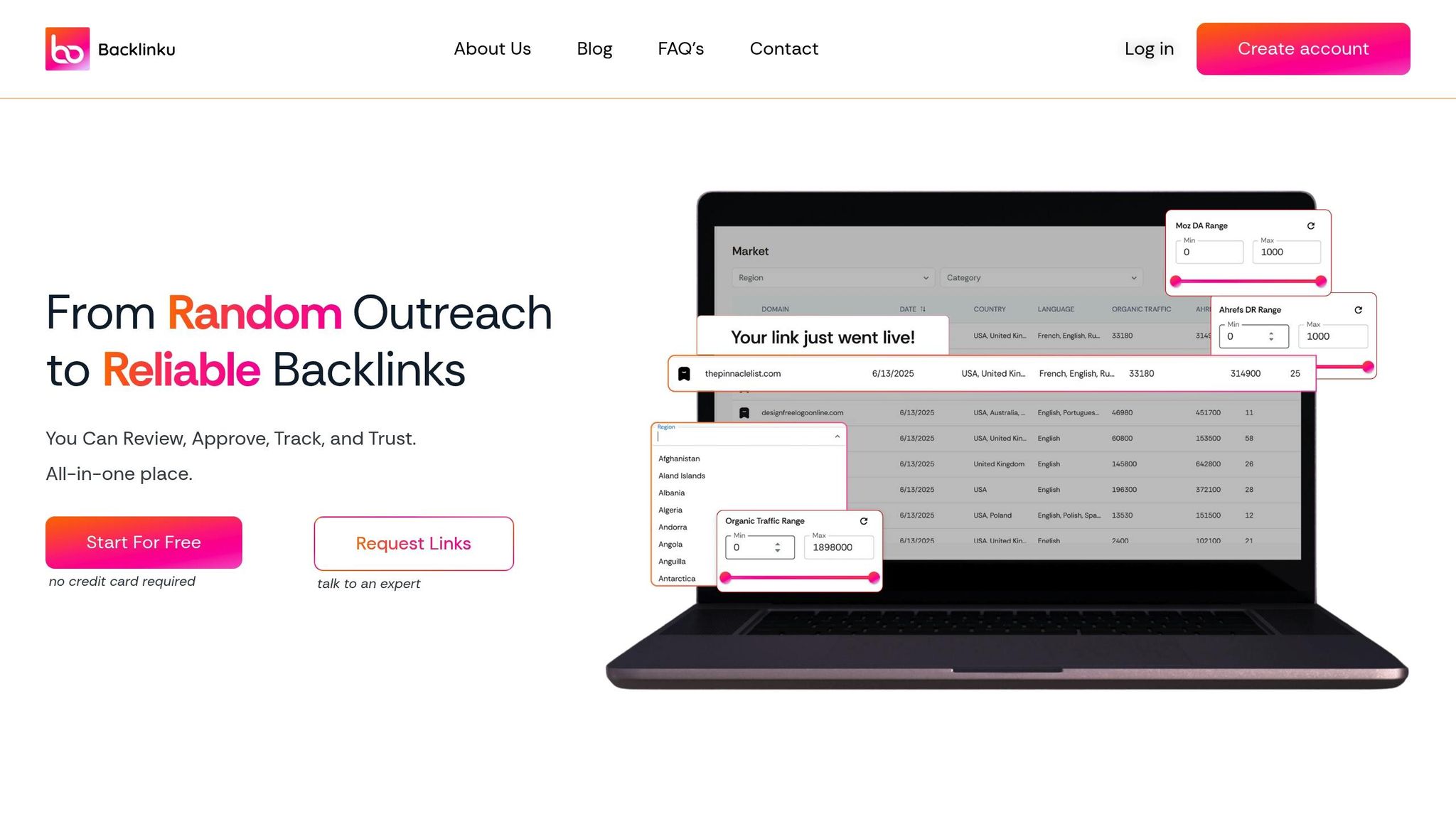
When it comes to building quality backlinks, traffic metrics are key. Backlinku simplifies this process by offering tools to identify and track high-value sites. With access to a marketplace of 50,000 manually reviewed websites and built-in traffic filters, the platform ensures you prioritize organic engagement over inflated numbers.
Filtering for High-Traffic Sites
Backlinku’s Authority Score (AS) filter incorporates organic traffic estimates as a key factor, while the Traffic Cost metric reflects the monetary value of a site’s keywords. Together, these tools help you focus on the kind of traffic that matters most – organic and meaningful.
The platform also automatically excludes sites with zero traffic, saving you time and ensuring your efforts are directed toward quality link prospects. Another standout feature is the niche relevance filter, which helps you avoid the pitfall of chasing high traffic numbers from irrelevant sites. A moderately trafficked site that aligns with your niche often brings better results than a high-traffic site with no connection to your content. This approach also shields you from "link farms" – sites that artificially boost rankings with unnatural backlinks but lack real user engagement.
Once you’ve identified high-traffic, relevant sites, the next step is keeping an eye on their performance.
Monitoring Links and Tracking Performance
Backlinku offers real-time link monitoring to track essential metrics like search impressions, keyword rankings, and overall performance of your target pages. This data provides valuable insights into which backlinks are driving actual results. For instance, high-quality backlinks from authoritative domains can lead to a 14% increase in organic traffic and a 3.5-position boost in average search rankings. Some campaigns have even seen a 275% jump in Google Search impressions, with pages expanding their keyword reach from a median of 12 to 30 ranking keywords.
Additionally, Backlinku’s alert system keeps you informed if a backlink is removed or altered. This ensures you focus on opportunities that consistently deliver value, allowing you to maintain an effective and impactful backlink strategy over time.
Conclusion
From our exploration of organic traffic and engagement metrics, it’s evident that traffic metrics play a pivotal role in assessing backlink quality. When Google directs organic traffic to a website, it signals trust and recognition for that domain. Links from high-traffic sites carry substantial SEO value, while those from low-traffic sources often have minimal impact.
The mantra today is quality over quantity. Prioritizing backlinks with strong traffic metrics helps avoid pitfalls like low-value placements and link farms. While relevance remains the top priority, traffic serves as the deciding factor, setting apart meaningful opportunities from superficial metrics like inflated Domain Authority scores.
High-traffic backlinks not only enhance search rankings but also bring engaged referral visitors, creating long-term benefits.
"The secret to ensuring your links are recognized by Google is to guest post on sites that Google is already rewarding with organic traffic." – Authority Builders
To maximize impact, aim for pages with at least 1,000 monthly organic visitors. Focus on page-level traffic rather than domain-wide numbers and use real-time tracking to ensure your links stay on high-performing pages. Tools like Backlinku can help you maintain a backlink profile that delivers measurable SEO value and earns Google’s trust. By anchoring your strategy in traffic metrics, you create a foundation for sustainable growth and results.
FAQs
Why are traffic metrics a better indicator of backlink quality than Domain Authority?
Traffic metrics offer a more accurate representation of a website’s performance by showcasing actual visitor behavior and levels of user engagement. These figures are much tougher to manipulate, making them a reliable indicator of what search engines like Google consider trustworthy.
On the other hand, Domain Authority (DA) is a third-party metric that Google doesn’t use in its ranking algorithm. While DA might give a rough idea of a site’s potential, it can be artificially boosted and doesn’t always reflect the site’s true quality or relevance. Focusing on traffic metrics ensures your backlinks come from sites that attract real visitors and deliver genuine value.
What impact can sudden traffic spikes from a backlink source have on my SEO?
Sudden surges in traffic from a backlink source can sometimes point to artificial or spammy traffic. When this happens, search engines like Google might start questioning the credibility of the linking page. This could lead to the link losing its value or, worse, trigger penalties that could negatively impact your SEO efforts.
To determine whether the spike is beneficial or problematic, take a closer look at engagement metrics like session duration and bounce rate. Legitimate, high-quality traffic usually comes with steady user interaction, while poor engagement could be a red flag that something’s off. Keeping an eye on these metrics ensures your backlinks are actually boosting your SEO strategy instead of dragging it down.
How can I evaluate the organic traffic of a website before building backlinks?
To measure a website’s organic traffic, you can rely on well-known SEO tools that offer traffic estimates and engagement data. These platforms analyze search engine activity to provide insights into a site’s visibility and overall performance. Top tools like Ahrefs, Moz, and SEMrush are particularly useful for tracking traffic patterns and spotting opportunities for high-value backlinks.
When examining a site, pay attention to metrics such as monthly organic visits, traffic sources, and user engagement. This approach ensures your backlinks originate from trustworthy and relevant websites, boosting your SEO efforts.