

Storytelling isn’t just for novels or movies, it’s a powerful tool for SEO. Why? Because stories make your content memorable, engaging, and link-worthy.
Data shows that stories are 22 times more memorable than plain facts, and content with a strong narrative tends to attract high-quality backlinks.
Whether you’re crafting blog posts, case studies, or original research, weaving human elements like emotions, challenges, and resolutions into your content can dramatically improve its performance.
Key Takeaways:
- Why it works: Stories create emotional connections, making your content easier to share and cite.
- What to do: Use proven frameworks like PAS (Problem, Agitate, Solution) to align with search intent.
- Proven formats: Long-form guides, case studies, and data-backed stories generate the most backlinks.
- Practical tips: Use practical examples, compelling hooks, and visuals like infographics to maximize engagement.
This guide breaks down how to write SEO-friendly stories that attract links, improve rankings, and keep readers hooked. Let’s dive in.
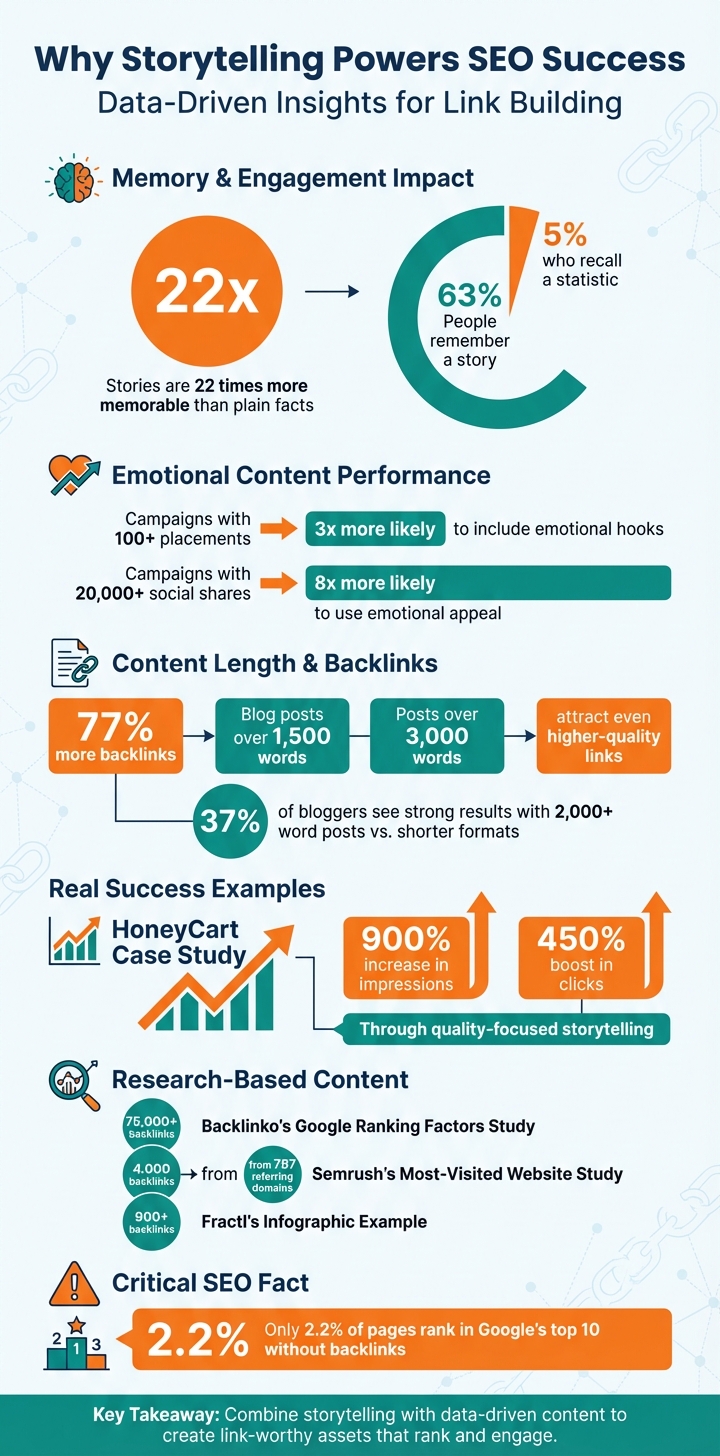
Storytelling for SEO: Key Statistics and Content Performance Metrics
Why STORYTELLING Beats Traditional Link Building – with Desmond Boateng
sbb-itb-566d57e
Core Storytelling Techniques for Linkable Content
Learn how to write content that naturally attracts backlinks by integrating powerful storytelling techniques.
Understanding Your Target Audience and Their Needs
Content that earns backlinks often resonates deeply with readers by addressing their struggles in a way that feels personal and relatable.
When your audience sees their challenges reflected in your story, they’re more likely to engage, share, and explore further.
A great way to achieve this is by aligning your storytelling with search intent. The PAS Formula (Problem, Agitate, Solution) is a proven method.
Start by identifying your audience’s problem, then emphasize the consequences of ignoring it, and finally, present your solution. This structure builds curiosity and makes your content more shareable.
Take Thinx, for example, a menstrual underwear brand that connects with women dissatisfied with traditional period products.
By using relatable language and visuals, they’ve built a loyal community and high levels of engagement. Avoiding overly complex terms and speaking in your audience’s language can also make your content more approachable and link-worthy.
Once you understand your audience’s needs, you can amplify the impact of your story by tapping into their emotions.
Using Emotion to Drive Engagement
Emotion is a powerful tool to captivate readers and encourage them to share your content. Campaigns that secure over 100 placements are 3 times more likely to include a strong emotional hook, while those with over 20,000 social shares are 8 times more likely to rely on emotional appeal.
High-arousal emotions like surprise, curiosity, disgust, or delight are especially effective for driving engagement. Research shows that 63% of people remember a story, compared to only 5% who recall a statistic.
Stories activate sensory and motor areas of the brain, making readers feel immersed in the narrative, while statistics often only engage the language-processing parts.
One standout example is Fractl’s “Perceptions of Perfection” campaign from April 2016. Designers from different countries edited the same photo of a woman to reflect local beauty standards. The surprising and emotional nature of this campaign earned nearly 600 placements, including links from BuzzFeed and Huffington Post.
To replicate this success, lead with a compelling story and support it with data. For instance, start with a gripping anecdote or quote within the first 100 words to grab attention and reduce bounce rates.
Don’t shy away from bold or polarizing perspectives; they can spark conversations and attract citations from writers looking for diverse viewpoints.
Adding Real-Life Examples and Case Studies
Real-world examples add instant credibility to your content. They shift your narrative from opinion-based to evidence-backed, making it a valuable resource that others want to cite.
Consider HoneyCart, a company that transitioned from producing low-quality, high-volume content to focusing on quality-driven storytelling. This pivot resulted in a 900% increase in impressions and a 450% surge in clicks.
When creating case studies, use the Hero’s Journey structure. Cast your customer as the hero, showing how they overcame challenges with your solution.
Be sure to include measurable outcomes, specific data and metrics that demonstrate clear benefits. For example, instead of vague claims like “easy to use”, describe a scenario where a customer achieved their goal effortlessly.
Another effective example is Fractl’s “Most Popular Concert Drugs” campaign, which analyzed drug mentions on Instagram across various music festivals.
By incorporating international festivals, the campaign secured nearly 1,900 placements from publishers in countries like the U.S., U.K., France, and Australia. This geographic angle gave local publishers a reason to cover the story, amplifying its reach.
“Your story needs to take [potential customers] on a tour of the aspects that step by step convinced you to believe so they can step by step come to believe the same things.” – Annette Simmons, Author of The Story Factor
Including real-life examples with clear names, numbers, and outcomes makes your content more authoritative and citable. These details prove your claims and demonstrate what works, naturally encouraging backlinks.
How to Write SEO-Friendly Stories That Attract Links
Writing stories that resonate with readers while satisfying search engine algorithms requires a well-defined structure. By blending an engaging narrative with SEO best practices, you can create content that not only ranks well but also earns backlinks.
Building a Clear Narrative Structure
A great story follows a clear structure: a beginning, middle, and end. This format keeps readers hooked and helps search engines identify its value.
Start with a compelling hook that incorporates your primary keyword within the first 100 words. Your story should include these essential elements: a relatable character (like a customer or founder), a specific setting to provide context, a conflict (the problem or challenge), and a resolution (the solution).
Tailor this structure to match search intent. For example, keep it concise and actionable for “how-to” queries, while “journey” queries might call for more detailed, personal storytelling.
To keep readers engaged, use bucket brigades; short, attention-grabbing phrases like “Here’s the twist:” or “But wait, there’s more!”
These transitions help maintain momentum. A great example is Moz’s Whiteboard Friday series, which uses visual storytelling and clear narratives to break down complex SEO topics, achieving an impressive average dwell time of ten minutes per episode.
“Storytelling isn’t decoration. It’s structure. It helps people understand, relate to, and remember your content.” – Trendline SEO
Support your story with scannable formatting. Use descriptive H2 and H3 headers, concise paragraphs, and bullet points to make your content easy to read and crawl.
Adding Keywords Naturally to Your Story
Keywords are your guide to aligning your story with what people are searching for. Place your primary keyword early within the first 100 words and integrate it naturally into your opening hook. Avoid overloading your text with the same keyword; instead, use related terms, synonyms, and LSI (Latent Semantic Indexing) keywords to maintain a conversational tone.
Long-tail keywords are especially effective because they often mirror the specific questions people ask. For instance, instead of repeatedly inserting “SEO tools”, you could share a story about how a team solved a ranking issue, naturally weaving in the tools and strategies they used.
“Rather than just inserting keywords, storytelling creates a natural flow where search terms are used in context. This not only improves readability but also signals topical authority.” – Rejoice Ojiaku, SEO Manager & Co-founder B-DigitalUK
To keep readers scrolling, use open loops; tease valuable insights that will come later in the post. When introducing technical terms, make them relatable by using practical examples. For instance, instead of simply defining “canonical tags”, explain how they helped a product page maintain its rank.
Using Visuals and Multimedia to Strengthen Your Story
Once your narrative is structured and keywords are properly integrated, visuals can elevate your story and make it more engaging and shareable.
Visual elements like infographics and data visualizations simplify complex ideas and make them easy to share. For example, an infographic on baking times for different cakes earned over 900 backlinks, while Backlinko’s “Google Ranking Factors” study, featuring original research and visuals, secured more than 75,000 backlinks.
Interactive tools like quizzes, calculators, or timelines add a layer of personalization, encouraging readers to stay longer and share your content.
Annotated screenshots and before-and-after visuals are also powerful for illustrating transformations, especially in case studies. Videos and motion graphics work similarly, but ensure they include captions for accessibility and better indexing by search engines.
Optimize visuals for both users and search engines. Use descriptive filenames and alt text for images, and add captions to highlight key takeaways.
Compress media files before uploading to maintain fast page load times, as slow-loading pages can hurt SEO performance. When done right, rich visuals not only enhance the user experience but also attract valuable backlinks.
| Visual Type | Storytelling Function | Link-Building Benefit |
|---|---|---|
| Infographics | Simplifies complex data | Highly shareable; attracts citations |
| Interactive Tools | Provides personalized value | Increases dwell time and sharing |
| Annotated Screenshots | Visualizes transformations | Adds credibility to case studies |
| Original Research Charts | Displays proprietary data | Acts as a primary source for citations |
| Videos with Captions | Breaks up text; maintains accessibility | Improves engagement and indexing |
Content Formats That Generate the Most Backlinks
The way content attracts backlinks often depends on its format, with the right mix of storytelling and practical value making all the difference. When content transforms raw data into something engaging and relatable, it becomes more link-worthy.
Long-Form Blog Posts and Guides
Long-form content provides the room needed to dive deep into a topic while keeping readers engaged with a well-developed narrative.
Research shows that blog posts over 1,500 words generate up to 77% more backlinks, and those exceeding 3,000 words often attract even higher-quality links.
Bloggers who focus on writing posts of 2,000 words or more are nearly twice as likely to see strong results (37%) compared to those sticking to shorter formats of 1,000–1,500 words.
To make long-form content even more compelling, weave in storytelling techniques like the PAS (Problem-Agitation-Solution) framework.
Use relatable anecdotes, vivid metaphors, and practical examples to keep readers hooked. And if you’re wondering what comes next, case studies might just be the perfect complement to your content strategy.
Case Studies and Success Stories
Case studies are another powerful way to generate backlinks, as they turn abstract ideas into concrete examples. By presenting a customer or client as the “hero” of the story and positioning your brand as the “guide”, you create a narrative that resonates. People are 22 times more likely to remember information when it’s shared as a story rather than standalone data.
Take, for example, HoneyCart, which revamped its content strategy to focus on quality over quantity. This shift resulted in a 900% increase in impressions and 450% more clicks. By sharing their journey from “empty volume” to “quality-focused results”, they created a case study that not only built trust but also earned valuable backlinks.
When writing case studies, introduce a central character (your client or customer), outline their challenges, and showcase measurable results. This approach builds credibility and positions your content as a resource worth citing.
Original Research and Data-Driven Stories
Original research is a magnet for backlinks, as journalists and bloggers are always on the lookout for fresh statistics to support their stories. For instance, Backlinko’s “Google Ranking Factors” study racked up over 75,000 backlinks by combining original data with eye-catching visuals. Similarly, Semrush’s “Most-Visited Website Study” in August 2024 garnered around 4,000 backlinks from 787 referring domains by presenting its findings as a compelling narrative about digital trends.
Adding an emotional layer to data-backed stories can strengthen their impact. For example, Fractl’s 2016 campaign on “Women in Video Games” paired the emotional topic of body image with pop culture references and visual comparisons.
This approach earned nearly 900 placements, including links from major outlets like BuzzFeed, Huffington Post, and Vice.
“Data informs, but stories persuade. A study by Jennifer Aaker at Stanford found that people are 22 times more likely to remember stories than standalone data.” – Chioma Anunobi, SEO & Content Writer
When sharing original research, don’t just present numbers; explain the story behind the data. Highlight key findings, provide context, and even offer downloadable charts to make it easy for others to cite your work. This combination of narrative and SEO strategy can significantly amplify your backlink potential.
Measuring the Impact of Storytelling on Link Building
Creating engaging stories is just the start; understanding their influence on link building is where the real insights lie.
Tracking Backlink Growth and Quality
In link building, quality always beats volume. Use Backlinku or Google Search Console to monitor new backlinks and referring domains, prioritizing links from high-authority domains with scores above 60.
Pay attention to the context and placement of these links. Links embedded within the main content are far more impactful than those buried in the footer or sidebars.
Also, differentiate between dofollow, nofollow, and sponsored links as each carries a different value. Another crucial aspect is tracking the co-citations. These are instances where your brand is mentioned alongside reputable sources, even if there’s no clickable link. With AI-driven search gaining prominence, co-citations significantly affect visibility.
Interestingly, about 60% of online brand mentions stay unlinked, presenting a huge untapped opportunity. Google Alerts or brand monitoring platforms can help identify these mentions. Once spotted, you can audit and request proper links to turn those mentions into valuable backlinks.
“Stop measuring success by the number of backlinks you acquire. Start measuring by the impact those links have on your actual business metrics.” – Rachel Thompson, SEO Consultant
Analyzing Engagement Metrics
After evaluating link quality, it’s time to assess how well your storytelling connects with your audience. Engagement metrics like time on page, scroll depth, and heatmaps can reveal which parts of your story hold the most attention.
Social shares are another key indicator of how your content resonates emotionally. Tracking shares, retweets, and comments can provide deeper insights into audience reactions and content performance.
Don’t panic if you see a high bounce rate; it doesn’t always mean failure. If users find what they need quickly, that’s still a success. Pairing bounce rate data with scroll depth analysis gives a more complete picture of how your content is performing.
Adjusting Your Strategy Based on Data
Metrics are only useful if you act on them. Refine your storytelling by focusing on elements that drive the most engagement and backlinks.
For instance, case studies or original data-backed research often outperform opinion pieces, with data-packed stories generating up to eight times more backlinks.
If your outreach campaigns are falling flat, the problem might be your narrative angle. Using the AIDA framework (Attention, Interest, Desire, Action) and starting with a compelling data point can improve response rates.
For example, in late 2025, a SaaS company shifted 40% of its link-building budget to digital PR storytelling and saw a threefold ROI compared to traditional outreach.
When analyzing long-form content, pay attention to where readers drop off. Adding engaging transition phrases can help maintain their interest.
Also, tracking which visuals (infographics or charts) get reused by others can guide the creation of future assets. Remember, only 2.2% of pages rank in Google’s top 10 without backlinks. Regularly measuring and adapting your approach ensures your storytelling continues to attract high-quality links.
Conclusion
Storytelling isn’t just a creative touch; it’s the backbone that turns SEO content into captivating, shareable assets. When you weave narrative techniques into effective SEO strategies, your content becomes 22 times more memorable than plain facts. That kind of memorability attracts high-quality backlinks, which are key to long-term rankings.
The numbers back it up. Content with a strong narrative consistently drives traffic and increases engagement. These examples prove that incorporating storytelling into your content strategy can deliver lasting benefits.
Why does storytelling work so well? It flawlessly integrates keywords, builds emotional connections, and keeps readers on your page longer, all factors that search engines love.
Better user signals, such as longer dwell times and lower bounce rates, naturally lead to improved rankings. Plus, when you share your own methods or present original research wrapped in a compelling story, your content becomes a go-to resource that others want to cite. Experts in the field agree:
“Storytelling also helps content rank better because search engines increasingly reward depth, clarity, and relevance. Rather than just inserting keywords, storytelling creates a natural flow where search terms are used in context”.
In a sea of bland, generic content, your narrative can set you apart.
Take the techniques we’ve covered here and put them into action. Start small, add a narrative arc to an existing piece of content.
Introduce a relatable character, highlight their challenge, and walk readers through the resolution. Then, track the results: watch for changes in metrics, backlinks, and reader engagement. The stories you create today can become the authoritative content that keeps earning links and attention for years to come.
FAQs
How does storytelling enhance my SEO strategy?
Storytelling can take your SEO efforts to the next level by making your content more engaging and memorable. A well-told story grabs your audience’s attention, encouraging them to stay on your page longer (increasing dwell time) and reducing the chances they’ll leave immediately (lower bounce rates). These behaviors send positive signals to search engines, indicating that your content is both relevant and valuable.
On top of that, stories tend to resonate with people, making them more likely to share your content on social media or link to it from their own websites. This natural sharing and backlinking promote engagement while helping your site climb in search rankings over time.
What are some effective storytelling techniques for creating content that attracts backlinks?
Effective storytelling for linkable content is all about blending engaging narratives with smart SEO techniques. One standout method is data-driven storytelling. This involves presenting original research or studies in a way that feels like a story. By guiding readers through the problem, explaining your methodology, highlighting key findings, and offering practical takeaways, you create content that’s not only informative but also highly shareable, naturally attracting backlinks.
Another strategy is using visual stories, like infographics. These formats are designed to catch the eye while conveying a clear narrative. Start with a striking statistic to grab attention, take readers on a logical journey, and finish with actionable takeaways. Infographics are incredibly shareable and often get cited by other websites, making them a powerful tool for earning links.
Lastly, the hook-conflict-resolution structure is a tried-and-true framework that works for various types of content. Begin with a strong hook to draw readers in, introduce a relatable challenge or problem, and wrap up with a clear solution or takeaway.
When you combine this structure with SEO best practices, you ensure your content is not only compelling but also easy to find online.
Why are emotions so important in storytelling for SEO?
Emotions pack a punch when it comes to grabbing attention, making your content stick in someone’s mind, and sparking engagement. When a story strikes an emotional chord, readers are more likely to linger on the page, share it with their network, or even link back to it.
These responses can directly contribute to important metrics like dwell time and social shares, factors that search engines often take into account when ranking content.
By infusing emotion into your storytelling, you’re not just connecting with your audience but also giving your SEO a meaningful lift.