

A successful SEO strategy relies heavily on link building, and it can be done in a variety of ways. One is white hat link building, which adheres to ethical practices, creating high-quality content to earn links naturally. Black hat link building, on the other hand, uses manipulative tactics like buying links or exploiting algorithms for quick results.
While black hat methods might deliver short-term gains, they carry high risks, including penalties and traffic drops. White hat strategies are slower but safer, focusing on long-term growth and credibility.
Key Differences:
- White Hat: Ethical, user-focused, aligns with search engine guidelines, and builds lasting authority.
- Black Hat: Manipulative, risky, violates guidelines, and often leads to penalties.
| Factor | White Hat | Black Hat |
|---|---|---|
| Compliance | Follows search engine rules | Violates guidelines |
| Focus | User value | Algorithm manipulation |
| Tactics | Guest posts, digital PR, research | PBNs, link buying, spam |
| Risk Level | Low | High |
| Results | Slower but lasting | Quick but short-lived |
If you’re serious about sustainable SEO, stick with white hat practices. Black hat methods may seem tempting, but the risks far outweigh the rewards.
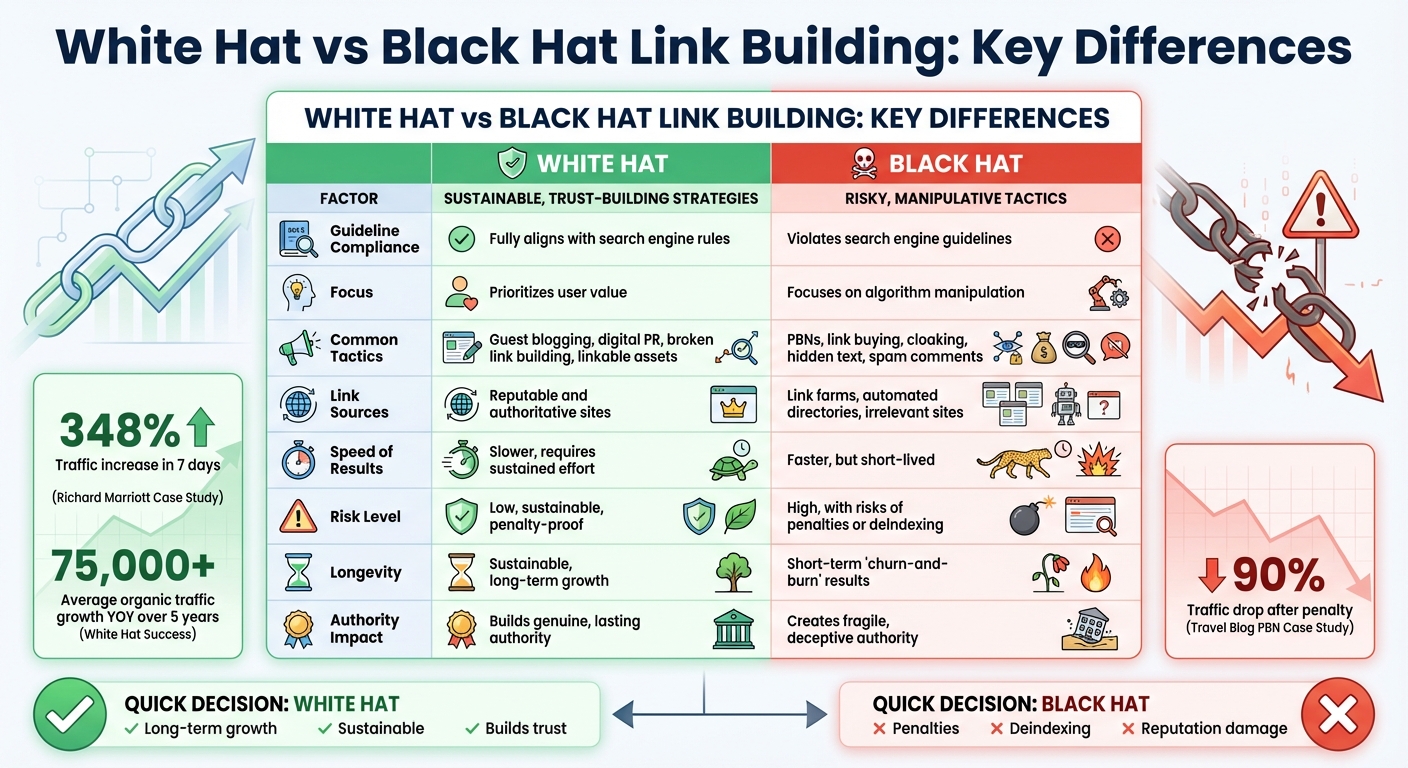
White Hat vs Black Hat Link Building Comparison Chart
White Hat Link Building
Core Principles
White hat link building focuses on creating content that genuinely benefits its audience, aiming to earn links naturally. This could involve writing in-depth guides, conducting original research, or developing useful tools that others find valuable enough to reference.
The emphasis here is on authenticity rather than volume; links are earned from websites that are relevant to your topic or geographic area, acting as authentic endorsements rather than artificially generated signals.
For example, a link from a niche blog closely related to your industry often carries more weight than one from a high-authority site with no relevance.
This approach also aligns with E-E-A-T (Experience, Expertise, Authoritativeness, and Trustworthiness). When credible sources link to your content, it’s a vote of confidence in your expertise. This helps to solidify your authority in the eyes of both users and search engines. Additionally, white hat practices are built to endure algorithm changes, providing a stable foundation for long-term growth.
Common White Hat Tactics
One of the most effective ways to earn quality links is by creating linkable assets. For instance, Backlinko’s “Google Ranking Factors” study attracted over 75,000 backlinks from more than 300 domains by presenting valuable insights with easy-to-digest data and visuals. Similarly, interactive tools like RentCafe’s “Rent Affordability Calculator” not only drive significant traffic, 28,600 organic monthly visits, but also secure links from 250+ root domains.
Another proven strategy is the Skyscraper Technique. This involves identifying high-performing content in your niche and creating an even better version.
Brian Dean used this method to dominate the “video SEO” keyword by analyzing existing top-ranking content, then producing a more detailed and updated guide.
His effort landed his page in the top three search results. The secret? Adding depth, improving visuals, and updating information before reaching out to sites that linked to the original content.
Broken link building is another practical tactic. By finding dead links on relevant resource pages and suggesting your content as a replacement, you provide value to webmasters while earning backlinks.
For example, an SEO professional named Richard used this approach for a post titled “55 SEO Experts Reveal 3 Favorite Link Building Tools”, which secured high-authority backlinks from sites like Search Engine Land and increased organic traffic by 348% in just one week.
Digital PR also plays a significant role in white hat link building. Take Credit Karma, for example; they conducted a data study in April 2025, revealing that nearly a third of Gen Z lives at home. By pitching these findings to journalists, they earned links from over 140 root domains. Similarly, HelpScout’s “Customer Service Statistics” post targeted keywords with high link intent, resulting in an impressive 3,800 linking root domains over time.
“I love some of the things I see from digital PR; it’s a shame it often gets bucketed with the spammy kind of link building. It’s just as critical as tech SEO, probably more so in many cases.” – John Mueller, Search Advocate, Google
Other effective methods include guest posting on niche, authoritative sites, reclaiming unlinked brand mentions, and pitching your content to resource pages.
Together, these tactics not only enhance your site’s authority but also improve its visibility in search results.
Benefits
White hat link building provides stability that black hat methods simply can’t match. One agency reported an average organic traffic growth of 104% year-over-year over five years through consistent white hat efforts. This approach ensures your site’s authority remains intact, even as search algorithms evolve.
It also bolsters your brand’s reputation by fostering genuine relationships with influencers, journalists, and other key players. These connections can lead to recurring opportunities. For example, Emil, the founder of a snack delivery company, created a guide with 121 employee wellness program ideas in 2015. Using his “Content Roadshow” outreach strategy, the guide achieved a #1 Google ranking that remained steady over time.
“White hat link building isn’t just a buzzword; it’s the foundation of sustainable SEO. When done right, it helps you build authority, attract real traffic, and stand out in a competitive search landscape.” – David Farkas, Founder, The Upper Ranks
Black Hat Link Building
Core Characteristics
Black hat link building exploits algorithm weaknesses rather than creating content that actually has value for users. These tactics blatantly violate Google’s guidelines, aiming for quick ranking gains instead of steady, long-term growth.
Unlike white hat strategies that focus on building lasting authority, black hat methods often rely on automation to churn out massive volumes of links in a short span.
Using software, these methods generate hundreds or even thousands of links, flooding the internet with low-quality connections that are of no use to anyone. The techniques used in black hat link building are as questionable as they are distinct, as outlined below.
“Black hat SEO is a gamble. While it can work in the short run, you run the risk of building your website on a house of cards that can collapse due to a manual action.”
– Ahrefs
Common Black Hat Tactics
Black hat link building employs several unethical approaches:
- Private Blog Networks (PBNs): These networks consist of websites often built on expired domains with some level of authority that exist solely to link back to a target site. For instance, in 2022, a travel blog used PBNs to climb to the top of Google rankings for “best tropical vacations.” However, after a Google Core Update, the site was hit with a manual penalty for unnatural links. The fallout was severe: a 90% drop in traffic and an eight-month-long recovery process.
- Paid Link Schemes: This tactic involves buying or selling links that manipulate PageRank. Many of these links come from link farms; websites created exclusively to sell backlinks, with no regard for relevance or quality.
- Automated Comment Spam: Bots are used to flood blog comments, forums, and guestbooks with links, often on a massive scale.
- Hacked Link Injection: This involves exploiting vulnerabilities in websites to insert links without the owner’s permission. A notable example is the fashion blog Still Being Molly, which had links secretly added to 500 of its posts, many of which directed users to inappropriate (NSFW) sites.
Other techniques include cloaking (showing different content to search engines than to users), keyword stuffing, and even negative SEO, where spammy links are deliberately pointed at competitors’ websites to trigger penalties against them.
Risks
The risks tied to black hat link building far outweigh any fleeting benefits. Google’s algorithms are now advanced enough to automatically detect and neutralize many black hat links, making the effort and expense entirely wasted. If a manual penalty is issued, the recovery process can take anywhere from days to months, depending on the severity.
In extreme cases, Google may completely de-index your site, effectively erasing it from search results. Cleaning up after such penalties can be both time-consuming and costly.
“A good rule of thumb is whether you would feel comfortable explaining what you have done…to a Google employee.”
– Google Webmaster Guidelines
Beyond penalties, black hat tactics can tarnish your brand’s reputation. If customers, business partners, or journalists uncover manipulative practices, the trust you’ve worked to build can quickly crumble. As Dr. Peter J. Meyers from Moz puts it:
“If you play the game purely for SEO, and you lose, you lose everything. If you build something of value that actually attracts visitors and then the rules change, you’ve still built something”.
Key Differences Between White Hat and Black Hat Link Building
Guidelines Compliance
When it comes to ethical versus manipulative link-building, the key distinction lies in how each approach aligns with Google’s Search Essentials (previously known as Webmaster Guidelines).
White hat strategies revolve around earning links by providing genuinely useful content to users. On the flip side, black hat tactics intentionally violate or exploit these guidelines to manipulate search rankings.
Here’s an easy test: would you feel comfortable explaining your link-building methods to a Google employee? If the answer is no, you’re likely venturing into black hat territory. White hat link-building focuses on enhancing the real user experience, while black hat methods are more about gaming the system.
This fundamental difference in how guidelines are followed dictates the tactics used in each approach.
Tactics and Link Sources
White hat link building revolves around creating “linkable assets”. Things like original research, in-depth guides, tools, or infographics that naturally attract backlinks because they offer genuine value. It also involves building relationships with journalists, influencers, and webmasters through personalized outreach efforts.
Black hat tactics, however, rely on spammy shortcuts like automated tools, buying links from link farms, or setting up Private Blog Networks (PBNs) to manipulate rankings. These methods might deliver quick results, but they often compromise long-term success and can lead to penalties.
Comparison Table
Here’s a breakdown of the key differences between these two approaches:
| Factor | White Hat Link Building | Black Hat Link Building |
|---|---|---|
| Guideline Compliance | Fully aligns with search engine rules | Violates search engine guidelines |
| Focus | Prioritizes user value | Focuses on algorithm manipulation |
| Common Tactics | Guest blogging, digital PR, broken link building, linkable assets | PBNs, link buying, cloaking, hidden text, spam comments |
| Link Sources | Reputable and authoritative sites | Link farms, automated directories, irrelevant sites |
| Speed of Results | Slower, requires sustained effort | Faster, but short-lived |
| Risk Level | Low, sustainable, and penalty-proof | High, with risks of penalties or deindexing |
| Longevity | Leads to sustainable, long-term growth | Short-term “churn-and-burn” results |
| Authority Impact | Builds genuine, lasting authority | Creates fragile, deceptive authority |
White hat link-building offers a sustainable path to building long-term authority, while black hat methods might provide quick wins but come with significant risks and short-lived rewards.
sbb-itb-566d57e
Choosing the Right Link Building Approach
Evaluating Your Current Strategy
When considering your link-building approach, ask yourself: How confidently can I explain my approach to a Google employee? If the answer isn’t an immediate yes, then it’s time for a strategy audit. Start by reviewing whether your tactics align with Google’s Search Essentials and Link Spam policies.
To analyze your backlink profile, tools like Google Search Console, Ahrefs, or Semrush can be invaluable. Keep an eye out for red flags such as links from websites in unrelated industries, pages with no meaningful content, or sites in non-native languages.
Pay close attention to your anchor text distribution; overusing exact-match anchor texts (e.g., “cheap insurance”) could put your site at risk. A healthy profile should show diversity, with no single strategy accounting for more than 30-40% of your total links.
If you find harmful links, disavow them to protect your domain’s reputation. Also, assess whether your website offers genuine “linkable assets”, content that’s informative, helpful, and non-promotional, like tools, research studies, or comprehensive guides. These assets provide others with a legitimate reason to link to your site.
Once you’ve assessed your current profile, consider the long-term advantages of sticking to ethical, white hat practices.
Benefits of Long-Term White Hat Practices
White hat strategies might take longer to show results, but their benefits last. Unlike black hat tactics that promise quick wins but often lead to harsh penalties, ethical link building creates steady, compounding growth over time.
Take, for example, Richard Marriott, an SEO newcomer who created an expert roundup titled “55 SEO Experts Reveal 3 Favorite Link Building Tools.” By reaching out to 115 influencers and using broken link building to promote his content, he secured backlinks from authority sites like Search Engine Land.
The outcome? A 348% increase in organic traffic in just seven days.
On the flip side, black hat methods often lead to disaster. In 2022, a travel blog used Private Blog Networks (PBNs) to rank for “best tropical vacations.” Initially, they hit the #1 spot. But after Google’s 2022 Core Update, the site was penalized for unnatural links, leading to a 90% traffic drop and an eight-month recovery period.
White hat practices align with Google’s E-E-A-T framework (Experience, Expertise, Authoritativeness, Trustworthiness), ensuring your strategies remain effective as algorithms evolve. They also protect your brand’s reputation, positioning your website as a trusted resource. In contrast, black hat tactics can permanently harm credibility.
“White hat link building isn’t just a buzzword, it’s the foundation of sustainable SEO.” – David Farkas, Founder, The Upper Ranks
These long-term benefits highlight the importance of tools that streamline ethical link building.
How Backlinku Supports Ethical Link Building
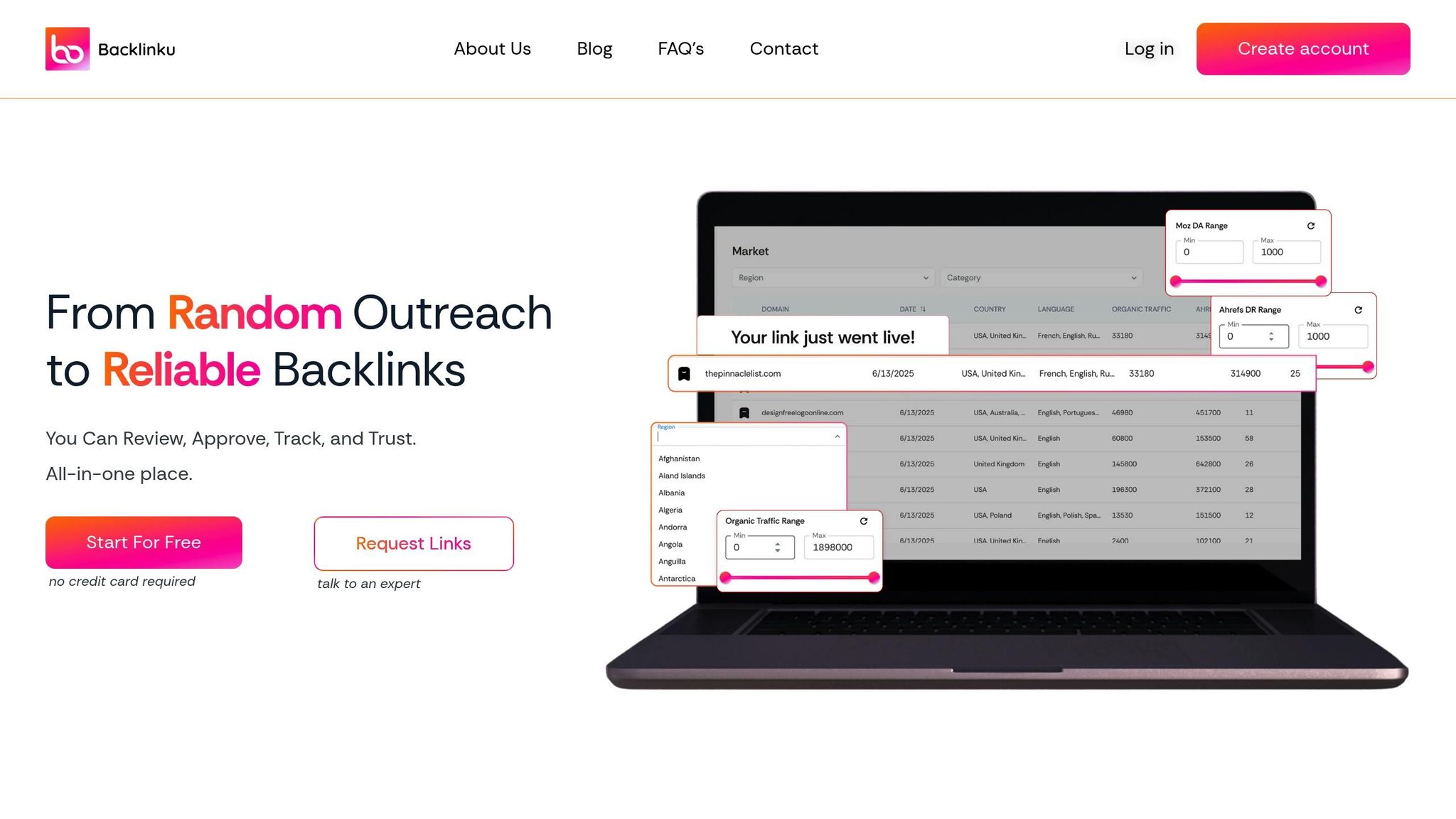
Backlinku is designed for businesses committed to ethical link-building practices. By sticking to white hat methods, you not only avoid penalties but also gain access to advanced tools that simplify the process. For instance, Backlinku offers a marketplace featuring over 50,000 manually reviewed websites, ensuring your links come from high-quality, relevant sources. With advanced filters, you can refine your search by niche, region, or SEO metrics, making it easier to secure valuable links.
The platform also provides content approval workflows, giving you the final say before any content goes live. Real-time link monitoring and alerts keep you informed whenever links are added or removed, saving you from manual tracking.
Plus, its AI-powered link matching helps identify opportunities based on your objectives, and transparent reporting ensures you always know how your campaigns are performing.
To make things even easier, Backlinku includes tools for organizing campaigns with features like projects, bookmarks, and blacklists. With dedicated customer support, the platform simplifies ethical link building, helping you build relationships with reputable publishers and create a link profile that withstands algorithm updates, all while driving long-term growth.
White Hat, Grey Hat, and Black Hat Link Building Strategies
Conclusion
Black hat tactics might offer short-term gains, but they rarely withstand the test of time. Just look at one travel blog that relied on a private blog network (PBN); after an algorithm update, their traffic plummeted by a staggering 90%. On the flip side, ethical approaches like expert roundups have proven their worth, with one case showing a 348% traffic increase.
White hat SEO aligns with search engine guidelines and focuses on creating long-term value through authentic content and user-first strategies.
As Si Quan Ong from Ahrefs wisely says:
“White hat SEO is a marathon, not a sprint”.
This mindset is what separates websites that thrive over the years from those that crash and burn.
The way you build links directly affects your site’s credibility. A manipulative link might give you a temporary boost, but it also puts your reputation and your entire online presence at risk. On the other hand, earning links from trusted sources strengthens your brand and signals reliability. The real question is: are you willing to gamble your long-term success for a fleeting advantage?
For those committed to sustainable growth, Backlinku provides tools that make ethical link-building achievable and scalable. From a curated marketplace of trustworthy publishers to clear, transparent reporting, it’s easier than ever to grow your authority the right way.
The choice is straightforward: invest in strategies that build enduring authority, not temporary wins.
FAQs
What are the long-term advantages of using white hat link-building strategies?
White hat link building focuses on ethical, search engine-approved methods that support steady, long-term growth. By sticking to these practices, your site can achieve rankings that are less likely to be affected by changes in search engine algorithms. Following Google’s E-E-A-T principles, this approach strengthens your brand’s credibility and authority over time.
Another key benefit? It minimizes the risk of penalties, protecting your website’s reputation. White hat strategies don’t just bring in reliable, high-quality traffic; they also create a strong framework for sustained online success.
What are the risks of using black hat link-building techniques for my website?
Using shady link-building tactics can seriously hurt your website’s reputation and SEO. These methods often involve spammy or low-quality links that might trigger penalties from search engines like Google. When that happens, your site’s visibility in search results takes a hit, making it harder for people to find you online.
On top of that, using unethical strategies can chip away at user trust and harm your brand’s image. Over time, this could lead to declining traffic, fewer conversions, and a damaged online presence. Sticking with ethical and sustainable approaches is the smarter choice for long-term growth.
What are some effective white hat link-building strategies?
Effective white hat link-building revolves around writing valuable, shareable content that naturally draws backlinks. Think of resources like detailed guides, original research, or tools that address real challenges for your audience. These types of “linkable assets” are the backbone of sustainable link-building strategies.
To make the most of your efforts, start by identifying keywords with strong search volume and pinpointing websites that publish related content. Then, reach out to these publishers with personalized messages, highlighting how your content could benefit their readers. Proven approaches include guest blogging on well-regarded sites, offering to replace broken links with your relevant content, and pitching timely, newsworthy ideas to journalists or industry outlets.
Other smart strategies include collaborating with niche influencers, contributing to curated resource lists, and turning unlinked mentions of your brand into clickable links. These methods not only align with search engine rules but also help you build authority and visibility over time without risking penalties.