

Want better results from your outreach emails?
Personalization is the key to earning backlinks. Generic emails fail 91.5% of the time, but tailored messages can boost response rates by 32.7%.
Here’s how to do it:
- Research prospects: Use tools like Backlinku to identify quality websites and ensure relevance.
- Personalize everything: Reference specific articles, stats, or details about the recipient.
- Write strong subject lines: Include their name, keep it brief, and avoid spammy phrases.
- Structure emails effectively: Start with a specific compliment, explain your value, and end with a simple call-to-action.
- Follow up smartly: Send a follow-up email 3–5 days later, adding value each time.
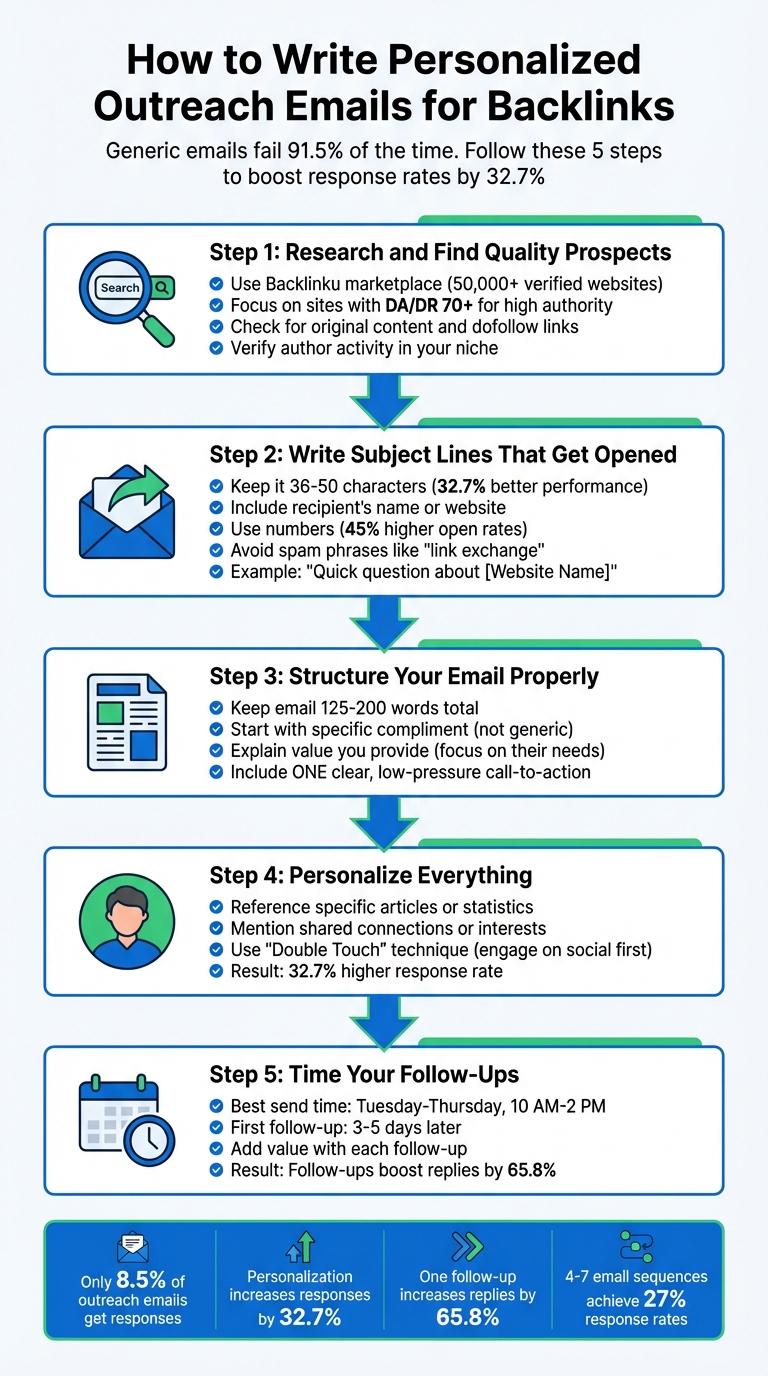
5-Step Process for Writing Personalized Backlink Outreach Emails
How to Write Outreach Emails (That Won’t Get Ignored)
Step 1: Research and Find Quality Prospects
Before you even think about writing an outreach email, you need to identify websites worth contacting. The success of your outreach hinges on the quality of your prospects.
As Vince Nero, Director of Content Marketing at BuzzStream, explains:
“DA/DR are only meant to be proxies for quality and authority. They can’t tell you everything”.
In other words, metrics like Domain Authority (DA) or Domain Rating (DR) are helpful, but not sufficient. You’ll need to conduct further research to identify sites that can genuinely support your link-building efforts.
Here’s how to lay the groundwork for a strong outreach strategy.
Using Backlinku to Find Opportunities
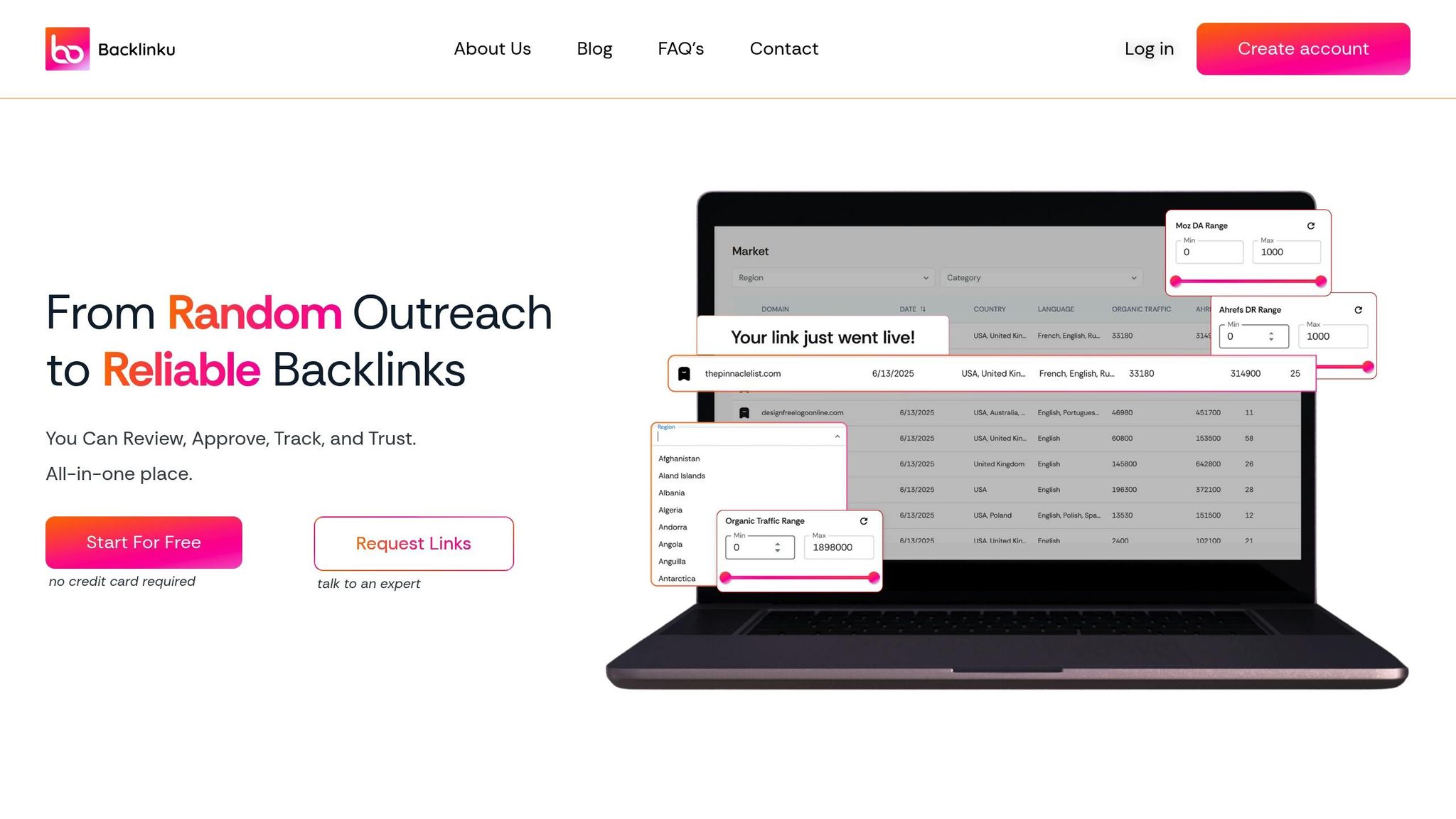
Backlinku offers a marketplace with over 50,000 verified websites, making it easier to find prospects without guesswork. Advanced filters help you refine your search by niche, region, and SEO metrics, such as DA and DR.
For high-authority coverage, consider sites with scores of 70 or higher. The platform also uses AI-powered link-matching tools to identify websites where your content fits naturally alongside well-known brands in your industry.
You can also use competitor backlink analysis to uncover similar opportunities. Another approach is the “Moving Man Method”, which involves reaching out to sites that still link to outdated resources. By offering them updated content, you can reclaim valuable backlinks.
Once you’ve compiled a list of prospects, the next step is to evaluate their quality and relevance.
Evaluating Website Quality and Relevance
A high DA score alone doesn’t guarantee a site is worth your time. Take a closer look at sites to spot any red flags, like spammy content or poor-quality design.
Verify if the site produces original, valuable content rather than just syndicating articles from other sources. It’s also important to understand their linking behavior.
Some websites only link internally or limit outbound links to authoritative domains like “.gov” or “.edu”, which may not align with your goals.
Make sure the authors are active and write about topics relevant to your niche. You can use a simple Google search (e.g., site:domain.com “Author Name” topic) to see if a specific journalist frequently covers your subject area.
Additionally, confirm whether the site provides “dofollow” links, as “nofollow” or “sponsored” tags won’t pass link equity to your site.
Danny Goodwin, Editor at Search Engine Journal, highlights another critical point:
“Know the publication you’re pitching. Pitching ideas that have already been published on the site is a waste of your time and my time – unless you have some new/unique spin on it”.
Collecting Information for Personalization
Once you’ve identified quality prospects, the next step is to gather details that will help you personalize your outreach. Start by reviewing recent blog posts to find insights or statistics you can reference. Check their “About Us” pages or LinkedIn profiles to uncover personal details like their location, hobbies, or education.
Pay attention to their social media activity to see what topics they’re currently interested in. If you have mutual connections or prior interactions, make a note of them to build trust.
A great way to catch their attention before emailing is by using the “Double Touch” technique. This involves engaging with a prospect on social media, liking a post, or leaving a thoughtful comment before reaching out.
It helps warm up the relationship and makes your email less of a cold pitch. To streamline personalization, consider creating custom fields in your outreach tools for notes like “Personalized Note” or “Recent Article.” This ensures your communication feels genuine without sacrificing efficiency.
Step 2: Write Subject Lines That Get Opened
After laying the groundwork with your research and personalization in Step 1, writing a strong subject line comes next.
Think of it as the gateway to your email; it’s the first thing recipients see, and in a matter of seconds, they’ll decide whether to open your message or move on.
A well-thought-out subject line is vital.
Let’s dive into what separates an effective subject line from one that gets ignored.
What Makes a Good Subject Line
Great subject lines tend to share a few standout qualities.
Personalization is one of the most effective strategies. Including the recipient’s name or referencing their website increases open and response rates significantly.
Brevity is another key factor. Subject lines that fall between 36–50 characters perform 32.7% better than shorter ones, striking the right balance between being descriptive and easy to read on mobile devices.
Remember that Android phones display around 30 characters, while iPhones show up to 41, so it’s smart to place the most important words at the beginning.
Specificity is what sets your email apart from generic mass mailings. For example, instead of using something general like “Quick question”, go for “Quick question about your [Topic] post.” This shows you’ve done your research and adds a personal touch to your outreach. Using numbers can be equally effective; subject lines with statistics or figures see about 45% higher open rates.
On the flip side, avoid spammy phrases like “link exchange” or “link request”, as well as excessive punctuation, which can push your email straight into the junk folder.
Garrett French, the Founder of Citation Labs, emphasizes the importance of writing subject lines that deliver value:
“Your subject line and offer need to clearly drip with page views, click-throughs, and social shares”.
Subject Line Examples That Work
Here are some examples of subject lines that follow these principles and get results. “Quick question about [Website Name]” is a simple yet effective choice because it’s direct and references the recipient’s site.
Another option is “Loved your recent post on [Specific Topic]”, which shows you’ve read their content and aren’t sending a generic email. For a conversational tone, you might try “Hey [Name], would love to talk about your latest blog post”.
If you’re offering immediate value, consider something like “Sharing my best strategy on [Topic]” or “Question about your recent blog post on [Topic]”.
For PR pitches, mimic the style of a journalist’s headline by focusing on the main takeaway. For example, “Thanks for tagging us on LinkedIn” works well if you’ve already had some interaction on social media. Curiosity-driven subject lines, such as “Ready to build your domain authority?” can also spark interest and encourage opens.
Mary Fernandez, a digital marketer, sums it up perfectly:
“Simple, straightforward subject lines tend to perform better than overly clever or vague subject lines”.
Step 3: Structure Your Email Properly
After crafting a strong subject line, the body of your email needs to live up to its promise. A clear, organized structure is just as important as the words you use.
Sticking to a concise format between 125 and 200 words ensures your message is quick to read and impactful.
Let’s break down the 3 key elements of a well-structured email.
Start with a Specific Compliment
Your opening line sets the tone for the rest of the email, so use it wisely. Begin by highlighting something specific about the recipient’s work, like a recent article, a tweet, or a unique detail from their bio.
Avoid generic praise. Make it clear that you’ve done your research.
Dario Supan, a Link Building Expert at Pitchbox, explains:
“Everyone wants to feel valued. A great way to show that you value the person or the blog you are reaching out to is to make sure you are not wasting their time with generic pitches”.
Instead of saying, “I enjoyed your content,” point out a specific statistic that you found compelling or a particular insight that was helpful. For example, mention how their analysis clarified a tricky concept for you or how their unique perspective stood out.
Authenticity is key; insincere compliments can damage your credibility. A genuine opener not only builds trust but also sets the stage for your value proposition.
Explain the Value You Provide
Once you’ve established a connection, shift the focus to what you’re offering and how it benefits their audience. This isn’t the time to talk about yourself or your company; frame your pitch around their needs.
Matt Janaway, VP of Search & Digital at The Workplace Depot, highlights this approach:
“Perception of value is key. You have to provide the person you are reaching out to with the perception that you are helping them out as much as they are helping you out – if not more”.
Tie your offer to their existing content. For instance, if they’ve written about email marketing but didn’t touch on personalization, explain how your resource fills that gap.
The key is to demonstrate that your offer complements their work and adds value to their readers. Keep this section brief and focused; don’t let it come across as a sales pitch.
Include a Clear Call-to-Action
Your call-to-action (CTA) should be straightforward and easy to respond to. Avoid asking for high-effort commitments like phone calls or meetings right away.
Edgar Abong, Outreach and Marketing Specialist at Influno, advises:
“The CTA should be low-commitment and easy to respond to. You’re not asking for a meeting, a phone call, or a detailed review. You’re just asking if they’re open to what you proposed”.
Simple CTAs like “Would this be of interest?” or “Should I send over a few headline ideas?” work well. Place your CTA just before your signature and stick to one clear option; offering too many choices can lead to indecision.
Research shows that reducing options from 24 to 6 increased conversion rates from 3% to 30%.
| Email Component | Best Practice | Impact |
|---|---|---|
| Opening Line | Specific compliment referencing their work | 32.7% higher response rate |
| Email Length | 125–200 words total | Optimal for engagement |
| Value Proposition | Frame as mutual benefit, not a favor | Builds trust and credibility |
| Call-to-Action | Single, open-ended, low-pressure question | Reduces friction and confusion |
sbb-itb-566d57e
Step 4: Personalization Techniques That Work
Writing a clear email structure is just the beginning. To truly grab attention, personalization must be present. The difference between an ignored email and one that gets a response often lies in how well you’ve tailored it to the recipient.
In fact, emails with personalized message bodies have a 32.7% higher response rate compared to generic ones.
Include Recipient-Specific Details
When reaching out, show that you’re prepared. Mention a specific blog post or article they’ve written and highlight an insight that resonated with you.
For example, if they shared a notable statistic or a thought-provoking angle, reference it directly to demonstrate you’ve genuinely engaged with their work.
Take it a step further by exploring their “About” page or social media profiles. Look for details like their location, hobbies, or alma mater. If you share a hometown or attended the same school, mention it to build a personal connection.
Utilize the “Double Touch” technique; interact with their LinkedIn post or tweet before sending your email. This adds a layer of familiarity when your message lands in their inbox.
Also, adapt your tone to match the recipient. For bloggers, a casual approach often works best, while a more formal tone is appropriate for larger organizations.
And always double-check that you’re pitching the right person by reviewing their latest articles or ensuring they cover the topic you’re addressing.
For even more efficiency, you can use tools like Backlinku to organize your personalization efforts.
Using Backlinku’s AI-Matching Tools
Backlinku’s AI-powered tools make scaling personalized outreach easier without losing the human touch. These tools identify backlink opportunities and provide insights to help you align your pitch with the recipient’s interests.
During your research phase, you can use custom fields to note specific details like a recent award they received, an interesting statistic from their latest article, or a shared interest. These details can then be integrated into your email templates, maintaining a natural and authentic tone.
The platform also lets you adjust your email’s tone based on the type of site you’re targeting. For example, you can set templates to automatically use casual language for independent bloggers and formal phrasing for larger publications.
When Backlinku identifies relevant content, include a concise explanation of why it stood out to you. This blend of automation and thoughtful detail helps you scale your outreach while keeping it personal, a crucial balance, especially when only 8.5% of outreach emails get a response.
While tools like Backlinku can make personalization more efficient, it’s essential to avoid over-relying on templates.
Avoid Cookie-Cutter Templates
Templates can be a helpful starting point, but overusing them or using them poorly can backfire. Errors like misspelled names, lowercase greetings, or placeholders like “[First Name]” immediately reveal automation and can damage your credibility.
Generic praise is another pitfall. As Hannah Smith, Founder of Wadds Inc., points out:
“I don’t believe journalists are interested in hearing that you’ve read or loved a bunch of their articles… it can sound a bit insincere… you’re potentially clogging up your pitch with fluff”.
Instead, be specific. If you’re going to compliment their work, reference one article and explain what you liked about it. Never pretend to have read something you haven’t or fabricate connections; insincerity can leave a lasting negative impression.
Keep your email focused and include just one clear call-to-action (CTA). Overloading your message with multiple CTAs can confuse recipients and reduce response rates. Aim for emails between 125 and 200 words, long enough to show you’ve done your research but concise enough to respect their time.
| Common Template Mistakes | Why It Fails | Better Approach |
|---|---|---|
| “Dear [First Name]” | Makes automation obvious | Verify and use their actual name |
| Generic praise | Feels insincere and unconvincing | Reference a specific insight or statistic |
| Multiple CTAs | Overwhelms the recipient | Stick to one clear, low-pressure CTA |
| Overly long emails | Likely to be ignored or deleted | Keep emails between 125-200 words |
| Off-topic pitches | Shows lack of research | Verify their recent work and coverage areas |
Step 5: Timing, Follow-Ups, and Tracking
You’ve put together a personalized email with a strong subject line and a clear, engaging structure. Now, it’s time to focus on timing, follow-ups, and tracking, key components that can dramatically increase the success of your outreach efforts.
When to Send Outreach Emails
The timing of your email is a major factor that determines whether it gets opened or ignored. Research shows that sending emails from Tuesday to Thursday between 10 AM and 2 PM (recipient’s local time) can increase open rates by 30%.
Darren Blumenfeld, CEO of InboxAlly, explains:
“The best time to send a cold email is Tuesday to Thursday between 10 AM and 2 PM, in your recipient’s local time zone.”
Midweek emails work well because people have cleared their Monday tasks and are still focused before the weekend. Interestingly, Sunday is an outlier; it accounts for 18.7% of email opens and 15.5% of replies, the highest of any day.
Why? There’s less competition in inboxes, making your email more noticeable. Saturdays also perform better than expected, driving 16.9% of weekly clicks.
On the flip side, avoid sending emails at lunch (12–1 PM), late evenings (after 8 PM), or Friday afternoons. And don’t forget to factor in time zones, a 9 AM email in New York hits inboxes at 6 AM in Los Angeles, which is far too early for most recipients.
How to Write Follow-Up Emails
Let’s face it: most outreach emails don’t get a response on the first try. In fact, only 8.5% of initial emails receive replies. But here’s the good news: sending just one follow-up can increase reply rates by 65.8%.
Campaigns with 4–7 emails in a sequence see even better results, with response rates climbing to 27%, compared to just 9% for shorter sequences.
Aim to send your first follow-up 3–5 days after the initial email. Don’t just “bump” your message; instead, add value each time. Reference something recent from the recipient’s work, suggest where your link could fit in their content, or even offer to promote their material on social media.
Matt Janaway, VP of Search & Digital at The Workplace Depot, highlights:
“Perception of value is key. You have to provide the person you are reaching out to with the perception that you are helping them out as much as they are helping you out – if not more.”
If there’s no response after 10 days, it’s time to move on. And remember, even if someone declines, thank them; it leaves the door open for future opportunities.
Tracking Results with Backlinku
Once your emails are sent, tracking their performance becomes crucial. Backlinku offers constant monitoring to ensure your backlinks stay live, don’t switch to “nofollow”, and aren’t removed. You’ll get instant alerts to address any issues before they affect your SEO.
Backlinku also simplifies campaign tracking by centralizing key metrics like email open rates, response rates, and referral traffic, all in one dashboard. You can monitor everything from content approvals to live link status. Plus, metrics like Domain Authority, Domain Rating, and Trust Flow help you ensure you’re building high-quality links. This data allows you to fine-tune your outreach strategy, focusing on what works and discarding the rest.
Conclusion
Key Points for Writing Outreach Emails
Writing effective outreach emails takes effort and attention to detail. With only 8.5% of outreach emails receiving a response, success hinges on a few critical elements: personalization, a clear structure, and consistent follow-ups.
Personalized emails can increase response rates by 32.7%. To achieve this, reference specific blog posts, highlight recent work, and show that you’ve done your research. Genuine compliments paired with a clear value proposition can go a long way in encouraging replies.
Follow-ups are equally important, boosting reply rates by an impressive 65.8%. Often, recipients are busy rather than uninterested, so a well-timed second email can make all the difference.
As Matt Janaway, VP of Search & Digital at The Workplace Depot, puts it:
“Perception of value is key. You have to provide the person you are reaching out to with the perception that you are helping them out as much as they are helping you out – if not more”.
By blending these strategies with advanced tools, you can significantly improve your link-building outcomes.
FAQs
How can I prevent my outreach emails from going to spam?
To make sure your outreach emails don’t end up in spam folders, start with the basics: proper email authentication. Set up SPF, DKIM, and DMARC for your domain. These protocols verify that you’re a legitimate sender, which helps build trust with email providers.
Next, put effort into personalization and writing high-quality content. Personalize your emails to the recipient by mentioning their work, interests, or other relevant details. Avoid using spammy words like “free” or “guarantee”, and write subject lines that are clear and directly tied to the email’s purpose – this signals authenticity.
Lastly, keep your email list in good shape. Regularly clean it by removing invalid addresses and contacts who aren’t engaging. Before hitting send, use spam-check tools to review your emails. Keep an eye on metrics like open rates and spam complaints; they can help you spot problems early and tweak your strategy for better results.
What should I include to make an outreach email more personalized and effective?
To compose a more engaging and personalized outreach email, focus on adding thoughtful, personal touches that show you’ve done your homework.
Start by addressing the recipient by their first name to set a warm, approachable tone. Then, highlight something specific about their work, maybe a recent blog post, article, or project they’ve shared. This not only shows genuine interest but also signals that your email isn’t just another generic pitch.
Next, connect the dots between your proposal and their objectives or audience. Keep it brief but clear, and explain why what you’re offering aligns with their work. A sincere compliment or insightful observation about their efforts can also help your email stand out in a crowded inbox. If you have any shared connections or common interests, don’t hesitate to mention them, it’s a great way to establish trust and familiarity. These small, intentional details can make all the difference in earning a reply.
How many times should I follow up if I don’t get a response to my outreach email?
If your initial email doesn’t get a response, give it 3 to 5 business days before sending a follow-up. If needed, you can send a second and even a third follow-up, spacing them out by another 3 to 5 days. Keep your messages short and to the point, and limit your outreach to 2 or 3 emails total.
This helps you remain professional without overwhelming the recipient.